

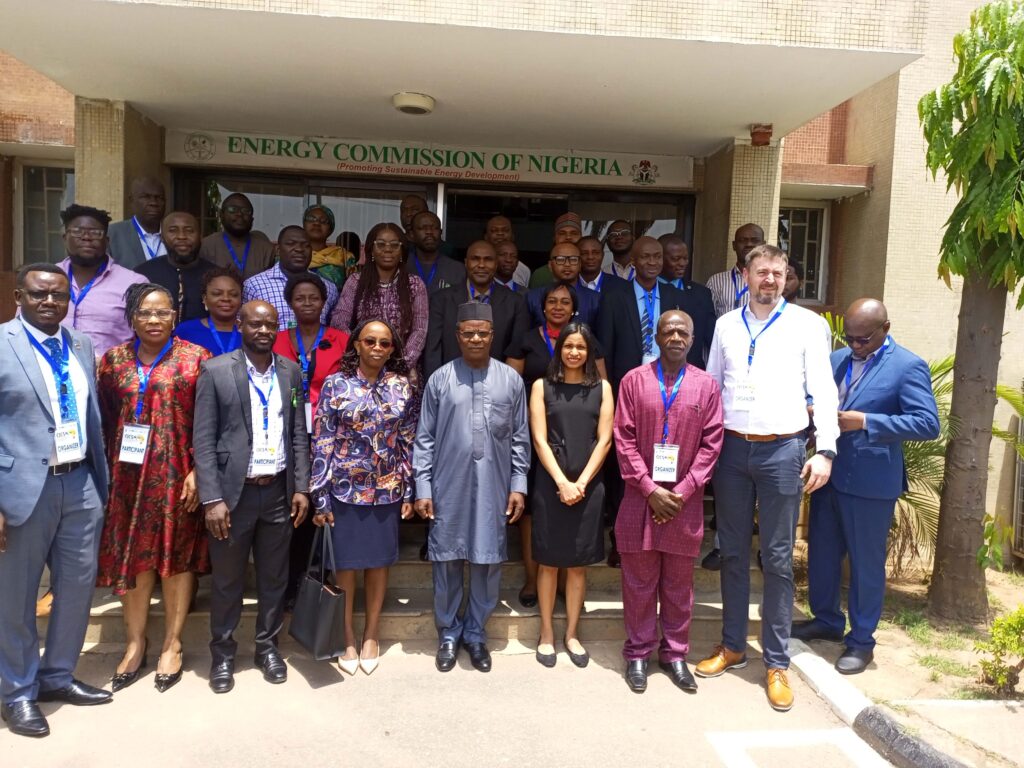
The United Nations Environment Programme (UNEP), Frankfurt School of Finance and Management in collaboration with Energy Commission of Nigeria have organized a one-day workshop to disseminate results and knowledge learnt from the implementation of the project on Clean Captive Installations for Industrial Client in Sub-Sahara Africa.
Speaking at the workshop, the Acting Director General, Energy Commission of Nigeria (TCN), Engr. Joseph Sunday Olayande acknowledged the presence of international partners from UNEP Office and Frankfurt School and thanked them for choosing Nigeria to be among the four countries that are benefiting from the project.
He said: “It may interest you to know that Nigeria has the largest economy in Africa – in tight competition with South Africa – and is the 30th largest economy in the world. This would not have been possible without the industrial sector, which this project is targeting Among the main industrial sectors in Nigeria, the manufacturing sector is likely to have the greatest potential for clean captive power uptake.
“According to the World Bank Enterprise Surveys 2014 for Nigeria (World Bank Group n.d.). 48.1 per cent of the enterprises in the manufacturing sector identify electricity as a major constraint. Average losses due to electrical outages incurred by these firms were 18.3 per cent of annual sales. Only 3 – 4 per cent of the energy consumption of the Nigerian manufacturing industry comes from grid-connected electricity. This implies that over 95 per cent of electricity consumption of these sector come from fossil-fuel based captive power”.
While responding to questions, Engr. Olayande said the project is a welcome idea as it will not only take-off diesel-based front the system but support clean renewable source, keep industries and commercial sectors working to boost the economy.
“So instead of relying on diesel generators and polluting the environment and warming the climate further, this can help improve the welfare of the people, generate economic activities for the installers of the facilities,” the Director General said.
He also posited that Commission’s primary duty is to coordinate the project activities in Nigeria, bringing together the various stakeholders and making sure they understand the concept very well and are able to relay back to their respective country, agency and private sector they belong to.
In his presentation, Tobias Panofen, Deputy Head, Frankfurt School – UNEP Collaboration Center for Climate and Sustainable Energy Finance said the four major components of the project implementation on Clean Captive Installations for industrial clients in Sub-Sahara Africa were; Base-line studies of awareness raising, economic and financial tools and assessment, realisation of one pilot project per country and knowledge dissemination and outreach.
Panofen said the experience and track record accumulated by the pilot projects will be spread at the national level, bringing clarity and visibility to the industrial sector, reducing risks perceived by industrialists as well as financiers, while the market for captive installations matures and expands despite a lack of long-term financial support.
On lessons learnt from Nigeria, he stressed on many companies that can deliver at scale but are confronted with issues as regards to prohibitively high transaction cost which UNEP and other stakeholders are very much willing to help companies to overcome such and be able to implement the business model that they have developed.
Also, the representative of Powergen/Superpower Africa, Kumbirai Makanzas said in surmounting part of challenges observed in the cause of the project implementation, the Corporate Power Purchase Agreements (CPPAs) and corperate lease-to-own schemes enables end users to pay for C&I solar energy service overtime this alleviating much of the main barriers to adoption. He added that business model requires patient affordable capital to scale.
Makanza pointed out ‘recievable-based financing as one of the solutions on which the fund uses advanced proprietary data technology to accurately forecast the payment behaviour of existing customers and also used to identify and aggregate high value customers into a secure, predictable and high performance securities.
He added that part of the solution-based by the company is the establishment of Ijebu Eye Hospital Pilot project in Ogun State with a 180kwp PV, 100KV PCS, 182kw BESS system hybrid energy was installed under a 10-year take-take-or-pay PPA contract.
To reel-out major lessons from the implementation, the Project Manager, Frankfurt School of Finance and Management, Yamini Jain, disclosed some of the lessons learnt from the project implementation.
These, he said are:Nigeria’s power sector faces many challenges, strong drivers for captive solar energy system in Nigeria, Nigerian captive solar market being competitive for many commercial and industrial customers, some opportunity existed for innovative financial solutions in Nigeria, mobilizing private investment to will help scale industry growth.
Others include innovative technological solutions that can help expansion of captive solar, development and multilateral finance can help de-risk investments, business models that can significantly impact sustainability of captive installations, gaps in the market create opportunity, determining optimal legal structure is crucial when establishing new financial vehicles.
In his goodwill message, the Principal Industrial Office, Federal Ministry of Industry Trade and Investment. Engr. Ike Owali Obin (r) Industrial Development Department. FMITI, said the project would not only promote sustainable industrial growth but also contribute to the reduction of greenhouse gas emissions in the region.
“We are committed to supporting the Energy Commission of Nigeria in its efforts to promote the adoption of clean captive installations in the region and encourage other stakeholders to join this initiative. We believe that this will help us achieve our common goal of building a more sustainable future for all,” he said.
Recall on 18th November 2019 had the first stakeholder consultative meeting of the project on “Clean Captive Installations for Industrial Clients in Nigeria” to create country’s ownership and buy-in for effective implementation and to demonstrate the financial and economic viability of replacing the current diesel-based captive power with renewable energy-based captive power installations in industrial and commercial economic sectors of Nigeria; raise awareness among industrial players and prepare the ground for clean modern technology dissemination.
This project is funded by the German Federal Ministry for the Environment, Nature Conservation and Nuclear Safety (BMU) through the International Climate Initiative (IKI); while the United Nations Environment Programme (UNEP) in collaboration with the Frankfurt School of Finance and Management implemented the project in four pilot countries, namely: Kenya, Ghana, Nigeria and South Africa. For Nigeria, UNEP is using the Energy Commission of Nigeria (ECN) as its coordinating office.



