

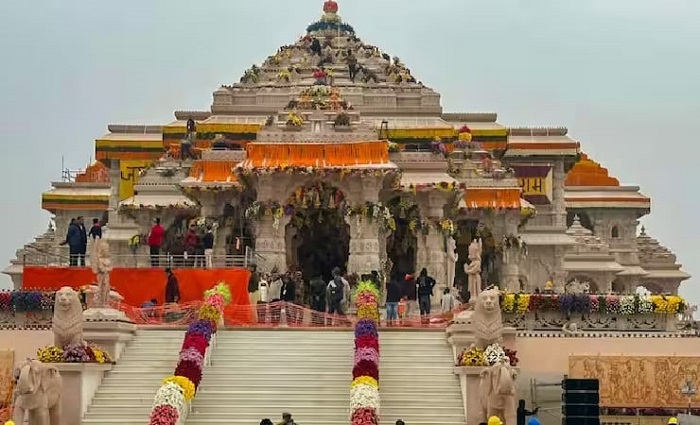
Prime Minister Narendra Modi of India inspired supporters with the unofficial launch of his reelection campaign this year by dedicating a temple on Monday that symbolizes the success of his forceful Hindu nationalist policies.
In a flowing traditional garment of golden hue, Modi revealed the black stone image of the god Ram in the center of the 50-meter (160-foot) temple. The temple was constructed on the site of a mosque that stood for centuries until being destroyed in 1992 by Hindu fanatics inspired by members of his party.
The biggest religious riots since independence were set off by that demolition, which killed 2,000 people, the most of them Muslims, and rocked India’s ostensibly secular government system.
Military helicopters dropped flower petals from the skies as tens of thousands of singing and dancing devotees crammed the streets of the northern town of Ayodhya, waving flags, honking horns, and banging drums.
Opposition figures are said to have refrained from attending the joyous street celebration, while few Muslims in Ayodhya were observed participating.
However, the inauguration of the Ram Mandir temple is a significant turning point for Modi’s ruling Bharatiya Janata Party (BJP) in a long-running effort to match the nation’s political system with the majority religion.
Prior to the “auspicious” unveiling, Modi prayed at the feet of the life-size statue, which was covered in flowers and wrapped with jewels.
Actors, cricket players, and tycoons
With hundreds of Hindu devotees dancing in the crowded streets while enormous loudspeakers blare holy music, the excitement has reached a fever pitch.
The 18-year-old Vijay Kumar traveled 600 kilometers (370 miles) by foot and hitchhiking before arriving at the town in four days.
Kumar stated, “We just wanted to be here.” “All we want to do before we depart is see the temple.”
The ornate temple was constructed at an estimated cost of $240 million, which the project’s promoters claim was funded by public donations. Approximately 2,500 musicians are entertaining the throngs of pilgrims around the complex on over 100 stages.
Bollywood icon Amitabh Bachchan and Indian tycoon Virat Kohli, a former captain of the national cricket team, are among the famous visitors scheduled to attend the event.
“Destruction”
Since the BJP and Modi stormed to power a decade ago, they have worked to elevate the Hindu faith in public life.
Party leaders frequently refer to past periods of Islamic domination over portions of India as “slavery” periods during which their own faith was persecuted, and Ayodhya is a central theme in their narrative.
Devotees of Hinduism hold that Ram, one of the most venerated Hindu gods, was born in the town over 7,000 years ago, but that a Muslim monarch from the 16th century erected the Babri mosque over his birthplace.
The public campaigning that finally resulted in the mosque’s destruction was greatly aided by the BJP.
The devastation signaled the arrival of the BJP and Modi as an unstoppable political force, usurping the secularist Congress party, which had ruled India nearly continuously since its independence from British colonial rule.
Prior to the anticipated April start of the general election, Modi will once again present himself as a champion of the religion with the temple’s dedication by Hindu priests.
Due in part to Modi’s appeals to Hindu nationalism, the BJP is strongly expected to win a landslide victory for the third time in a row. Opposition parties are boycotting the temple ceremony, claiming it would be little more than a thinly veiled campaign rally.
However, a large portion of India’s 200 million Muslims, who are already uneasy amid heightened sectarian tensions, have observed the commotion surrounding the temple with caution.
Speaking to AFP in Ayodhya this month, 52-year-old Mohammed Shahid described how a mob burnt his father alive.
He declared, “The temple represents nothing but death and destruction to me.”


