

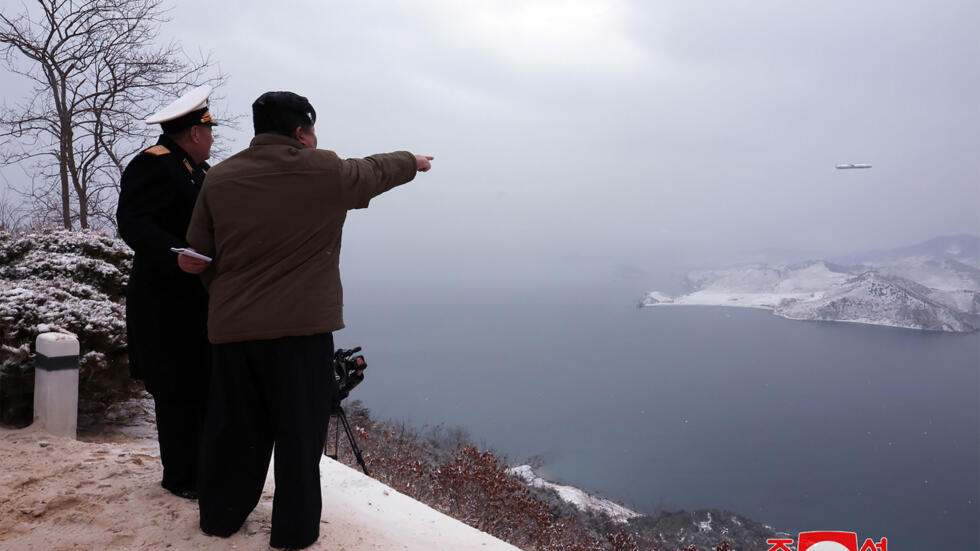
According to state media on Monday, North Korean leader Kim Jong Un praised the test launch of a new strategic cruise missile from a submarine as a significant milestone in the development of the country’s naval might.
In the new year, Pyongyang has increased its testing of armaments, demonstrating its “underwater nuclear weapon system” and its hypersonic ballistic missile powered by solid fuel.
According to state-run news agency KCNA, Kim expressed “great satisfaction” with the test on Sunday, saying that it “is of strategic significance in carrying out the plan… for modernizing the army which aims at building a powerful naval force.”
The newspaper claimed, without providing details, that the North Korean leader also examined “the building of a nuclear submarine” and talked about matters pertaining to the production of other new vessels.
Kim presented a comprehensive list of strategic weaponry during a major party convention in 2021, including solid-fuel intercontinental ballistic missiles, hypersonic warheads, and surveillance satellites. Among them was a nuclear-powered submarine.
The “submarine-launched strategic cruise missiles” (SLCM) on Sunday were reported by KCNA to have been in the air for almost two hours, although the agency did not specify the distance they traveled or if they were launched from above or below the ocean.
Images released by state media showed a missile blasting upwards from the ocean, behind a massive plume of white smoke, however it was unclear if the missile was fired from a submarine.
The present UN sanctions on Pyongyang do not prohibit the testing of cruise missiles, in contrast to their ballistic equivalents.
According to KCNA, Kim “guided” the two Pulhwasal-3-31 missiles’ Sunday launch.
Pyongyang claimed to have just tested the Pulhwasal-3-31, a new generation of strategic cruise missiles, on Wednesday.
Cruise missiles are more difficult to identify and intercept than more advanced ballistic missiles since they are often jet-propelled and travel at a lower height.
It is still unknown how precise North Korea’s sea-based launch capabilities are, and earlier tests were conducted from older ships—including a submerged platform—rather than from a submarine.
Pyongyang claims that in March of last year, North Korea launched two SLCMs that traveled 1,500 kilometers (930 miles), which would have covered all of South Korea and a large portion of Japan.
However, experts noted that it seemed they were fired from above the sea, eliminating the weapon’s ability to be stealthily deployed.
“New danger”
One of the main resolutions made at the year-end party conference was to increase the nation’s naval might. Since Kim personally oversaw Sunday’s launch, observers believe this indicates the route Pyongyang’s defense strategy will take this year.
Yang Moo-jin, head of the University of North Korean Studies, stated, “They will focus on improving naval power in the East Sea and testing weapons systems that can be mounted on submarines, with the first attempt being this strategic cruise missile.”
It will eventually result in the construction of nuclear-powered submarines and ballistic missiles launched from submarines, which will have a far greater impact.
With a projected range of 1,900 kilometers, North Korea now possesses an operational submarine-launched ballistic missile (SLBM) known as the Pukguksong-3.
A second-strike capability in the case of an assault and deployment well beyond the Korean peninsula would be made possible by proven SLBM capabilities, which would elevate North Korea’s arsenal to new heights.
South Korea would face a “new threat” from a nuclear-tipped SLCM if it becomes operational, according to former South Korean Navy submarine commander Choi Il.
He declared, “North Korea will have a two-track nuclear attack capability, with the ability to launch a precision strike with an SLCM and cause mass destruction with an SLBM.”
The South Korean military reported at the time that North Korea launched what it claimed to be its first “tactical nuclear attack submarine” last year.
The vessel’s apparent modification from an existing diesel-electric submarine that was first developed in the 1950s has raised concerns among analysts over its limitations and weaknesses as a platform.


