

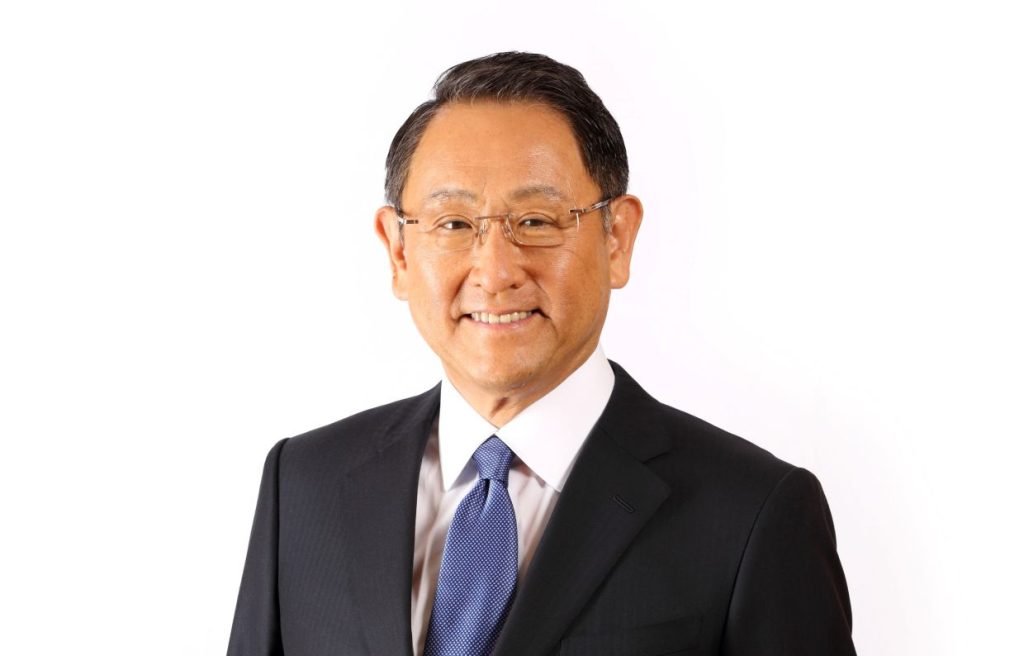
As the Japanese automaker revealed record-breaking 11.2 million car sales across all of its brands last year, Toyota’s chairman said on Tuesday that he was “ashamed” of recent controversies involving its subsidiaries.
Thanks to a rebound in demand and alleviating chip shortages, Toyota has maintained its position as the best-selling carmaker globally for four years running with this bumper figure, an industry record.
With the exception of the Toyota and Lexus brands, global volume sales reached 10.3 million units. However, Daihatsu, a manufacturer of small cars involved in a falsified safety test controversy, had a decline in growth.
Volume sales for truck and bus manufacturer Hino, which has also been impacted by a controversy involving faked engine tests in Japan, fell by about 10%.
It happened the day after Toyota announced that it was stopping the shipping of ten vehicles with diesel engines connected to anomalies in testing at a subsidiary, Toyota Industries.
At a news conference on Tuesday, board chairman Akio Toyoda expressed regret and acknowledged that he was ultimately to blame for the malfeasance.
“I sincerely apologize for the repeated transgressions committed by Toyota Industries, Daihatsu Motor, and Hino Motors that have upset and alarmed stakeholders and customers,” he said to reporters.
He claimed to be “ashamed” of the circumstances and claimed that “they lost sight of the values and priorities that should have been upheld.”
“Regaining the trust of our customers will require time,” Toyoda stated, pledging to spearhead a “transformation.”
Top-selling automaker Toyota saw a 7.2 percent year-over-year increase in overall vehicle sales, compared to the 9.2 million units sold by Germany’s Volkswagen Group, whose unit sales increased by 12 percent.
Hyundai-Kia, a South Korean company, held third position in 2023 with 7.3 million units sold, an increase of 6.7%.
However, Elon Musk’s US electric carmaker Tesla continues to rank higher than the Japanese behemoth in terms of market value.
“Solid demand in each region, in addition to easing semiconductor shortages in each region” is how Toyota is recognized for its success.
The sales total on Tuesday above Toyota’s previous record of 10.7 million, which it had established in 2019, the year before it passed Volkswagen, and included sales for the Toyota, Lexus, Daihatsu, and Hino brands.
With 10.97 million units sold in 2019, Volkswagen set the previous industry record.
– EV goals
Tatsuo Yoshida, an auto analyst at Bloomberg Intelligence, told AFP that scandals involving subsidiaries “may potentially have repercussions on Toyota’s overall reputation, especially if there are concerns about corporate governance or ethical practices.”
Nonetheless, there are millions of contented owners of Daihatsu, Hino, Toyota, and Lexus automobiles. Strong customer confidence like this is a vital asset that won’t disappear overnight, he stated.
Toyota has historically prioritized hybrid vehicles over electric vehicles, therefore it has been slower than some of its competitors to invest in the latter.
It sold just 104,018 EVs in 2023, far less than the 1.81 million sold by Tesla and the 1.57 million sold by China’s BYD.
Sales of hybrid Toyota vehicles reached 3.4 million last year, an increase of 31.4 percent.
However, the business has stated that it intends to provide an electric variant of each Toyota and Lexus vehicle worldwide by 2025.
Additionally, it plans to sell 1.5 million EVs a year by 2026 and 3.5 million by 2030. This month, it announced plans to greatly expand its electric battery plant located in North Carolina.
As a result of Toyota’s sluggish EV sales growth and the recent backlash against battery-powered cars, Yoshida stated that reaching the 2026 goal may be “more difficult” than anticipated.
The ability of Toyota to increase production and innovation, market demand, regulatory environment, and technological improvements are some of the variables that will determine whether this target is met or delayed.


