

*** As Salako underscores importance of chemicals to national GDP when managed responsibly
BY AKUDORO GLORIA

The Minister of Environment, Mallam Balarabe Abbas Lawal on Tuesday said unlocking Nigeria’s Carbon market opportunities holds potential for sustainable growth, stimulate economic development and climate change mitigation.
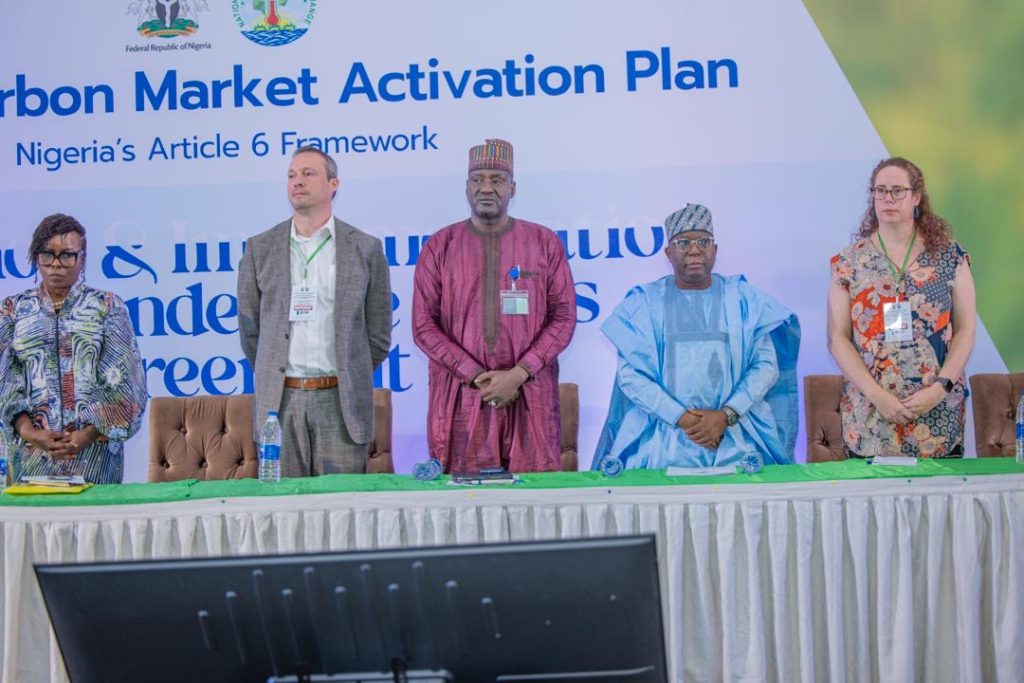
Speaking through the Ministry’s Permanent Secretary, Mahmud Adam Kambari during the “Nigeria’s Carbon Market Framework: Article 6 Workshop and Implementation Design” workshop held in Abuja, the Minister asserted that the country’s carbon market would serve as an attraction for climate finance and as a means to curb greenhouse gas emissions.
The 2-day ongoing Nigeria’s Carbon Market Activation Plan: Article 6 Framework and Implementation Design” workshop which is under the Paris Agreement is organized by National Council on Climate Change (NCCC), aimed at delving deeper into the intricacies of Article 6, with a focus on operationalization and advancing the development of Nigeria’s Article 6 Framework. The intensive training is supported by the United Nations Development Programme (UNDP) and the Neyen Consulting SL.
This he said would be achieved by deepening collaboration with international partners, promote capacity building and targeted investments can help actualize these potentials.
According to the Minister, Nigeria has the potential to produce million tons worth of carbon credits annually by 2030 through projects like Reforestation, Renewable energy, Waste to energy, Improved cooking stove.
“Nigeria has over the years shown increasing interest in reducing its emissions through engagement in relevant partnerships and initiatives. This has been demonstrated in our NDC, the long-term low emission development strategies and the country’s interest to consider cooperative climate action under Article 6 of the Paris Agreement.
“In the updated NDC submitted in 2021, based on the new mitigation analysis, “Nigeria restates its commitment to its unconditional target to reduce GHG emissions by 20% below business-as-usual by 2030, and increases its conditional target to 47% below business-as-usual by 2030 on the condition of receiving appropriate support. All these initiatives are pointers to Nigeria’s efforts in reducing its GHG emissions”, he emphasized.
The Minister while called for commitments from relevant sectors and stakeholders to ensure successful deliberation and providing assistant to the National Council on Climate Change (NCCC) realize its commitments, said it is timely to consider the different approaches for carbon market necessary to steer the country on the trajectory of low-carbon policies while considering national priorities such as socio-economic development and sustainable development”, he posited.
In his opening remarks, the Director General, National Council on Climate Change (NCCC), Dr. Salisu Dahiru emphasized the strategic importance of Article 6 in achieving Nigeria’s ambitious Net Zero target by 2060. He said Market-based mechanisms, including a well-designed and implemented trading scheme, can be a powerful tool for reducing emissions.
According to him, the National Council on Climate Change (NCCC) is Nigeria’s National Designated Article 6 Authority (NDAA), responsible for overseeing all Article 6-related activities and transactions. NCCC authorizes and approves Article 6.2 and Article 6.4 projects that accord with national interest.
Stressing further the significance of the workshop, Dahiru hinted that the establishment of an Article 6 Technical Committee (A6.TC) ensures cross-ministerial coordination and assesses the impact of cooperation agreements on emission reduction, sustainable development, and financial resource mobilization.
The Director General who called for commitment and corporations of industry players to ensure successful deliberation and accomplishment of the goals of the workshop, assured of President Bola Ahmed Tinubu’s support saying that anything that constitute an obstacle to achieving our aim in this regard would be dismantled.
Similarly, the Minister of Environment for State, Dr. Iziaq Adekunle Salako who lamented on the harzadeous impact of chemicals on environment, human and animals, also underscored the significance of it to the national gross domestic product (GDP).
Delivery his keynote address on “Chemical and Waste Management: Circular Solutions for Sustainable Economy” in Ogun State on Tuesday, Dr. Salako revealed that Nigeria generates about 32 million tons of solid waste per year with little or no segregation including the waste often dumped in open spaces, sometimes with hazardous materials burnt openly.
He said: “These unwholesome practices have been linked to perennial flooding across the country, increased respiratory and cardiovascular diseases, increased incidences of cancer, loss of aquatic life, and agricultural productivity”.
However, the Minister who harped on the pros and cons of chemicals, also revealed that if managed responsibly can contribute to the wellbeing of the society.
He clarified: “Distinguished Ladies and Gentlemen, we are all aware that chemicals are an essential part of modern society, as they are produced and used in almost every sector of our society, including industry, health, energy, transport, agriculture, construction, textiles and consumer products.
“The importance of chemicals to the economy of a nation cannot be overemphasized as affirmed by the International Council of Chemical Associations (ICCA). According to ICCA, the sector contributes an estimated US$5.7tn, or 7%, to the world gross domestic product (GDP) through direct, indirect, and induced impacts, supporting 120 million jobs worldwide.
“However, while they contribute significantly to the well-being of society, they also pose a threat to human health, the environment and sustainable development if they are not managed responsibly”.



