

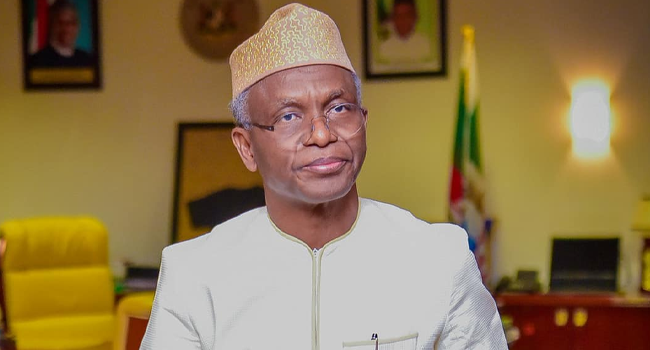
Nasir El-Rufai, the former governor of Kaduna State, has been described by the All Progressives Congress (APC) as the quintessential self-interested politician who is egotistical.
El-Rufai is a politician, according to the APC, who is fueled by wild emotion and a vindictive desire to “collapse the system.”
El-Rufai was urged by the ruling party to stop pouting and take control of his life in a statement released by Felix Morka, its National Publicity Secretary.
Morka was responding to the former governor’s denigration of the APC in interviews.
The former governor recently switched to the Social Democratic Party (SDP) from the APC.
He explained his decision to defect to the SDP by saying that the party had strayed from its original principles.
El-Rufai also called on leaders of the opposition to join the SDP.
“@elrufai’s call for opposition members to work with him under the SDP banner is nothing short of an invitation to drink from a chalice poisoned by selfishness, vengefulness, and delusion of grandeur,” Morka stated, dismissing his call.
In an interview with BBC Hausa, Mallam Nasir El-Rufai, the former governor of Kaduna State, made a desperate attempt to defend his rather improbable decision to leave the All Progressives Party (APC). He claimed that the party had strayed from the progressive principles of its founders and had become one where “everyone is now pursuing personal interests.”
El-Rufai did not hold back when he criticized lawmakers in a once-viral video, claiming they were driven solely by self-interest. In his words, “we have politics of private interest. We have no politics of public interest. Politicians will proudly tell you that politics is about interest. If they don’t get what they want, they are ready to collapse the system.
EI-Rufai is now viewed as the quintessential self-centered politician, egotistical, enraged, and full of a vindictive desire to “collapse the system.”
El-Rufai gave the true cause of his pain in the aforementioned BBC interview, claiming that he was dissatisfied with the treatment he received from President Bola Tinubu and his government, presumably in regard to his unsuccessful ministerial quest.
“His assertion that he left the Party because it had strayed from its progressive ideology or founding principles is a smokescreen to weaponize personal grievances masquerading as principled dissent.” El-Rufai’s failure to secure a cabinet seat seems to have scarred him. He now strikes out at the platform that propelled him to political stardom, nursing a shattered ego.
“APC’s dedication to its core principles and objectives is still as relevant and forward-thinking now as it was back then. Only in his hazy imagination can El-Rufai claim that our Party has strayed from its core principles.



