

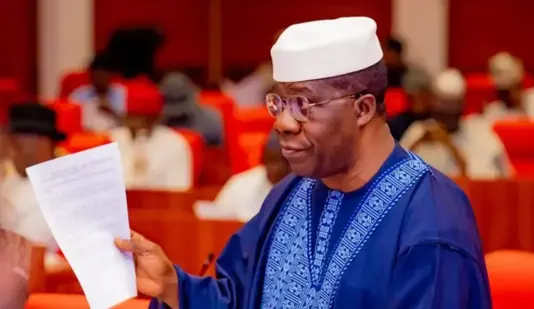
Bamidele addressed criticism of the subsidy removal in a statement released on Monday by his Directorate of Media and Public Affairs, stating that the decision was essential for the long-term stability of the nation.
He clarified that because the fuel subsidy only benefited a small number of people, it was no longer in the best interests of the majority.
In my opinion, the president made the correct decision in eliminating the fuel subsidy, for which the 9th National Assembly had provided funding through May 2023. However, Bamidele claimed that those who benefited from gasoline subsidies were the ones who made it impossible for President Tinubu to rule.
Bamidele noted that a group of people with access to resources rather than the general public were the true beneficiaries of the fuel subsidy.
He added that by using the subsidy to pursue their own interests at the expense of the public, these people undercut the administration’s efforts.
Bamidele underlined that the subsidy was removed because it was no longer feasible for the nation, as approved by the 9th National Assembly, of which he was a part.
He claimed that the fuel subsidy did not benefit the average men and women in this nation. The fuel subsidy was available only to cabal members. In the name and on behalf of the masses, they are the ones denying this privilege. And it didn’t help the general populace.
He explained that the subsidy would eventually be removed because the National Assembly had only approved funding for it through May 2023.
Bamidele asserts that the subsidy would have terminated shortly after President Tinubu took office due to a lack of finance, independent of his declaration.
The National Assembly only included a gasoline subsidy through May 2023 in the 2023 budget. Bamidele clarified, “We did not make provisions for it beyond May 2023, so there was no longer funding for the subsidy, whether President Tinubu was removed at his inauguration or not.”
Shifting Budget Focus: Capital Over Recurrent Expenditure
Bamidele also discussed the 2025 Appropriation Act, noting that the government’s budget priorities were shifting to support economic recovery. He highlighted the government’s increased focus on capital expenditure rather than recurrent spending.
“Compared to the previous fiscal years, the federal government is devoting less to recurrent expenditure while more is being devoted to capital expenditure. That is a major shift from what had been in practice since the return to democracy. It means we are spending less on consumables,” he said.
Bamidele further emphasized the importance of prioritizing critical sectors such as education, health, agriculture, and social welfare, with a particular focus on ensuring that the country’s budget addresses the needs of both national and sub-national governments.
The Senate Leader also praised President Tinubu’s decision to not retrench public workers, despite the severe economic challenges facing the nation. Bamidele warned that such a move would exacerbate the country’s issues, especially regarding security, which had significantly affected agricultural activities.
He stated, “Retrenching workers is not an option before this administration because it will cause more problems. Look at our situation. We are confronted with grave security challenges that nearly erode the gains of the administration, especially in the area of agriculture. This is mainly because people could no longer go to farms.”
Bamidele expressed optimism about improvements in the security situation, acknowledging that the situation remained difficult but was gradually improving, with displaced persons (IDPs) beginning to return home and farmers returning to their farms.
He concluded by urging Nigerians to focus on the long-term benefits of the administration’s policies and efforts to stabilize the economy and ensure sustainable growth. Bamidele reassured the public that despite the current challenges, conditions would improve over time.
“While it is not yet Uhuru, the security situation is fast improving across the federation today. Some of the IDPs are gradually relocating to their base. Farmers are steadily returning to their farms. Altogether, things are improving. I am sure that things will be different very soon,” he said.



