

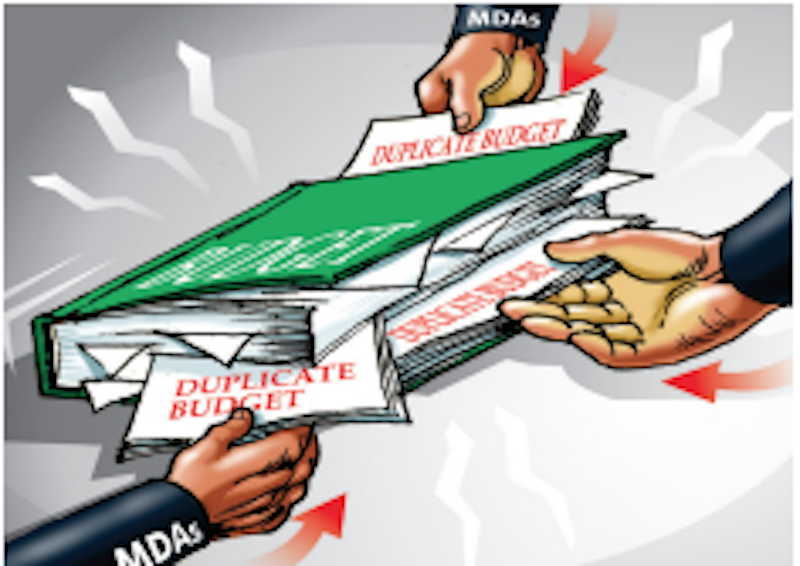
There is no gainsaying the fact that budget padding, which has become a major characteristic of Nigeria’s fiscal packages since the return to democracy in 1999, has had debilitating impacts on the country’s economy.
Aside from eroding the credibility of members of the National Assembly, the practice has, over the years, impacted negatively on the nation’s fiscal discipline, transparency, and public trust in governance.
Budget padding, also known as budget over-allocation or inflated budget, is a common concern in Nigeria, particularly within the National Assembly and government agencies. It involves insertions of projects couched as constituency or zonal intervention projects.
In most cases, as experience has shown, the paddings were done by inclusion of unnecessary or exaggerated expenses, in attempts to divert funds for personal gains of NASS members. And Nigerians have never shied from criticising such shady deals by the federal lawmakers to no avail.
Truth be told, in advanced democracies, budgets submitted to lawmakers do not necessarily come out the same way it was handed over to them. The package would have been reviewed, amended and almost rewritten.
But that’s where there is transparency, not in Nigeria where everyone wants to corner national resources for himself or his people. Which is why the recent cries over padding of the 2025 budget becomes germane.
How did the controversy begin?
BudgIT, a civic-tech organisation promoting budget transparency and accountability in Nigeria and other African countries, had uncovered 11,122 projects worth N6.93 trillion that were inserted by NASS into the 2025 budget, a 12.5 percent increase over the N54.99 trillion budget signed into law by President Bola Ahmed Tinubu on February 28, 2025.
Earlier in December 2024, President Tinubu had presented a budget of N49.7 trillion for the next fiscal year but two months later, in February 2025, requested an upward review of the package to N54.2 trillion.
The increase, he said, was due to additional revenue generated by key federal agencies: N1.4 trillion from the Federal Inland Revenue Service, FIRS; N1.2 trillion from the Nigeria Customs Service, and N1.8 trillion from other government-owned agencies.
On February 13, 2025, the National Assembly revised the budget upward to make the package N54.99 trillion.
BudgIT reported that 238 projects – each valued above N5 billion and totaling N2.29 trillion – were inserted into the budget with little or no justification.
“Also, 984 projects worth N1.71 trillion and 1,119 projects within the range of N500 million to N1 billion, totaling N641.38 billion, were indiscriminately inserted into the budget,” the report claimed.
Further analysis showed that 3,573 projects worth N653.19 billion were directly assigned to federal constituencies, while 1,972 projects valued at N444.04 billion were allocated to senatorial districts.
The report also highlighted numerous questionable projects, including 1,477 streetlight installations worth N393.29 billion, 538 borehole projects totaling N114.53 billion, and 2,122 ICT-related projects valued at N505.79 billion. Additionally, N6.74 billion was earmarked for the “empowerment of traditional rulers”.
“Shockingly, 39% of all insertions – 4,371 projects worth N1.72 trillion – were forced into the Ministry of Agriculture’s budget, inflating its capital allocation from N242.5 billion to N1.95 trillion,” BudgIT said.
The Ministries of Science and Technology, and Budget and Economic Planning, also had their capital votes inflated by insertions of N994.98 billion and N1.1 trillion respectively.
BudgIT’s findings also revealed that many Ministries, Departments, and Agencies (MDAs) were allocated projects outside their statutory mandates, calling them frivolous and of no tangible value to national development.
We note how budget padding has fueled corruption in the past 26 years of our unbroken democratic experience. But more importantly, some leaders had shown courage and refused to sign padded budgets.
For instance, President Olusegun Obasanjo rejected the 2000 Appropriation Bill and accused NASS of padding it by about N2 billion, citing the legislature unilaterally jacking up its allocation from N22.7 billion to N24 billion.
Eleven years later, in 2011, President Goodluck Jonathan refused to sign the budget for what he described as an unjustified increase in the National Assembly’s allocation – from about N120 billion to N232.74 billion.
We support BudgIT which, while wrapping up its report, called on President Tinubu to assert stronger executive leadership to ensure that the national budget aligns with Nigeria’s medium- and long-term development strategy.
As the body said, “The current practice – where lawmakers independently insert projects without coordination with national priorities – undermines the credibility of the budget and weakens the impact of public expenditure.”
“The current practice – where lawmakers independently insert projects without coordination with national priorities – undermines the credibility of the budget and weakens the impact of public expenditure.”



