

Central banks worldwide are accelerating efforts to launch digital currencies as part of a broader strategy to modernize financial systems, enhance payment efficiency, and drive financial inclusion.
Nations like the Bahamas, Nigeria, and Jamaica have successfully launched their Central Bank Digital Currencies (CBDCs), albeit with varying levels of adoption and success.
Central bank-issued and supported virtual currency is known as a CBDC, according to the Atlantic Council, a think organization based in the United States.
98% of the world’s GDP is represented by the 134 countries and currency unions that are currently investigating CBDCs, a significant rise from the 35 countries that did so in May 2020. As of right now, 66 nations have either launched their digital currencies or are in the advanced stages of research or pilot testing.
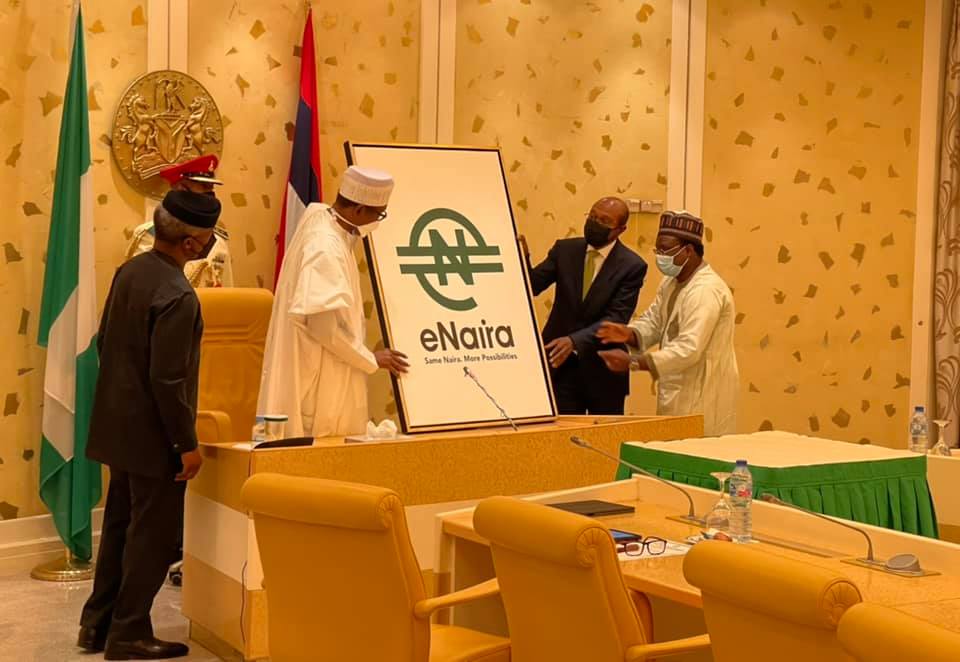
With the October 2021 introduction of the eNaira, Nigeria became the first nation in Africa to implement a CBDC.
Former President Muhammadu Buhari announced the digital currency, which is based on the Nigerian naira. Its main goal was to integrate unbanked people into the nation’s financial system in order to promote financial inclusion.
The Central Bank of Nigeria (CBN) outlined several advantages of the eNaira, such as lowering the cost of currency printing, establishing a quick and dependable payment system, bolstering the digital economy, making cross-border payments easier, and enhancing economic activity.
To assist Nigeria’s economic growth, the eNaira was also designed to improve the efficiency of monetary policies, enable focused social initiatives, and simplify tax collection and remittance.
A Centralized Cryptocurrency Substitute
As part of its plan to reduce the usage of cryptocurrencies, which were thought to be unstable and untraceable, the CBN developed the eNaira. In contrast to cryptocurrencies, the eNaira is a centralized system that allows the CBN to keep an eye on transactions, manage wallet access, and control holders’ purchasing power.
In the weeks following its launch, the eNaira app garnered tremendous downloads, with over 589,000 downloads across iOS and Android stores by November 2021.
By January 2022, the app had executed over 35,000 transactions and topped 694,000 downloads, with an average of 20,000 downloads per day. Later that year, the portal handled transactions totaling little under $10 million, according to the CBN.
The eNaira’s adoption rates have remained surprisingly modest, despite the initial excitement. Only 0.5% of Nigerians had adopted the eNaira, according to an IMF report dated July 2023, and 98.5% of wallets were still inactive a year after it was introduced.
Over three years later, the rate of adoption is still slow, and the general public’s opinion of the digital currency has been mostly negative.
The IMF described the public adoption of the eNaira as “disappointingly low.” On social media, users have mocked the initiative with terms like “E-vanish,” “E-vaporate,” and “E-Dead,” suggesting that the currency has failed to gain momentum.
Further complicating matters, the eNaira mobile app, designed for easy access to the digital currency, was removed from the Google Play Store, although it remains available on the Apple Store.
Additionally, the USSD code (*997#), intended to facilitate transactions for users without smartphones, has proven non-functional. The eNaira’s official social media accounts have been largely inactive, with the last post made on August 10, 2023.
IMF Report: Low Transaction Volume And Inactive Wallets
In a recent IMF Article IV consultation report released in May 2024, it was revealed that the number of eNaira wallets had grown to 13 million, although most of these wallets remain inactive.
Since the launch, the total volume of executed transactions amounted to 854,512, mostly consumer-to-merchant transactions, valued at N29.3 billion. The report also indicated that the slow adoption of the eNaira could be attributed to the CBN’s “phased approach,” which initially restricted the digital currency to bank account holders and domestic transactions.
A development journalist, Mayowa Tijani, downloaded the eNaira app and funded his wallet shortly after its launch. Speaking with TheCable, he noted that aside from waiving transaction fees at the start, the CBN failed to communicate the unique benefits of using the eNaira compared to regular banking apps.
“I just did not see any use that was beyond what the normal naira or bank apps would do.
“I feel like it was just following the craze of CBDCs because a number of countries in the world were discussing the possibility of CBDCs. So, the central bank just felt like it was a good idea to do the same. We did not deploy it really well in a way that it was going to be useful for anybody within the country.
So, for me, now having it and wanting to use it, I was looking for people who had the same eNaira wallet. Of course, since the adoption was not great, a lot of people did not have it. At the end of the day, I couldn’t use it. I still had to do transfers from my bank. That’s probably why it died a natural death,” he said.
A blockchain and crypto expert, Solomon Amunde, also pointed to the unclear value proposition and limited use cases as factors stifling the adoption of the eNaira.
“I would say one of the major problems here, why it hasn’t gotten that wide adoption, is because it’s not being communicated properly, and it’s not being put in front of everyone.
“So, even if it’s useful, people don’t know that. Even if it promises lower transaction costs, people haven’t been able to see that yet.
“Ideally, eNaira should function like stablecoins such as USDT or USDC, facilitating instant transactions and financial inclusion. But if people can’t easily integrate it into their daily transactions, what’s the incentive to switch?” he said
To boost adoption, Amunde suggested that the federal government mandate the use of the eNaira for National Youth Service Corps (NYSC) members, civil servants, and government payments.
“Corp members should be paid through the eNaira. All government payments will be made via the eNaira. Civil servants should be mandated (give them two weeks or a month to submit their eNaira wallet details), and that’s the means through which they’ll be paid.
“Also, platforms that they have some form of control over, let’s say, if you want to pay for a driver’s license or an international passport, should include the eNaira as a payment option,” he said



