BY ODIGIE OKPATAKU
Ojude Oba (The King’s Forecourt) is an ancient festival, celebrated by the Yoruba people of Ijebu-Ode, a major town in Ogun State, Southwestern Nigeria. This annual festival usually takes place the third day after Eid al-Kabir (Ileya), to pay homage and show respect to the Royal Majesty, the Awujale of Ijebuland. It is one of the most spiritual and glamorous festivals celebrated in Ijebuland and generally in Ogun State as a whole.
During the course of the festivities, different cultural age groups known as regberegbe composed of indigenes, their friends, and associates far and near parade at the front courtyard of the king’s palace on the third day of Eid al Kabir popularly referred to as “Ileya” in Yoruba language Oba Adetona was the one that brought back the age groups in the 18th century into the general acceptable phenomenon that is found among today’s Ijebu, and this has become an integral part of the yearly Ojude Oba festival in Ijebu. The reason for the age groups was to bring development and progress to the community.
Ojude Oba which means king’s fore-court in Yoruba language is usually celebrated with Pomp and pageantry by about 1,000,000 people from different parts of the world and Nigeria, especially those from Yoruba origin and most especially by people of Ijebu descent all over the world.
Ojude-Oba Festival is a one-day celebration of culture, fashion, glamour, candour, beauty and royalty as sons and daughters of Ijebuland. The festival always commenced with prayers by the Imam of Ijebuland, then followed by the National Anthem, then the Ogun State Anthem and the Awujale Anthem, and finally the Lineage praise of the Ijebu. After all of these, the parade of different ages known as Regbe regbe with names––such as Obafuwaji, Bobagbimo, Bobakeye, Gbobaniyi and Globaleye begins.
This is the heart of the ceremony as each group with both male and female counterparts are distinct either in their manner of appearance and style of dressing or by their dance patterns. Some of the group’s members are top managers, chief executive officers, head of industries and prominent traditional title holders. The groups each has a recognizable face, like the Gbobaniyi, a group of middle-age men, that dress in rich traditional Aso-Oke, wield walking sticks and dance like conquerors, has former Ogun State Governor Gbenga Daniel as its patron, while the female Gbobaleye are noted for gaiety and dance and has as member the popular Waka music star, Queen Salawa Abeni.
In straightforward terms, these groups file in turn by turn with their drummers to pay homage through their dance, and with presentation of gifts and offerings at the feet of the King. They pray for him, wishing him a peaceful tenure and long life.
Key highlights
Horse-riding
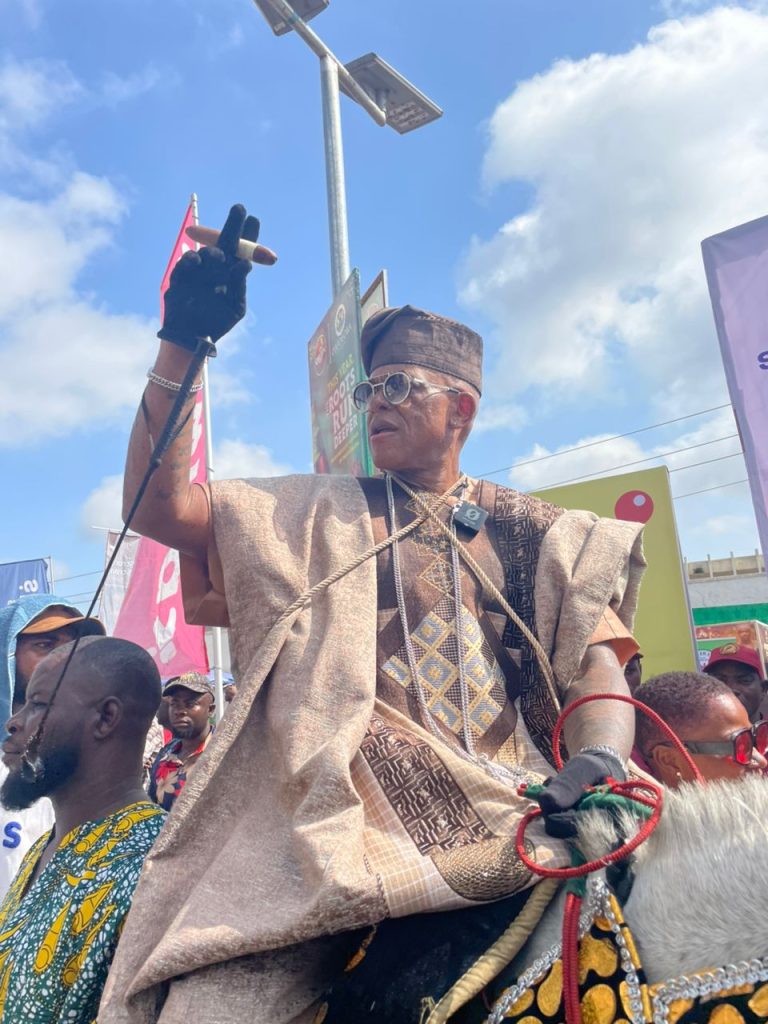
Different horse-riding families are led by the Balogun. Descendants of Ijebu war heroes are regarded as the Balogun. Some horse-riding families includes; Balogun Odunuga, Balogun Bello Odueyungbo Kuku, Balogun Agboola Alausa, Balogun Alatishe, Balogun Otubu, Balogun Adesoye, Balogun Odejayi, Balogun Adesoye Onasanya, Balogun Towobola, Balogun Aregbesola and Balogun Ajibike Odedina. Intermittent gunshot is used to announce their entry, which sends many people into a frenzy.
Artistic beauty of the Ojude Oba Festival
One of the very reasons why people from entirely different cultural backgrounds find the Ojude Oba festival very interesting is because Art plays a very significant role in the festival. To really account for the artistic beauty of the Ojude Oba festival, take into consideration the style and manner of dressing of the different age groups, the music and musical instrument, even to the design on the horses of the Balogun families, and so on
Dressing
Age grades compete for the best dressed. Hence, the reason why groups go all out for the season’s most expensive clothing. Attires from a previous festival cannot be worn again at a new Ojude Oba festival, they wear entirely different attires year to year which makes a statement on the economic status and wealth of the age group and how well they are doing. Arguably, nowhere else is the Yoruba flair for traditional attire better demonstrated than in the flamboyance at Ojude Oba. Traditionally, the favourite dress colours of the Yoruba people include; tan, the rich natural tone of the silk known as sanyan, and blue, ranging from the palest to the deepest blue black obtainable from the indigo dye pots.
Sponsors and supporters
The Ojude Oba festival is sponsored and supported by the incumbent Awujale, the people of Ijebu-Ode, individuals and some major corporate organizations in Nigeria. One of the major sponsors of the festival is Globacom. The telecommunication giant has been a sponsor of the event for up to 10 years, year after year, providing gifts, prizes and trophies to branded chairs and sundry benefits. Their help in the upliftment of the Ojude Oba festival is immeasurable. Other sponsors of the festival are First City Monument Bank (FCMB), UAC of Nigeria, Fan Milk, The Seven-Up Bottling Company and MultiChoice and so many more.