

By Ameh George
The renewed clamour for a 2027 presidency of former President Goodluck
Jonathan is being viewed as a strategic political calculation aimed at disrupting
the opposition. While some citizens call for his return due to the longing for his
administration and the current economic hardships, political analysts and
insiders suggest it is primarily a calculated move by certain interests.
groups—including elements within the ruling All Progressives Congress
(APC)—to split the opposition’s voter base and weaken candidates like Peter
Obi.
Northern political leaders and strategists are reportedly pushing for Jonathan
because they believe he would serve only one term (2027–2031), allowing
power to return to the North, and thus creating a pathway for them in 2031.
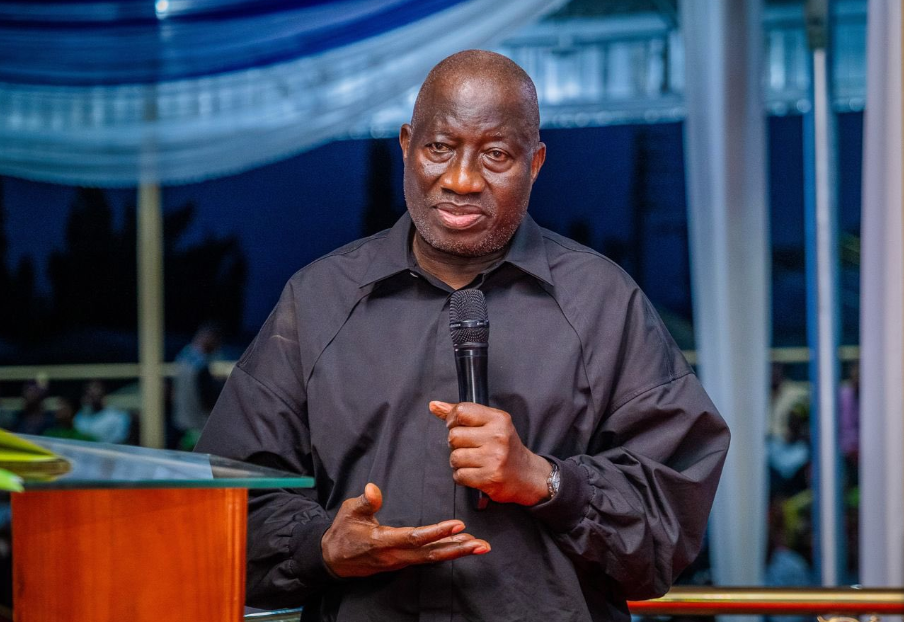
The New National Star reports that former President Goodluck Jonathan
announced he would consult widely before making a final decision after a major
youth group, the Coalition for Goodluck Jonathan, staged a massive solidarity
rally at his Abuja office and residence. Led by the coalition’s National President,
Dr. Tom Ohikere, the demonstrators blocked streets in Maitama, waving
placards with slogans like “GEJ: Nigeria is dying, save it!” and demanding he
contest the 2027 presidential election on the platform of any political party.
Jonathan told the gathering that running for the Nigerian presidency “is not a
computer game” and requires structured stakeholder engagement rather than a
hasty declaration.
He challenged the youth to move past passive commentary, noting that Nigeria
suffers from severe voter apathy. He noted that up to 50 per cent of those
chanting for his return don’t even possess a valid voter card.
He urged young Nigerians to actively register, pick up their Permanent Voter
Cards (PVCs), and directly drive the electoral process.
If Jonathan runs on the Peoples Democratic Party (PDP) platform, it would
significantly divide the opposition vote, as he would directly compete with other
strong contenders like Peter Obi, ultimately benefitting the incumbent, Bola
Tinubu.
Groups like the Coalition for Jonathan 2027 cite his previous experience,
“democrat” status, and the perceived stability of his administration as reasons
for his return.
Former President Goodluck Jonathan is, however, yet to officially declare his
intention but has stated he is “consulting widely” after being approached by
various political groups.
Political analysts argue that this is a “distraction” or a “strategy by the
incumbent to break the unity of the Southern and South-South electorate, which
was crucial for the opposition in 2023.
Some PDP stakeholders believe only a figure like Jonathan can unite the
fractured party to take on the APC.
Other supporters and political observers, such as Nyesom Wike, have warned
that another bid could tarnish Jonathan’s reputation as a “hero of democracy” if
he fails, especially if he is perceived as being used by political actors.
The clamour has created divisions within the PDP in the South-South, with
some groups supporting him while others worry it breaks the zone’s unity.
His entry would likely reduce the support base for Peter Obi, who has strong,
young followers, potentially leading to a “three-way” contest that helps the
APC.
Despite his eligibility being upheld by some courts, he still faces legal hurdles
from other groups trying to prevent his candidacy.
While there is a segment of the public that may support him, the intense,
organized pressure on Jonathan is viewed more as a deliberate strategy to break
the opposition’s momentum rather than an organic, bottom-up demand.
Since Goodluck Jonathan left office in 2015, Nigeria has experienced
significant shifts in its political landscape, security situation, and economic
structure, marked primarily by the transition to the All Progressives Congress
(APC) administration and, by 2026, the party’s consolidation of power under
President Bola Tinubu.
The 2015 election marked the first time an incumbent Nigerian president lost to
an opposition candidate, resulting in a shift from the Peoples Democratic Party
(PDP) to the APC.
Elections in Nigeria have seen increased use of technology, such as the card
reader, BVAS and iREV systems, aimed at reducing electoral fraud.
Many of the political actors who facilitated Jonathan’s removal in 2015 later
voiced nostalgia for his tenure, citing rising hardship under subsequent APC
leadership.
Since leaving office, Goodluck Jonathan has transformed into a respected
international statesman, leading election observer missions and taking on peace
mediation roles for ECOWAS.
While the fight against Boko Haram became more focused initially, security
issues have since spread, with increased challenges from banditry, kidnapping,
and farmer-herder conflicts nationwide. Economic conditions have undergone
major volatility, with complaints of increased hardship, high costs of goods and
services, and economic stagnation cited in comparison to the pre-2015 era.
Later administrations, particularly from 2023, began dismantling major
economic policies, such as the fuel subsidy regime, and managing a more
fragile economic climate.
By the 2023-2026 period, public sentiment in certain sectors saw a shift, with
some Nigerians expressing regret for playing a role in removing the previous
administration.
Despite having left office, Jonathan remains a relevant figure, occasionally
courted by political parties to return to the political arena, a move highlighting a
shifting evaluation of his economic and political management.
Former President Goodluck Jonathan is facing significant, yet mixed,
momentum for a potential 2027 presidential bid under the People’s Democratic
Party (PDP). While some PDP stakeholders view him as the only candidate
capable of rescuing the party from its current crisis and challenging the ruling
APC, others view the effort as a futile attempt to revive a “decimated” party.
Proponents believe Jonathan can unify a fractured opposition and leverage
public dissatisfaction with economic conditions to defeat the incumbent.
Reports indicate Jonathan is engaging with northern stakeholders, with some
groups (e.g., Arewa Consensus for Jonathan) backing him as a stable, single-
term option (2027–2031) that could allow power to return to the North in 2031.
A Federal High Court in Yenagoa reportedly ruled in late 2025 that Jonathan is
eligible to contest the 2027 election, despite a 2018 constitutional amendment
limiting presidents to two terms.
The ruling APC has dismissed the threat, arguing they defeated Jonathan when
he was an incumbent president, and that he would be even easier to defeat in
2027.
The party faces intense internal crises, with key leaders such as the current
minister of the FCT, Barr Nyesom Wike, accused of supporting the incumbent
APC rather than their own party.
Prominent figures have left or are rumoured to be leaving for other platforms,
such as the African Democratic Congress (ADC).
The 2023 elections showed a significant shift in voting patterns, with the APC
establishing strong footholds in former PDP strongholds, making it difficult for
any PDP candidate to garner necessary national votes.
Jonathan is reportedly engaging in private consultations with influential national
figures, including former military President Ibrahim Babangida.
Despite the 2025 ruling, other lawsuits continue to challenge his eligibility to
stand for election.
Recently a legal challenge against former President Goodluck Jonathan’s
eligibility for the 2027 presidential election was stalled on Monday, May 11,
2026, at the Federal High Court in Abuja, with the next hearing adjourned to
May 15, 2026.
The suit had stalled due to the absence of the plaintiff, Johnmary Jideobi, and
his counsel, Ndubuisi Ukpai, at the scheduled proceedings.
Records showed that the Independent National Electoral Commission (INEC)
and the Attorney-General of the Federation (AGF)—key defendants—had not
been properly served with the suit.
Justice Peter Lifu adjourned the matter to May 15, 2026, and warned that
punitive costs could be awarded against the plaintiff if they fail to appear at the
next hearing.
Counsel to Jonathan, Chief Chris Uche (SAN), urged the court to strike out the
suit due to a lack of diligent prosecution by the plaintiff.
The suit; marked; FHC/ABJ/CS/2102/2025 seeks a perpetual injunction
restraining Jonathan from contesting the 2027 election, alleging he has already
served his maximum constitutional limit. The plaintiff argues that allowing
Jonathan to contest would violate Section 137(3) of the 1999 Constitution (as
amended).
Jonathan’s legal team has already challenged the competence of the suit,
arguing it is premature and academic.
The court is now allowing a final opportunity for the plaintiff to appear before
considering a dismissal.
The PDP has been described as being on “life support,” and while some
factional leaders are courting Jonathan, others are wary of the internal power
struggles it may trigger.
While supporters believe Jonathan is the only “miracle” that can save the PDP,
his chances are hampered by the party’s severe internal divisions and the
strength of the ruling APC, which views his potential candidacy as “premature”
and “doomed”.
As the build up towards the 2027 General Elections Intensifies, the race for
Nigeria’s 2027 presidency has triggered early, intense political maneuvering
across major political parties. Politicians are deploying distinct strategies to
secure party tickets and build voter coalitions.
Opposition factions are discussing alliances to form a single, stronger front
against the ruling party. Camps are using digital influencers to systematically
leak opposition scandals and shape public perception early.
Politicians are manipulating traditional power-rotation arguments to favor their
specific geopolitical zones.
High-profile lawmakers and governors are switching parties to secure
guaranteed platforms for their ambitions. Aspirants are filing pre-election
lawsuits to disqualify strong internal rivals before the primary voting begins.
While The All Progressives Congress’ (APC) focus is on consolidating power,
defending the current economic track record, and managing internal factional
discipline, The People’s Democratic Party’s (PDP) efforts center on resolving
long-standing leadership structural crises to present a unified national appeal.
The Labour Party’s (LP) strategies involve rebuilding structure at the grassroots
level and capitalizing on youth and urban voter discontent.
The African Democratic Congress, ADC, which most people saw earlier as the
emerging strong coalition that would give the ruling APC a run for its money,
seems to be fast losing steam to the new Nigeria Democratic Congress, NDC
which is likely to field the strong opposition figures of Peter Obi and Rabiu
Kwankwaso who currently control a majority of the youth demography of
voters.



