

…Senators express scepticism, caution against running three budgets
…Draft three-man committee to work with President’s economic team
…Mandate prompt payment of contractors
BY SAM OTUONYE
As lawmakers raise the alarm over stalled projects and slow releases, the Federal Government has disclosed plans to rollover about 70 percent of the 2025 budget into 2026, a move that has triggered fresh concerns over implementation and infrastructure delivery.
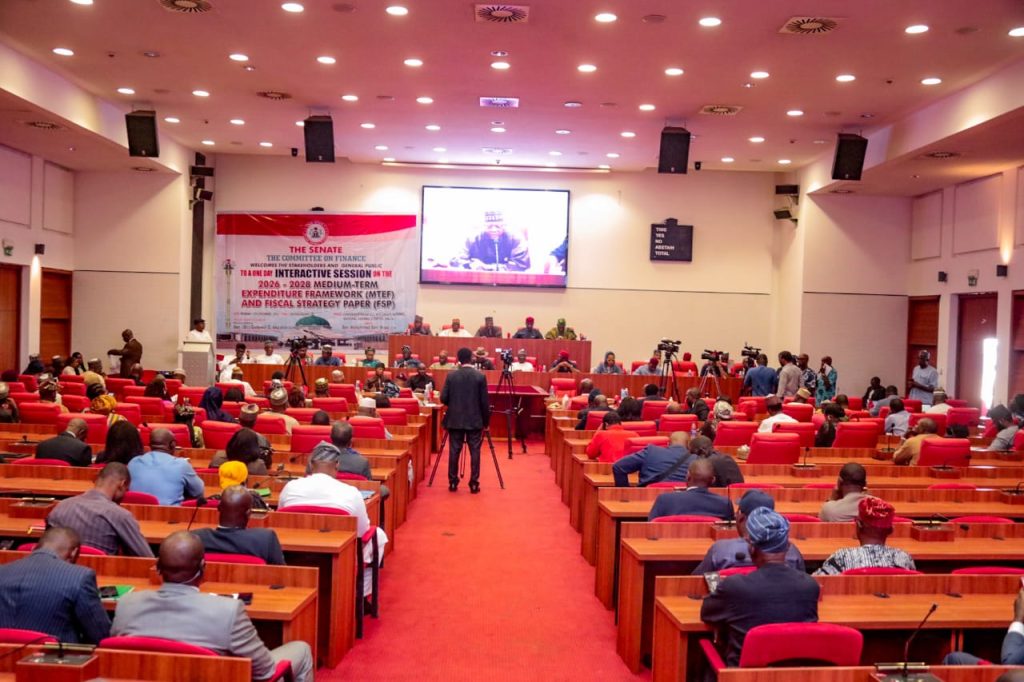
The Minister of Finance and Coordinating Minister of the Economy, Wale Edun, stated this on Monday during a one-day interactive session between the Senate Committee on Finance and members of the President’s economic team on the 2026–2028 Medium-Term Expenditure Framework and Fiscal Strategy Paper (MTEF/FSP).
During the session, the Chairman of the Senate Committee on Finance, Sani Musa, disclosed that the meeting followed a formal request by the Executive to the Senate President, Godswill Akpabio, seeking approval of the 2026–2028 MTEF/FSP, which was approved by the Federal Executive Council on December 3, 2025.
The Senate Committee on Finance met with members of President Bola Tinubu’s economic team on the 2026–2028 MTEF/FSP on December 15, 2025.
Meanwhile, in August, President Tinubu directed that the budget implementation process be expedited. However, as of November 2025—the eleventh month of the fiscal year—the Federal Government had yet to commence execution of its ₦54.99 trillion ‘Budget of Transformation,’ which the President signed into law in February after its passage by both chambers of the National Assembly.
The meeting was attended by the Minister of Budget and Economic Planning, Abubakar Bagudu; Minister of State for Finance, Doris Uzoka-Anite; Minister of Petroleum (Oil), Senator Heineken Lokpobiri; the Accountant-General of the Federation, Babatunde Ogunjimi; and the Chairman of the Federal Inland Revenue Service, Zacch Adedeji.
In his presentation, Edun stated that the 2024 budget had been extended and largely implemented, particularly on the capital expenditure side, with funds available to complete outstanding components.
He disclosed that only 30 per cent of the 2025 budget had been fully funded, necessitating the rollover of about 70 per cent into 2026, even as he noted that revenue estimates rose from N20 trillion in 2024 to N40 trillion in 2025.
Edun acknowledged that the Federal Government’s revenue projections far exceeded actual collections, underscoring the need to shift focus from borrowing to revenue generation.
“There has been a yeoman’s job in revenue mobilisation, but we need a more robust revenue optimisation programme for 2026,” he stated.
“The focus is not borrowing but revenue. For the economy to grow, we need mass savings and productive investment.”
The Accountant-General of the Federation also told the committee that arrangements had been concluded to clear outstanding 2024 obligations, confirming that indigenous contractors had been paid up to 80 per cent, with the first and second batches of payments already completed.
However, lawmakers raised concerns over budget implementation. Senator Danjuma Goje questioned the continued non-implementation of constituency projects despite claims that revenue targets for 2025 had been met, warning that the country was effectively running three budgets simultaneously.
Other senators queried whether revenue projections would also be rolled over into 2026 and whether fresh capital funding would be introduced in the new budget cycle.
In response, Edun explained that the rollover was designed to prevent repeated budget extensions and ensure that 2026 operates as a single budget year. He noted that while non-oil revenue had performed relatively well, oil revenue remained a challenge, requiring flexibility in spending commitments.
Several senators called for the prompt payment of contractors, urging the government to prioritise outstanding obligations. Some lawmakers, however, argued that rolling over 70 per cent of the 2025 budget while claiming to avoid multiple budgets amounted to playing with words.
At the end of the session, the Senate Committee on Finance announced the immediate constitution of a three-man committee to work with the President’s economic team to fast-track the release of payments to indigenous contractors.
Senator Musa said the National Assembly would rigorously interrogate the assumptions underpinning the MTEF to ensure fiscal discipline and realistic projections.
Nigeria’s 2025 budget implementation has faced significant challenges, including slow capital releases due to procurement delays, a widening fiscal deficit requiring increased borrowing, and a lack of timely and transparent reporting, resulting in fiscal indiscipline and uncertainty. Capital spending, analysts note, only gained traction late in the year, despite the budget being signed months earlier, alongside a growing trend of rolling over unimplemented budgets.
Analysts said the delays are distorting fiscal planning, stalling capital project delivery and eroding credibility in public finance management.
Muda Yusuf, Chief Executive Officer of the Centre for the Promotion of Private Enterprise (CPPE), described the situation as “an aberration,” warning that persistent delays have weakened the integrity of Nigeria’s budgeting process.
“What has happened now is that the whole thing has been mixed up, and there’s a whole lot of uncertainty around the budget.
“Even the whole principle of budgeting is losing its essence. Because if you have a project in the budget and you don’t even have confidence that it would be implemented, then what is the essence of having the budget?” he said.
Yusuf cautioned that the continuous rollover of unimplemented budgets could lead to an erosion of confidence in fiscal governance, particularly regarding capital projects that depend on timely funding.
According to him, the failure to align projected revenues with spending commitments has made budget planning unrealistic and ineffective.
“There’s a huge gap between what is appropriated in the budget and what we have the capacity to fund in terms of actual revenue,” he said. “There’s no point budgeting for huge things and, at the end of the day, not being able to implement half of it. It creates uncertainty and systemic problems.”



