

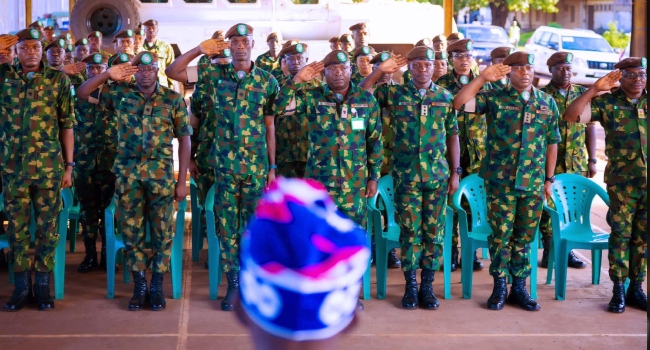
…Lawmakers say President acted within emergency powers
BY JOHN DANJUMA
The Nigerian Senate on Tuesday unanimously validated President Bola Tinubu’s deployment of troops to the Benin Republic following a quelled military insurrection.
The President had evoked his emergency powers when he, on Sunday, deployed members of the Nigerian Armed Forces to Benin to help restore democracy after a faction of soldiers attempted to overthrow the government, despite constitutional provisions requiring him to first seek the approval of the National Assembly for such actions.
But the President on Tuesday presented the same request for Senate approval, three days after he took the action.
The Senate, in swift action, approved the President’s request for legislative consent to deploy Nigerian troops to the Republic of Benin following an aborted coup attempt in the neighbouring country, affirming that the President acted within the powers granted by the 1999 Constitution (as amended).
The approval came two days after President Tinubu authorised Nigerian air and ground support to assist Beninese authorities in foiling an attempted unconstitutional seizure of power in Cotonou. The Senate’s consent, granted during plenary after deliberation in the Committee of the Whole, formally regularised the emergency military intervention.
The President’s request was contained in a letter titled “Deployment of Nigerian Troops to the Republic of Benin for a Peace Mission,” read on the floor of the Senate by Senate President Godswill Akpabio.
In the letter, President Tinubu explained that the deployment followed an “exceptional and immediate” appeal from the Government of Benin Republic, which was facing a serious threat to constitutional order.
“The situation as reported by the Government of Benin requires urgent external intervention,” the President wrote, adding that Nigeria’s response was guided by long-standing ties of brotherhood between both countries and the collective security principles of the Economic Community of West African States (ECOWAS).
Although Nigerian forces had already commenced operations under emergency circumstances, Tinubu acknowledged that the Constitution requires Senate consent and formally sought legislative approval in line with Section 5(5) of the Constitution.
That provision allows the President, in cases of urgent or imminent threat to national security, to deploy troops after consultation with the National Defence Council, provided Senate consent is sought within seven days.
After the letter was read, the Senate resolved into the Committee of the Whole and unanimously approved the request by voice vote. No dissenting voice was recorded.
Declaring the result, Senate President Akpabio stated that the President’s swift action had prevented a potential humanitarian crisis at Nigeria’s western border.
“President Tinubu’s action saved Nigeria from thousands and thousands of refugees and ensured peace along our borders,” Akpabio said, adding, “An injury to one is an injury to all.”
He announced that the Senate’s letter of consent would be communicated to the President immediately.
Senate Leader, Senator Opeyemi Bamidele, provided the clearest constitutional explanation of the Senate’s decision, stressing that the request was not a proposal to initiate war but a constitutional requirement to ratify an emergency action already taken.
According to Bamidele, Section 5 of the Constitution generally requires Senate approval before deploying troops outside Nigeria, but Subsection 5 explicitly permits emergency deployment where national security is threatened.
“What we have done today is to respond faithfully to Section 5, Subsection 5 of the Constitution,” Bamidele said. “The President requested our consent for what was already done in Benin Republic, and the Senate acted within the time allowed by law.”
He noted that the Senate was constitutionally given 14 days to consider the request but acted swiftly in the national interest.
“Our speed reflects the collective will of well-meaning Nigerians who believe democracy must be protected in Africa, especially in West Africa,” he added.
Senator Jimoh Ibrahim placed Nigeria’s action within a broader global and historical context, arguing that Nigeria, as the leading power in West Africa, has both a moral and strategic duty to prevent democratic collapse in neighbouring states.
Citing international precedents, Ibrahim noted that the United States has undertaken hundreds of military interventions globally to protect its interests and values.
“If the global hegemonic power can intervene repeatedly to protect democracy and strategic stability, Nigeria, as the hegemonic leader of West Africa, cannot stand idle when democracy is under threat at its doorstep,” he said.
Ibrahim stressed that instability in Benin Republic would directly affect Nigeria’s security, economy and border communities, making proactive intervention unavoidable.
Former Bayelsa State Governor and Senator Seriake Dickson also spoke in support of the President while clarifying procedural misunderstandings during the session.
Dickson explained that the President acted correctly by first consulting the National Defence Council and then formally communicating the deployment to the National Assembly.
“The President did the right thing by exercising his constitutional powers to respond to an emergency,” Dickson said. “In matters of national security, there should be no politics and no partisanship.”
He identified three areas where national unity must prevail: national security, the economy, and the defence of democratic principles.
However, Dickson also used the opportunity to issue a broader warning, noting that democratic governments were collapsing across West Africa due to governance failures.
“Nigeria must lead not only with military power but also by encouraging constitutional governance and legitimacy across the sub-region,” he said, calling on West African leaders to address undemocratic practices that alienate citizens and weaken democratic institutions.



