

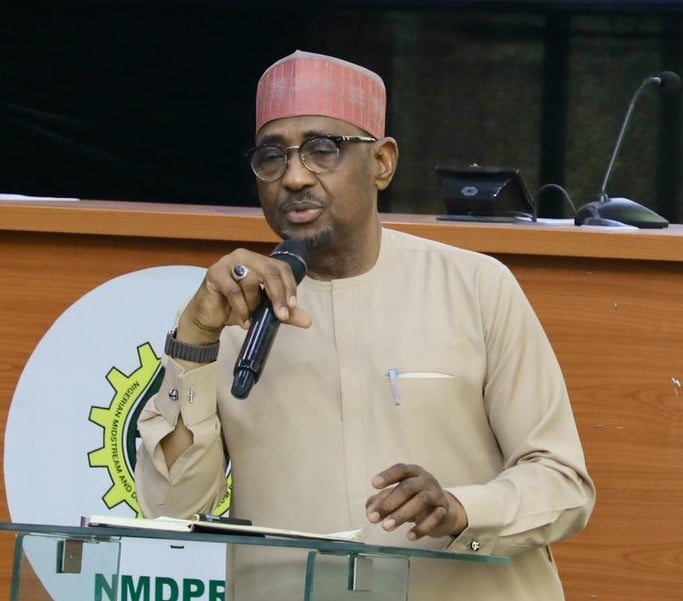
BY PETER USMAN
The Nigeria’s midstream and downstream petroleum sector remains hampered by low refinery utilisation despite a combined installed capacity of 1.125 million barrels per day, the Federal Government, through Nigerian Midstream and Downstream Petroleum Regulatory Authority, NMDPRA, has revealed.
Going by the NMDPRA’s October 2025 Fact Sheet on the state of the midstream and downstream sector released on Friday, the country recorded only 61.58 per cent refinery utilisation between Q1 and Q3 2025, a performance the regulator linked to technical constraints, crude supply limitations across refineries, and repeated downtime at government refineries.
According to the document, only four refineries, Dangote, Aradel (11,000bpd), Edo (1,000bpd), and Waltersmith (5,000bpd), are currently active, with a combined operational capacity of 467,000 barrels per day.
The 650,000bpd Dangote Refinery remains the country’s largest refining asset, but NMDPRA data showed the Lekki-based plant is still running below capacity, despite the company’s plan to ramp up output to 1.4 million barrels per day. The regulator noted that the $20bn facility processed 449,000bpd in October.
The document read, “Refining Capacity & Status: Total Refining Capacity and Installed Capacity (Conventional & Modular) is 1,125,000 Barrels per day. But current utilisation is 61.58 per cent (Q1-Q3 2025) due to technical constraints and crude supply limitations.
“Active Refineries are (Dangote, Aradel, Edo, and Waltersmith) 4 nos-467,000 bpsd Combined capacity (as of October 2025).”
Other conventional refineries include the state-owned facilities undergoing phased rehabilitation.
The Port Harcourt Refinery comprises an old 60,000bpd unit and a new 150,000bpd train, while the Warri and Kaduna refineries have installed capacities of 125,000bpd and 110,000bpd, respectively.
In the modular refining space, Waltersmith operates a 5,000bpd plant, Duport Refinery 2,500bpd, Edo Refinery 1,000bpd, OPAC Refinery 10,000bpd, and Aradel’s modular unit 11,000bpd.
The NMDPRA stated that 47 Licences to Establish with a cumulative capacity of 1.75 million barrels per day have been issued since 2000. Similarly, 31 Licences to Construct have been granted for facilities representing 1.228 million barrels per day of planned capacity.
Despite the approvals, only three refineries are currently under active construction, with a total expected capacity of 47,000bpd, including Waltersmith’s Train 2 expansion of 5,000bpd.
The regulator noted that the 47 LTEs include the six private refineries currently in operation as well as the 31 facilities that have advanced to the construction stage.
It added, “We have issued 47 Licences to Establish refineries with a combined capacity of 1,752,000bpd since 2000. So far, 31 Licences to Construct, totalling 1,228,000bpd, have been granted, with three refineries currently under active construction. These include Waltersmith Train 2 (5,000bpd), AIPCC (30,000bpd), and Azikel (12,000bpd). The 47 LTEs also cover the six operational private refineries and the 31 LTCs that have advanced to the construction stage.”
The figures highlight the widening gap between Nigeria’s refining ambitions and actual production output, despite years of licensing activities and heavy investments.
In a similar development, owners of crude modular refineries repeatedly complained of crude shortages, asking the Federal Government to implement the domestic crude supply obligation as enshrined in the Petroleum Industry Act.
The National Publicity Secretary of the Crude Oil Refinery-owners Association of Nigeria, Eche Idoko, in an interview earlier this year, highlighted that this gap in operational capacity is not solely affected by funding but by technical challenges, of which crude guarantee is a huge challenge.
He added that these facilities are currently unable to scale past the final investment decision stage because they cannot secure a source of feedstock.
Idoko said, “The major challenges that investors have had with completing the proposed plants in Nigeria are that a lot of these plants need to get past the Final Investment Decision stage, and for them to pass this stage, which is the final financial investment stage, they would have to guarantee and allay the fears of investors on some challenges.
“And one of the major fears that they have is the availability of crude. So crude availability is a major issue, and the news making the rounds about the unavailability of crude to refineries that are already operating is not making our case easier.”



