

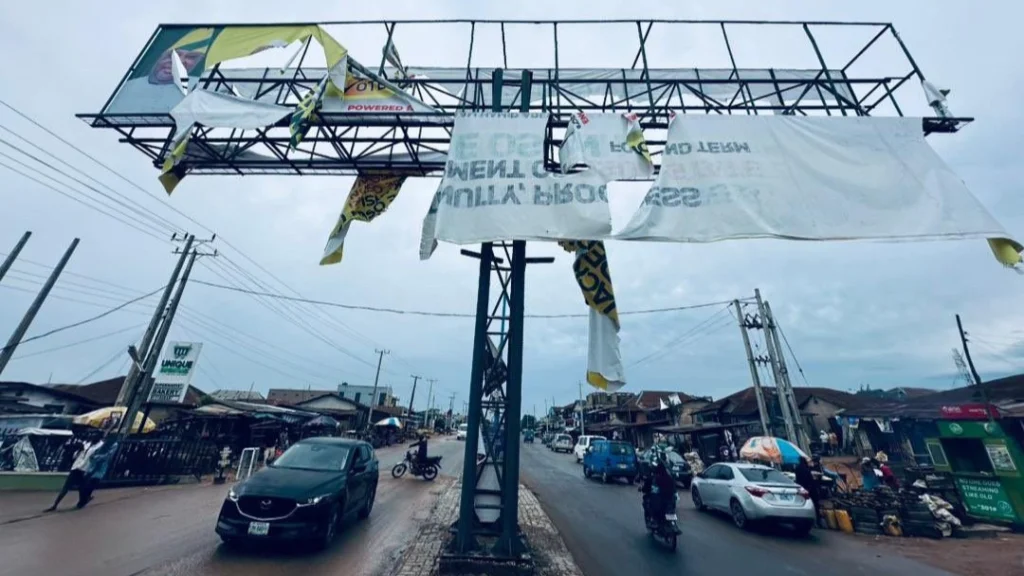
As campaigns intensify across the country, security agencies like the Lagos State Police Command have warned that anyone caught vandalising political materials will face immediate arrest and prosecution. Tearing down billboards can lead to heavy fines, arrest, and jail time.
Indeed, the destruction, defacing, and removal of campaign posters and billboards are all punishable electoral offences under Nigerian law.
However, reports of billboard and campaign poster vandalism have surged across Nigeria, especially in parts of the North as citizens express their anger over the prevailing hardship, hunger and deplorable state of the economy, with political actors ramping up preparations for the 2027 general elections.
Opposition parties, civil society figures, and local advertising regulatory bodies have raised the alarm over the deliberate destruction of campaign materials, which many view as a tactic to suppress political rivals.
For instance, in Edo State, opposition parties at a recent INEC stakeholders’ forum in Benin City, condemned the systematic destruction of their billboards and campaign materials. They called on security agencies to protect all parties equally.
In Rivers State, the Nigeria Democratic Congress (NDC) reported the brazen destruction of a campaign billboard featuring its presidential candidate, Peter Obi and Rivers politician Dumo Lulu-Briggs, near the Port Harcourt International Airport.
The Dumo Lulu-Briggs Campaign Organisation attributed the act to entrenched anti-democratic forces trying to intimidate the opposition.
In Kano State, the outbreak of public anger, driven by economic frustrations, led groups of youths to tear down and dismantle massive campaign billboards promoting President Bola Tinubu for re-election in 2027.
In Kogi State, following reports of attacks on political campaign materials, the Kogi State Signage and Advertisement Agency (KOSSAA) issued a formal warning against the destruction of billboards.
This followed a violent encounter where an African Democratic Congress (ADC) senatorial candidate’s campaign vehicles and materials were attacked. In Delta State, the NDC issued public warnings in communities like Onicha-Uku after their campaign banners were torn down, stating they would not tolerate further destruction of their campaign materials.
Also in Lagos State, high-profile politicians, including former governorship candidate, Gbadebo Rhodes-Vivour (GRV), noted that their campaign banners were systematically taken down within days of being erected, highlighting a broader institutional hurdle regarding who controls public advertising spaces.
The threat of vandalism has grown severe enough that security personnel have reportedly been deployed in states like Kaduna to physically guard campaign billboards featuring President Tinubu and Governor Uba Sani.
This move attracted criticism from human rights advocates like Chidi Odinkalu, who argued that authorities are expending more energy protecting political advertisements than safeguarding local communities from insecurity.
In tandem with physical vandalism, opposition parties argue that incumbent state governments are using state signage agencies to effectively “vandalise” their visibility legally.
By imposing exorbitant political advertising fees, such as a ₦200 million fee introduced in Abia State and demanding rigid compliance under threat of immediate removal, multiple states are making it financially impossible for non-ruling parties to maintain a public presence ahead of the 2027 polls.
Civil society groups, the Nigerian Institute of Public Relations (NIPR) and media platforms have often emphasised that PVC is the voter’s power. It is the only valid weapon to accept or reject a candidate on election day.
Hence, we urge eligible voters to speak up peacefully. They should use their voices to advocate for their preferred candidates through dialogue, debates, and peaceful community engagement rather than destroying property.
In situations where a campaign billboard or signage is placed or posted in a wrong or prohibited location, such should be reported to the appropriate government agency.
If a campaign poster is placed illegally on a private wall or fence, it should not be torn down by individuals, rather such incidence should be reported to local authorities or the Independent National Electoral Commission (INEC) to handle it officially.
According to reports by the Electoral Institute for Sustainable Democracy in Africa (EISA), damaging campaign materials limits a citizen’s fundamental right to learn about candidates and make an informed choice.
It is our view that citizens should allow campaign posters of opposing candidates to be displayed alongside those of their preferred candidates as this reflects a commitment to democratic tolerance, open public discourse, and the principle that elections are ultimately decided at the ballot box.
In Nigeria, political discourse surrounding elections often involves discussions from various stakeholders on civic responsibility, peaceful campaigning, and the importance of preventing political violence or intimidation.
Many civic education groups, international observers, and INEC emphasise that peaceful coexistence, mutual respect among political supporters, and adherence to the rule of law are essential for a mature and credible electoral process.
Observers note that while tolerance is a democratic ideal, ensuring a fair and peaceful campaign environment requires robust enforcement of electoral laws, institutional oversight, and continuous civic engagement to discourage hostile actions between competing political camps.



