

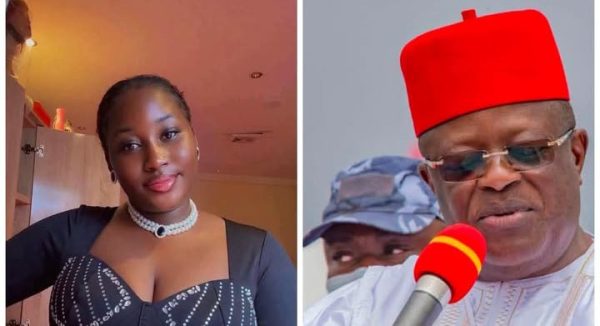
….. Insists autopsy must be conducted to establish cause of death
…… Ebonyi Police Command assures Nigerians that investigators are pursuing every available lead
…… Habila’s family expresses reservations about an autopsy, seeks release of her remains for burial
By Joy Onu
The Minister of Works, Sen. David Umahi, has appealed to Nigerians not to play politics with the death of Mary Habila at his residence in Uburu, Ebonyi State. Umahi made the appeal at a press briefing on Thursday in Abuja.
“If you want to use the unfortunate death of a young girl to play politics; if we had a hand in the killing, it will follow us in our family. But if we don’t have a hand and you are jumping into it, then behold, for everyone using this to play politics, may the death of this girl not be worse than their own. It is annoying when people use other people’s misfortune to play politics,” Umahi said.
The minister rejected allegations of secrecy and called for a thorough police investigation and a forensic autopsy. He also requested that the Inspector-General of Police transfer the case to Abuja in the interest of transparency.
“An autopsy must be conducted to scientifically establish the exact cause of death. It is the most credible and responsible way to resolve questions surrounding the incident,” he said.
Appealing directly to Habila’s parents, Umahi urged them to reconsider their reported opposition to the procedure.
“I’ve been begging the parents to allow autopsy to happen. They say it’s against their culture, but we insisted through our lawyer that the autopsy should happen,” he said.
He said he had formally requested the Inspector-General of Police to transfer the investigation to Abuja, explaining that the move would reinforce public confidence in the outcome while maintaining that he suspected no foul play.
“So, the matter is ongoing. We’ve reported to the IG to transfer the case to Abuja… Let them beg the family to do autopsy,” he said.
Umahi described Habila as one of the most dedicated members of his medical team and corrected reports that described her as a physiotherapist.
“One information I want to correct is that the lady in question was like a daughter to me. She had stayed with me for three years. She was a staff of the Federal Medical University. She was a nurse and not a physiotherapist. The family and my family are like one family,” he said.
Umahi said Habila had spoken with her boyfriend shortly before her death and reportedly complained of bleeding from the nose. He said the boyfriend later made repeated attempts to reach her without success, adding that investigators had been requested to examine the telephone records as part of efforts to reconstruct the events preceding her death.
According to Umahi, every possible effort was made to save Habila after she was found unconscious. “They broke the girl’s door, called doctors who took her to hospital and did everything to revive her but failed.”
The minister’s media office also maintained that Umahi had consistently advocated a scientific approach to resolving the questions surrounding Habila’s death.
In a statement, the minister’s Senior Special Assistant on Media, Francis Nwaze, said Umahi personally received Habila’s parents after her death, conveyed his sincere condolences and advised that a forensic examination be conducted.
“Following confirmation of Miss Habila’s passing, the Honourable Minister personally received her parents, conveyed his sincere condolences, and advised that an autopsy be conducted to scientifically establish the exact cause of death. At the time, however, the family declined the recommendation,” Nwaze said.
He added that the minister had remained unwavering in his position that the circumstances surrounding Habila’s death should be thoroughly investigated.
“The Honourable Minister has consistently expressed his desire that the root cause of the unfortunate passing of Miss Mary Habila be thoroughly investigated and established,” he stated.
The minister’s legal representatives, Roy & Associates, reinforced that position in a petition addressed to the Commissioner of Police in Ebonyi State, urging that Habila’s remains should not be released for burial until a forensic autopsy had been completed.
According to the petition, releasing the body before a post-mortem examination could undermine efforts to determine the actual cause of death and weaken the integrity of the investigation. The law firm argued that a forensic examination remained the most reliable means of establishing the facts while preserving the integrity of the investigation.
The differing positions of investigators and the family have since become one of the defining issues in the case.
While many sympathise with the family’s cultural and emotional concerns, others argue that the circumstances surrounding Habila’s death demand an independent forensic examination capable of answering lingering questions and dispelling speculation.
For legal experts and criminal investigators, autopsies often play a crucial role in determining the medical cause of death, particularly where the circumstances are unclear or have attracted significant public interest. In cases involving public officials or institutions, forensic findings can also strengthen public confidence by ensuring that conclusions are based on verifiable scientific evidence rather than conjecture.
Although police commenced investigations immediately after the incident, the case drew nationwide attention in early July after media reports brought it into public focus, triggering widespread public interest and intense scrutiny.
Responding to the growing attention, the Ebonyi State Police Command assured Nigerians that investigators were pursuing every available lead.
“The Ebonyi State Police Command has commenced a comprehensive investigation into the incident and transferred the matter to the State Criminal Investigation Department for thorough investigation,” SP Joshua Ukandu, the Police Spokesman,said.
He said detectives had visited the scene, obtained statements from relevant persons and were preparing to engage the services of a pathologist to conduct a post-mortem examination aimed at establishing the exact cause of death.
Ukandu assured Nigerians that the investigation would be guided solely by evidence. “We assure the public that the investigation will be conducted in a thorough, transparent and impartial manner.”
As the investigation progressed, another dimension of the case emerged with the reported position of Habila’s family on the proposed forensic examination, introducing a new layer of complexity to an inquiry already under intense public scrutiny.
According to the Ebonyi State Police Command, members of the family expressed reservations about an autopsy and sought the release of Habila’s remains for burial. Investigators, however, maintained that the examination was necessary to establish the exact cause and circumstances of her death.
The Police spokesman said the command was awaiting the cooperation of the family to enable the process to move forward.
“The family of the deceased has expressed opposition to an autopsy, but the command considers the examination necessary due to the circumstances surrounding the case. The command therefore awaits the attendance of the family or their duly appointed representative, as their presence is essential,” he said.
The Ebonyi State Police Command confirmed that Habila, 26, a nurse attached to the David Umahi Federal University of Medical Sciences, Uburu, was part of the minister’s medical team.
The police said they received a distress report on June 27, 2026, from the Divisional Police Officer in Ohaozara that Habila had been taken to the David Umahi Federal University Teaching Hospital Uburu.
Ukandu said hospital authorities informed officers that she had been brought in dead, prompting the Commissioner of Police to immediately transfer the matter to the State Criminal Investigation Department for a full-scale investigation.
Preliminary police findings indicated that Habila and another female member of the minister’s medical team travelled with Umahi to Uburu and were accommodated in a staff building located within his residence.
The minister’s legal representatives clarified that the building served strictly as staff accommodation and that Umahi did not reside in the same facility. They also stated that Habila and another female member of the medical team occupied the building on the night of the incident.
Beyond the immediate investigation, the case has ignited a broader conversation about transparency in the management of sensitive cases involving senior government officials. Although no evidence has been made public linking the minister or any member of his staff to wrongdoing, the status of those connected to the case has intensified demands for openness and accountability throughout the investigative process.
The police have repeatedly assured Nigerians that the inquiry will be conducted professionally and without bias, while the minister has publicly stated that he welcomes a thorough investigation and supports every lawful step necessary to establish the truth.
For now, the investigation continues, with the exact cause of Habila’s death yet to be determined. Investigators have identified a forensic examination as a critical step toward establishing the facts and bringing clarity to the circumstances surrounding the incident, a position that has also been consistently supported by the Minister of Works, Senator David Umahi.
Until the investigation is concluded, Habila’s death will remain more than a personal tragedy. It has become a test of Nigeria’s ability to ensure that sensitive, high-profile cases are resolved through evidence rather than speculation. A transparent and impartial investigation is essential not only to establish the facts and provide answers for the deceased’s family, but also to ensure that public office holders are neither unfairly judged because of the offices they occupy nor shielded from accountability where the evidence so warrants.



