

By Akudiang Comfort, Jos
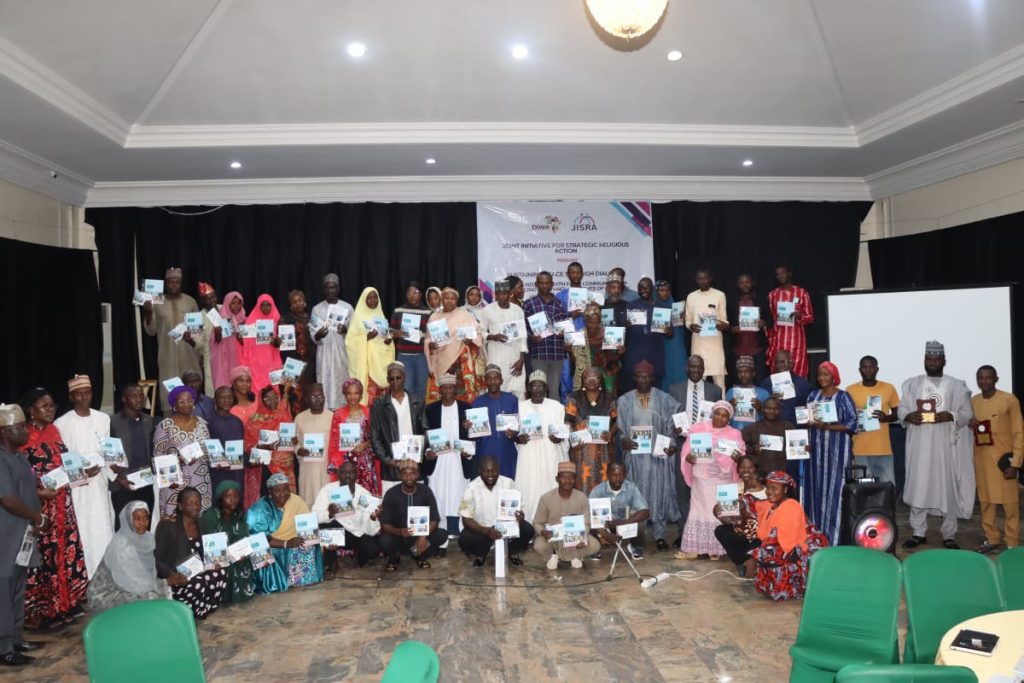
Calls for peace, tolerance, and unity echoed strongly as the Joint Initiative for Strategic Religious Action (JISRA), in collaboration with the Development Initiative of West Africa (DIWA), hosted a high-level roundtable in Jos to advance freedom of religion or belief (FoRB) and the rights of minority groups in Nigeria.
The event, held on August 26, 2025, at Novel Suites & Resorts, Rayfield, Jos, Plateau State, was themed “Sustaining Peace Through Dialogue: A Roundtable with Faith Communities on Advancing Freedom of Religion or Belief (FoRB) and the Rights of Minority Groups in Nigeria.” It brought together faith leaders, traditional rulers, government officials, civil society groups, journalists, women, and youth leaders from Bokkos, Barkin Ladi, Bassa, Jos North, and communities including Daffo, Kwatas, and Sabon Layi.
Delivering opening remarks on behalf of DIWA’s Chief Executive Officer, Project Officer Habila Mohammed Kudu described peace as “a bridge between what JISRA has achieved and what our communities must now own.” He stressed that peace cannot be outsourced nor left to chance but must be nurtured intentionally, protected collectively, and sustained through dialogue.
Kudu outlined three purposes of the roundtable: to provide a safe and inclusive platform for honest reflection on FoRB and minority rights; to document and celebrate success stories from JISRA’s peacebuilding work; and to design sustainability structures, including a proposed Multi-Faith FoRB & Minority Rights Working Group and a guiding communiqué for future advocacy.
“Yet, beyond these objectives, this gathering is about something far deeper: it is about hope,” Kudu declared. “Hope that leaders will strengthen legal and policy frameworks to protect all Nigerians. Hope that the media will amplify voices of peace rather than narratives of fear. Hope that dialogue becomes part of our everyday interactions — in town halls, mosques, churches, schools, and community spaces.”
Nafisat Abdulazeez of the Crest Center for Peace and Social Advancement (CCPSA) emphasized that peace must be community-owned. “Not even the UN can bring peace to a community that doesn’t want it,” she said, urging elders to model peaceful coexistence for younger generations.
Executive Director of the Victor Dielat Memorial Foundation, Jumai Danuk Tadi, recalled her childhood memories of Christians and Muslims living peacefully side by side. “Development does not come without peace, and progress cannot exist without peace,” she said, stressing the need to preserve JISRA’s legacy.
General Secretary of TEKAN, Rev. Augustine Akawu, challenged participants to extend the dialogue beyond the conference hall. “Where there is peace, tremendous achievements are possible. In its absence, there is only destruction,” he warned.
Representing the NUJ Correspondents Chapel, journalist Lola Fadile Bello reaffirmed the media’s role in promoting harmony, highlighting peace summits, training programmes, and advocacy efforts by journalists. “Today, the media is more than a source of information. It is a platform for dialogue, understanding, and unity,” she said.
Community voices added weight to the discussions. Mallam Zayanu cited women’s empowerment, youth engagement, and the creation of a community farm as lasting benefits of JISRA. “This peace will remain a legacy forever. By God’s grace, we will never return to the past,” he said. Malama Fatima and Mary John from Gindin Akwati also praised the initiative, calling for greater women’s participation in peacebuilding.
Delivering a goodwill message on behalf of the Plateau State Commissioner for Women Affairs and Social Development, Caroline Dafur, the Director of Planning, Research and Statistics, Mr. Dombin, said peace could not be achieved without women’s involvement. He disclosed that the state had defended a N2 billion budget for 2026 to tackle gender-based violence and empower women, while paying a N250 billion counterpart fund with the World Bank to train 15,000 women in two phases. He added that the Commissioner had requested the programme’s expansion to Crisis Local Government to reach more vulnerable groups.
In his keynote address, the Chief Imam of Jos, Sheikh Ghazali Ismail Adam, described dialogue as a vital tool for sustaining peace. He listed trust-building, inclusivity for women and minority groups, and respect for differences as core principles, noting that since 2021 JISRA, led by DIWA, had helped to reduce religious tensions in Kaduna and Plateau States.
Launched in 2021 and winding down in August 2025, JISRA was widely praised at the forum for transforming interfaith relations in Plateau. The roundtable concluded with the adoption of a communiqué from the Women’s Summit on FoRB and Peacebuilding in Nigeria 2024, which called for inclusivity, stronger legal protections for minority rights, and community-driven dialogue mechanisms.



