

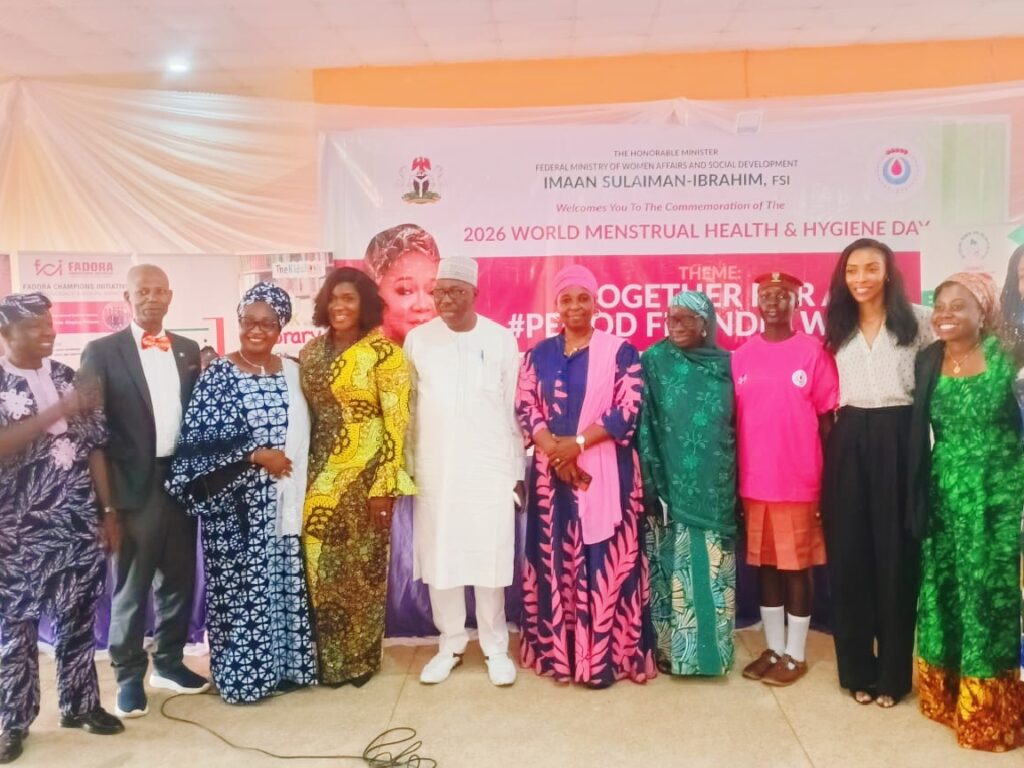
The Federal Government has called for a collaborative approach involving governments at all levels and society to improve menstrual health and hygiene for girls across the country and promote menstrual dignity as a key component of education, public health and human rights.
The Minister of Women Affairs and Social Development, Hajiya Imaan Sulaiman-Ibrahim, made the call on Tuesday at an event to mark the 2026 World Menstrual Hygiene Day celebration at the Federal Government Girls’ College, Bwari, Abuja, in collaboration with PSI Nigeria, Plan International and other development partners.
Sulaiman-Ibrahim, represented by the Director of Child Development in the ministry, Mr. Andrew Madugu, said that menstruation should never be a source of shame, exclusion or missed opportunities for girls.
She noted that although menstruation is a natural biological process experienced by an estimated 1.8 billion girls and women globally, millions of Nigerian girls continue to face challenges including stigma, inadequate sanitation facilities, poor access to sanitary products and school absenteeism.
She highlighted the Federal Government’s efforts to address these challenges through the development and launch of Nigeria’s first National Policy and Implementation Strategy on Menstrual Health and Hygiene Management, designed to provide a coordinated framework for education, access to menstrual products, improved infrastructure, and stigma reduction.
According to the Minister, the ministry is also strengthening menstrual health education, expanding access to affordable hygiene products, improving Water, Sanitation and Hygiene (WASH) facilities in schools, and promoting advocacy to ensure menstrual dignity is integrated into the nation’s education and healthcare systems.
She further disclosed that under President Bola Ahmed Tinubu’s Renewed Hope Agenda, the Renewed Hope Social Impact Intervention (RHSII-774) is being implemented across the 774 local government areas of the country to enhance social protection, education, healthcare, nutrition, and support for vulnerable groups.
A major component of the intervention, she explained, is the establishment of Pad Banks in schools to guarantee that no girl is forced to miss classes because of a lack of sanitary products.
Describing the initiative as “dignity infrastructure,” the Minister said the programme aims to ensure that girls remain in school and participate fully in learning activities regardless of their menstrual status.
The Permanent Secretary, Federal Ministry of Education, Mr. Abel Olumuyiwa Enitan, represented by the Principal of Federal Government Girls’ College, Bwari, Mrs. Gladys Ibrahim, said menstrual hygiene management remains essential to girls’ educational attainment.
He noted that inadequate information, limited access to sanitary products, poor sanitation facilities, and persistent misconceptions about menstruation continue to affect school attendance, participation, and academic performance among girls.
The Permanent Secretary reaffirmed the ministry’s commitment to creating safe, inclusive, and supportive learning environments through school health programmes, policy initiatives, advocacy, and partnerships.
Senior Programme Manager of PSI Nigeria, Mrs. Winifred Kwaknat, said the organisation’s menstrual health interventions across seven states and 24 local government areas had demonstrated the importance of collective action in breaking menstrual stigma and increasing awareness.
She explained that PSI Nigeria’s programmes have brought together schools, health facilities, community champions, pad producers, media organisations, and government institutions to improve menstrual health outcomes for girls and women.
Mrs. Kwaknat also cited innovative initiatives including menstrual health-themed songs in local languages, storytelling platforms, and audiovisual tools that are helping to create safe spaces for conversations around menstruation while building confidence and leadership among adolescent girls.



