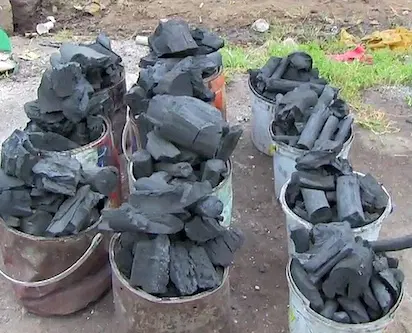
The Federal Government has raised concerns about the adverse effects of the charcoal trade on forest sustainability and livelihoods in the country.
The Permanent Secretary, Ecological Project Office (EPO), Office of the Secretary to the Federal Government, Dr. Aishetu Ndayako, said this at the opening of a one-day stakeholders’ dialogue on charcoal production and forest conservation. She called for strengthened regulation of the charcoal trade for forest sustainability.
The event, organized by the Centre for Renewable Energy and Action on Climate Change (CREACC-NG) and supported by EkoEnergy, was themed: “Trade and Trees—Rethinking Charcoal Production and the Vanishing Forests.”
Ndayako, who spoke on the topic, “Charcoal Trade, Forest Loss, and Ecological Challenges in Nigeria,” said that the largely informal and weakly regulated trade has led to devastating environmental consequences, including deforestation, ecosystem collapse, and biodiversity loss.
“The paradox is that charcoal remains a significant source of household energy for millions of Nigerians, particularly in rural and peri-urban communities,” she said. “With over 70% of our population depending on biomass for cooking, the demand for charcoal has grown exponentially, both for domestic use and as an export commodity. Trees are felled indiscriminately, and entire ecosystems are degraded with minimal efforts at regeneration. Forests, which serve as our carbon sinks, biodiversity reservoirs, and cultural heritage, are under siege.”
She highlighted some strategic shifts that must be taken to forge a coherent and inclusive response. According to her, there is an urgent need to harmonize national policies on forest and biomass energy, and to empower enforcement agencies to regulate charcoal production and trade effectively.
“Sustainable forestry can only be achieved with the active participation of local communities. We must incentivize tree planting, agroforestry, and community-managed woodlots. Forests must be seen as renewable assets, not disposable resources. We must scale up the transition and access to cleaner energy sources such as LPG, ethanol, biogas, improved biomass briquettes, and solar cookstoves, particularly in vulnerable rural and peri-urban communities,” she said.
She added that the EPO was committed to providing sustainable solutions to Nigeria’s ecological concerns and supported dialogues that bring together key stakeholders to forge a coherent and inclusive response to the charcoal trade and forest degradation.
The Minister of State for Education, Prof. Suwaiba Ahmad, said that forests were vital to the planet’s health, as they absorb carbon dioxide, regulate the climate, and support rich biodiversity in Nigeria. Represented by Mrs. Aminulai Modupe, Assistant Director of the Environmental Science Education Technology and Science Education Department, Ahmad emphasized the need to integrate environmental education into the national curriculum. She said that it would raise a generation that values conservation and understands the environmental cost of unsustainable practices.
The minister said that beyond basic and secondary education, the ministry had launched the Diaspora Bridge Initiative aimed at strengthening research and collaboration across tertiary institutions, including Science, Technology, Engineering and Mathematics-Medical (STEM-M). She called on stakeholders to support community workshops and outreach initiatives that promote charcoal production techniques.
“Students are learning about tree life cycles, biodiversity, and the importance of sustainability from an early age,” Ahmad said.
Earlier, the Executive Director of CREACC-NG, Usman Muhammad, said that as the largest producer of charcoal in Africa and the second-largest globally, Nigeria faced significant environmental challenges. According to him, there is an alarming rate of deforestation and tree cover loss, especially in the Savannah woodlands of Niger, Taraba, Benue, Kwara, and Kogi States.
He said that 1.5 million trees are lost every day, contributing to a 3.5% deforestation rate annually. “This leads to significant CO2 emissions, biodiversity loss, drought, land degradation, desertification, and health issues from inefficient production methods,” he said.