

BY JENNIFER EZIMAKOR
In a major push to transform food systems and boost agricultural productivity, the Federal Government has committed $538.05 million to establish Special Agro-Industrial Processing Zones (SAPZ) across Nigeria.
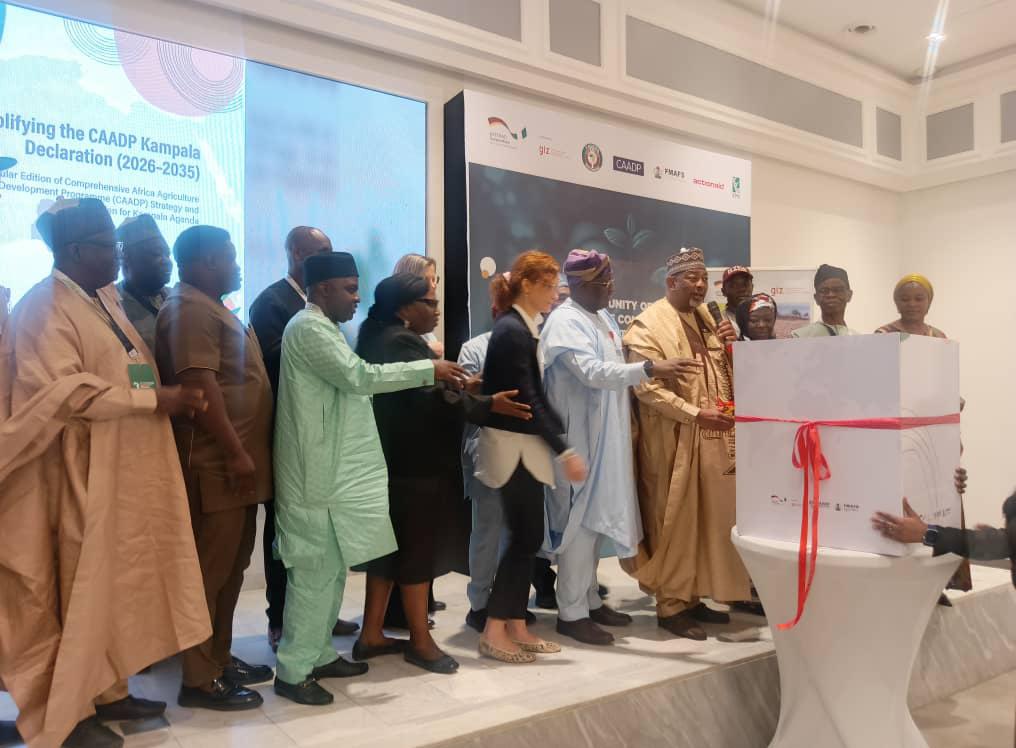
The Minister of Agriculture and Food Security, Abubakar Kyari, announced the investment on Monday in Abuja at the Community of Practice Summit on the Comprehensive Africa Agriculture Development Programme.
He explained that the initiative is part of a broader strategy to make Nigeria’s food systems more productive, resilient, inclusive, and sustainable.
Under the plan, SAPZ projects have already been launched in Kaduna, Cross River, and Ogun States, with more expected to follow. The zones are designed to drive value addition, create jobs, strengthen value chains, and enhance food security.
“Under this project, the country has committed substantial investments of $538.05 million, leveraging the private sector in the establishment of industrial hubs and agricultural transformation centres. The zones are projected to stimulate a total of $1 billion in investments by 2027,” Kyari said.
He added that the government has also provided 2,000 tractors and related equipment to support farmers. An Agricultural Sector Working Group has been set up to bring together research institutions, development partners, the private sector, and civil society to track progress and promote accountability.
Speaking on Nigeria’s Postharvest Systems Transformation Programme, recently presented at the African Food Systems Summit in Dakar, Kyari said the initiative aims to reduce post-harvest losses estimated at ₦3.5 trillion annually, improve value chains, and secure national food sovereignty.
He stressed that the outcome of these investments will create a more efficient and equitable food system, improve farmers’ incomes, reduce waste, and support economic growth.
Development partners also expressed support for Nigeria’s efforts. Dr Karin Jansen, Head of Development Cooperation at the German Development Cooperation, said their Sustainable Agricultural Systems and Policies project is working to strengthen agricultural transformation in nine African and Asian countries.
“It promotes the scaling up of local innovations, embedding successful practices into national and regional policies to bridge local priorities with global agendas and reinforce reform processes,” she said.
Jansen added that Germany has reaffirmed its cooperation with the African Union on CAADP and the Kampala Agenda, providing additional funding, technical expertise, and coordination with other partners to support food system reforms.
Civil society groups also pledged support. Rosemary Effiong, Chairperson of the Coalition of NGOs in Agriculture and Sustainable Development, said stakeholders remain committed to working with government and partners to build capacity, promote sustainable farming, and advocate for stronger agricultural budgets.
She urged increased investment in rural infrastructure, credit access for women and youth, climate-resilient practices, research, and open data systems. She also called for the integration of non-state actors in policy implementation and monitoring, and for the domestication of CAADP commitments across all states.
Effiong emphasised that effective collaboration, adequate funding, and inclusive policies will be key to building a resilient agricultural sector and achieving national food security.



