

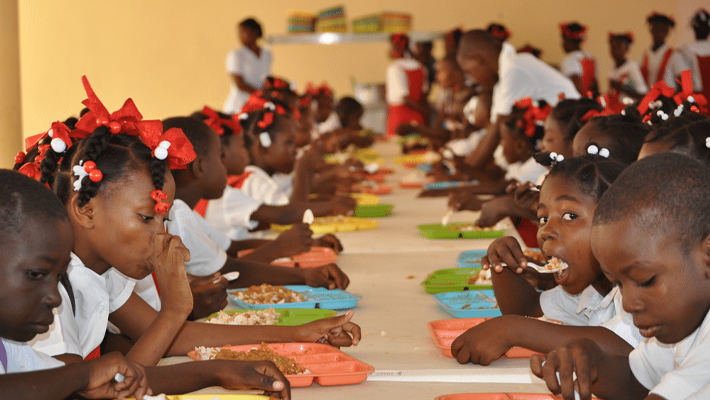
The Federal Government has said that it plans to expand the National Home-Grown School Feeding Programme to cover 50 million primary school pupils by 2026.
The National Programme Manager of the National Social Investment Programme Agency (NSIPA), Aderemi Adebowale, disclosed this in Abuja during an interview with the News Agency of Nigeria (NAN).
She explained that the expansion would extend the initiative to children in primary one through six, as well as out-of-school children, who are being gradually integrated.
“So, by the year 2026, we are looking at feeding close to 50 million pupils in primary school in Nigeria,” Adebowale said.
On cost, she noted that a daily meal should fall between ₦500 and ₦1,000 per child. “Even at ₦500 per child, you should be able to still give the children a nutritious and delicious meal on a daily basis,” she added.
Adebowale said the agency was working with smallholder farmers, aggregators, and development partners to stabilise food prices.
“With this alignment, we’ll be able to control prices from the rock bottom. We are not going to be doing market prices,” she said.
According to her, agreed prices would be set with suppliers, agri-vendors and farmers, followed by a strict monitoring of payments and service delivery.
The latest plan builds on the government’s Alternate Education and Renewed Hope National Home-Grown School Feeding Project, launched on May 27, 2025, in Abuja. The programme, inaugurated by former Minister of Humanitarian Affairs and Poverty Reduction, Prof. Nentawe Yilwatda, aims to provide meals for 20 million out-of-school and underserved children by 2026.
Yilwatda, now National Chairman of the All Progressives Congress (APC), had described the scheme as a key component of the NSIPA, rolled out to mark President Bola Tinubu’s second year in office.
The project is being implemented in partnership with the National Commission for Almajiri and Out-of-School Children Education and the National Identity Management Commission.



