
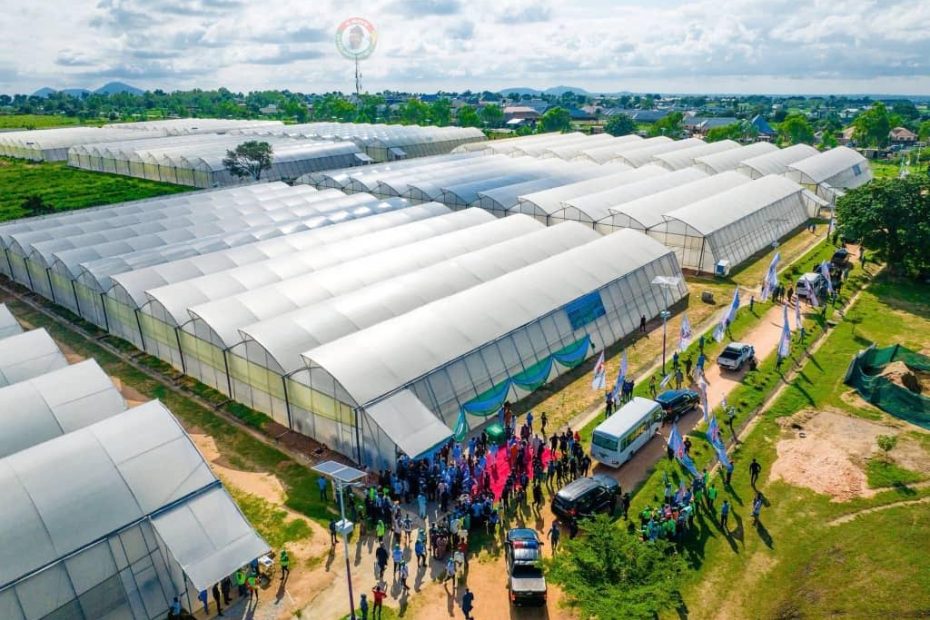
NAHUM SULE, New National Star correspondent in Taraba State, reports on one of the successful projects of Governor Agbu Kefas.
It was a humid afternoon in Jalingo when the gates of the Taraba State University GreenHouse swung open, revealing rows of cucumbers and green peppers thriving in carefully controlled environments. Once abandoned and derelict, the facility — locally known as the “Cucumber Farm” — has been resurrected under Governor Agbu Kefas’s administration, now standing as a living testament to what modern agriculture can accomplish in Nigeria’s northeast.
The Green House is more than a patch of green; it is being framed by state officials as a cornerstone of a food-security push, youth empowerment effort, and proof that innovation can take root even in places previously overlooked.
Governor Kefas, in multiple speeches, has made it clear that agriculture remains central to his vision for Taraba. In presenting the 2024 budget to the State House of Assembly, he emphasised that agriculture will not only be modernised but will serve as a driver for food security and employment. Under Kefas, the greenhouse project has gone from moribund to productive, aided by technical backing, upgraded infrastructure, and a renewed focus on management transparency.
Governor Agbu Kefas, while commissioning the revitalized facility, described the project as “a doorway to opportunity, innovation, and food security for our people.” He said the once-abandoned greenhouse now stands “as proof that with modern technology, we can farm all year round, empower our youths, and make Taraba a hub of agriculture in the North-East”
The governor assured that his administration would provide steady water supply, technical support, and market linkages to keep the project running sustainably, stressing that “our investment in agriculture is not just about feeding Taraba, it is about transforming lives and reducing poverty.”
The management team running the greenhouse includes Navon Gil as Project Manager, Haggai Hochman as Managing Director (of TSI Company Limited), and Pam Jerry Dalyop as Chief Agronomist Ohad Shtilman and Eyal Tal are also named among technical leads associated with TSI. These people have been credited with introducing modern farming techniques such as soil-less (compost-based) cultivation, automated or sensor-assisted irrigation systems, temperature control, and packaging infrastructure.
In July 2025, following these reforms, the greenhouse marked its first major harvest since the revival: green pepper and cucumber in substantial quantities. The project manager, Navon Gil, during tour visit by selected journalists, said, “A new day has indeed arrived for greenhouse farming in Taraba.” He emphasized that the bumper harvest confirms the viability and global competitiveness of their farming technology.
When our correspondent interviewed local market women and traders, they said changes are visible. “Before, tomatoes and peppers were out-of-state in the off-season; now we get fresh produce in Jalingo markets, and prices are steadier,” a trader said.
For them, having a Green House reduces wastage, improves quality, and means less dependency on long supply chains. Women especially report improved incomes as demand rises for the greenhouse produce.
Nonetheless, community voices also stressed caution. Some recall how, under the previous administration, the greenhouse lay idle; staff were disengaged; youth employment fell away. The feeling among many was that this time, the project must be sustained. “If you start strong and let it collapse again, the hope dies with people’s patience,” one community member was quoted saying in earlier coverage.
Governor Kefas has addressed such concerns. In his speeches and public statements, he has pledged continuous support for infrastructure — reliable water supply, ongoing maintenance, training programmes for young farmers, and open markets for the harvest.
In particular, during ACReSAL Day in March 2025, he reasserted his administration’s commitment to climate-smart agriculture, forging partnerships to provide inputs, equipment, and financial support to farmers, as part of wider resilience efforts.
Technically, the greenhouse employs a soil-less cultivation system, where compost or other growing media replace traditional soil beds—this reduces problems with soil borne pests and variability. Also, a reservoir and automated irrigation help moderate the water supply and ensure plants are watered when needed without overuse or wastage.
Economically, the prospects are promising. If fully operational, the facility can stabilize vegetable supply in Taraba State and beyond, reducing seasonal price spikes, lowering import pressure, and generating income for farmers, traders, and the state itself. The Green House’s produce is already drawing attention from buyers both locally and from major cities, keen on fresh, high-quality vegetables.
Navon Gil, Project Manager, told this paper: “A new day has indeed arrived for greenhouse farming in Taraba.”
Emmanuel Bello, Special Adviser to Governor Kefas on Media and Publicity, said that “The world-class technology here guarantees all-year cultivation of vegetables, regardless of weather conditions.”
But challenges remain. Water supply must be reliable; power for climate control must be maintained; operational costs can be high; skilled technical staff must be continually trained; and markets must be secured. Even the soil-less systems, while promising, require inputs and oversight. Some locals wonder whether the cost of maintaining the facility will be borne for long or whether political shifts might threaten its continuity.
Still, for many in Jalingo, the revived Green House is more than a crop farm — it’s a symbol. It shows what careful investment, political will, and technical partnership can achieve. It suggests that with the right mix of modern farming, resilience planning, and community engagement, Taraba State might not just feed itself, but supply others, build livelihoods, and anchor a more stable, secure food future.