

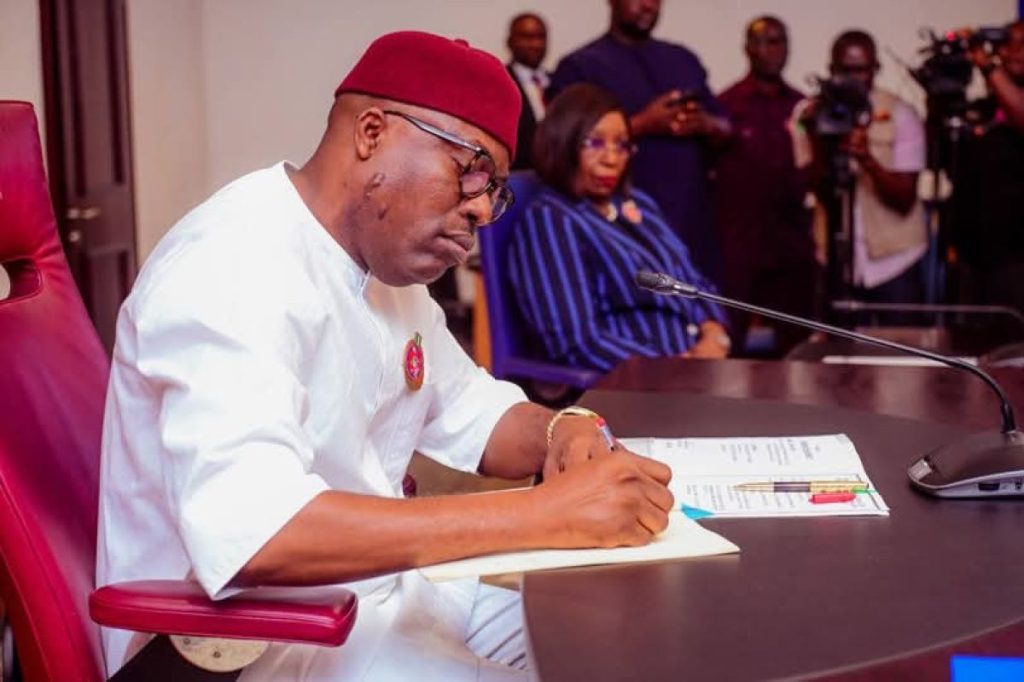
*As Ibas represents amended budget
BY JOHN DANJUMA
As clamour for his reinstatement heightens, the Nigerian Senate on Thursday, made a shocking revelation that about 85 percent of the N1.48 trillion 2025 budget submitted by the Sole Administrator of Rivers State, Vice Admiral Ibok-Ete Ibas (rtd), was originally drafted by suspended Governor Siminalayi Fubara.
It would be recalled that the suspended governor has commenced the implementation of the 2025 appropriation budget, which was passed by a factional State House of Assembly, following his controversial decision not to recognise the former Amaewhule-led assembly. This was before his suspension by President Bola Tinubu, following the violence that trailed the Supreme Court ruling.
The budget defence, the first major legislative interrogation since the emergency rule was declared earlier this year, took place before the Senate Ad Hoc Committee on Emergency Rule Oversight.
Vice Admiral Ibas described the budget as a “people-first, post-crisis framework” designed to stabilise governance, restore public trust, and drive inclusive development following months of political unrest in the oil-rich state.
“This is not business as usual,” the Administrator said. “The 2025 budget is crafted to address insecurity, fix broken systems, and lay the foundation for lasting peace and inclusive prosperity.”
According to Ibas, 85% of the budget was inherited from the previous administration but revised upward by 15% to accommodate three urgent priorities, such as Clearing N50 billion in pension and gratuity arrears, Funding emergency security and peacebuilding efforts and legally integrating first-quarter spending incurred before emergency rule was declared.
These additions, according to him, brought the total proposed expenditure to N1.846 trillion, up from N793.5 billion in 2024.
The budget allocates N1.072 trillion (72.4%) to capital projects—an unusually high ratio for state budgets—with just N408.4 billion (27.5%) for recurrent expenditure, and minimal funds assigned to overheads.
Major allocations included N324.5bn for roads, bridges, and transport infrastructure, N55bn for the upgrade of Rivers State University Teaching Hospital, N30bn for secondary schools, N5.75bn for primary school rehabilitation and N38.85bn for shoreline protection and erosion control.
Others included N10bn for food security and agricultural support, N50bn to clear pension liabilities, N20bn to recapitalise Rivers Microfinance Bank for MSME development, N3bn for a youth innovation center and N2.5bn for women’s economic empowerment initiatives
The Administrator stressed that the focus goes beyond physical infrastructure.
“This budget is about dignity—about retirees who’ve served and deserve their entitlements, about safe access for farmers, and opportunities for young people,” he said.
The proposal also provides for the potential restoration of constitutional governance, with legal placeholders for suspended political offices and responsibilities.
To fund the ambitious plan, Rivers State projects: N550bn from the Federation Account (FAAC), N360.46bn from internally generated revenues, N67.6bn from grants and donor aid, N250bn from loans and credit facilities and N220.8bn from the opening balance of prior fiscal operations
The debt component rose modestly from N237 billion in 2024 to N250 billion in 2025, now constituting 16.6% of the total budget. Debt servicing alone is projected at N120.8 billion, a 57.9% increase from the previous year.
Despite concerns, the Senate appeared partly reassured by the state’s 2024 performance, which exceeded revenue expectations by N250 billion (31.6%) and recorded an underspend of N52.7 billion, largely attributed to the governance transition.
Ad Hoc Committee Chairman, Senator Opeyemi Bamidele, commended the clarity and ambition of the budget but issued a strong warning that legislative approval would come with strict and sustained oversight.
Bamidele said, “In the last three weeks, we’ve reviewed this budget in detail and engaged directly with the sole administrator and key members of his team — including the Accountant General, the Permanent Secretary of Finance, the Budget Director, and the Planning Director — all of whom retained their positions after the emergency rule began.
“Our findings show that at least 85 per cent of the submitted estimates were drawn up under the Fubara administration.
“Only 15 percent was added by the current administrator to accommodate new projects.”
The committee also revealed that Ibas has requested a N50 billion supplementary budget to address outstanding pensions and gratuities — a move the Senate is now considering.
“Part of the urgent need is to inject N50 billion to settle pension liabilities and enhance peace in Rivers State.
“The administrator is passionate about it, and we agree — governance is not just about roads and infrastructure. It’s also about ensuring those who have served the state receive their due,” Bamidele said.
He added that over 70 percent of the budget is earmarked for capital projects — a move the Senate described as commendable and urged other states to emulate.
“This shows a clear commitment to development and infrastructure, rather than recurrent expenses,” he said.
Ibas further announced an upward review of the state’s 2025 budget from N1.48 trillion to N1.846 trillion—an increase of approximately N400 billion.
He revealed that the state’s total revenue for 2024 stood at N1.04 trillion, significantly exceeding the budget target of N800.39 billion—a 31.6 percent increase.
“It is my well-considered opinion that the expenditures were clearly understated,” he said.
“We are not rubber-stamping this. We will follow the money, ministry by ministry, project by project. Approval is not the end—it is the beginning of scrutiny,” he said.
He emphasized the importance of translating allocations into real-world outcomes such as functioning hospitals, reliable roads, working schools, and meaningful security.
“When paper figures become visible improvements in people’s lives, then we can talk about restoring trust in governance,” Bamidele added.
While the N1.846 trillion figure is historic, lawmakers and observers agree that the budget’s legacy will be defined by implementation and impact. In a state still recovering from political instability and economic dislocation, the real test lies not in how much is spent—but in how effectively.
If the funds deliver roads, jobs, safety, dignity for pensioners, and empowerment for youth and women, then the Sole Administrator’s budget may well mark a turning point for Rivers State governance in both form and substance.
He acknowledged that the proposal may not be perfect, given the tight timeline and prevailing circumstances under which it was prepared.
Ibas was accompanied by other key officials, including members of the economic team to appear before Senate Ad-Hoc Committee on Emergency Rule in Rivers State.



