

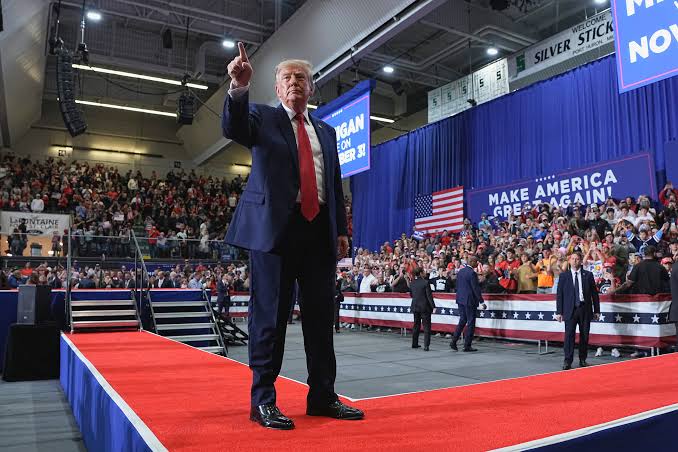
… Democrats win majority seats in both chambers
…. Nigeria could learn valuable lessons from the U.S. mid-term elections – Osuntokun
By Ameh George
The U.S. President Donald Trump and the Republican Party suffered setbacks in the 2026 midterm elections amid growing voter dissatisfaction over rising living costs, economic policies and concerns about government corruption, according to a new Associated Press voter poll.
As reported by the Economic Times on Wednesday, the survey, conducted among voters across all 50 states, found that many Americans were increasingly frustrated with Trump, whose failure to fulfil key campaign promises, particularly his pledge to reduce inflation, reportedly contributed to the Republicans’ poor performance.
The findings suggested that voters believed Trump was more concerned about his personal interests and wealth than addressing the economic challenges facing ordinary Americans.
Rising inflation emerged as one of the major issues influencing voting decisions, with many voters expressing concern about the increasing cost of groceries, healthcare, fuel and other essential expenses.
In Texas, about two in 10 voters said inflation had caused severe financial hardship for their families. Approximately three-quarters of this group supported Democratic Senate candidate James Talarico.
Another six in 10 voters reported moderate financial hardship, with Talarico also winning majority support among them.
A similar pattern was recorded across several states, as voters who expressed serious concerns about everyday expenses largely supported Democratic candidates in their local US House elections.
The poll also found that voters blamed Trump’s economic policies, including tariffs and the failure to deliver on his campaign promise to reduce prices, for worsening economic conditions.
About two-thirds of voters nationwide said Trump’s policies had made the economy worse, while approximately eight in 10 of those voters supported Democratic candidates.
The poll further revealed that government corruption was a major concern for voters, with more than half describing it as crucial to their decision at the polls.
The issue appeared to have overshadowed the cost of living, despite approximately six in 10 voters saying they were very concerned about the rising prices of food and groceries.
Many voters also expressed concerns about Trump’s personal financial interests, including his cryptocurrency ventures, family business dealings and efforts to secure donations from major companies for the construction of a new White House ballroom.
Overall, about two-thirds of voters said Trump did not have the right priorities, with the overwhelming majority of those voters supporting Democratic candidates in House elections.
Another factor identified by the poll was Trump’s influence over Republican candidate selection.
The president endorsed several candidates whose experience, character and close association with him became major issues during their campaigns.
In Texas, Trump backed Attorney General Ken Paxton over incumbent Senator John Cornyn during the Republican primary. However, about two-thirds of voters in the Senate election said Paxton lacked the character required to serve in the Senate.
In North Carolina, approximately six in 10 voters considered Republican Senate candidate Michael Whatley too supportive of Trump, contributing to support for Democratic candidate Roy Cooper.
Trump suggested in an interview with Fox News Channel on Tuesday evening that some Republican candidates struggled because the party’s base did not particularly like his endorsements.
The survey also highlighted widespread concerns about the balance of power in Washington.
About seven in 10 voters said Congress was not doing enough to provide checks and balances on the president, including approximately four in 10 Republicans.
The findings indicated that voters wanted lawmakers to exercise stronger oversight of the executive branch.
“The president’s failure to deliver on key promises, most prominently, his vows to tame inflation, which has worsened instead, clearly weighed on his fellow Republicans in Tuesday’s midterm elections for the House and the Senate.
“The polling shows that voters generally saw Trump as being more focused on his own fortune and gold-leafed existence than their needs,” the survey added.
Despite the Democratic Party’s gains in both chambers of Congress, the poll cautioned that the results did not represent overwhelming support for Democrats.
Only about half of voters expressed a favourable opinion of the Democratic Party, compared with approximately four in 10 who viewed the Republican Party positively.
The findings suggested that many voters were dissatisfied with both political parties but turned to Democratic candidates as an alternative to the Republican leadership.
The AP Voter Poll was conducted by SSRS in partnership with major US media organisations, including ABC News, CBS News, CNN, Fox News Media and NBC News. Interviews with registered voters across the 50 states took place between October 19 and November 3, 2026.
The findings point to inflation, concerns about corruption, dissatisfaction with Trump’s priorities and controversial Republican endorsements as major factors behind the party’s losses in the 2026 midterm elections.
Meanwhile, a former Presidential Political Adviser, Chief Akin Osuntokun, who spoke against the backdrop of the outcome of the U.S Midterm Elections says Nigeria must develop an electoral culture driven by ideology, merit and performance to strengthen democracy
Osuntokun, who served as Political Adviser to former President Olusegun Obasanjo and a former Managing Director of the News Agency of Nigeria (NAN), said Nigeria could learn valuable lessons from the U.S. midterm elections.
He spoke in an interview with journalists in Lagos on Wednesday, against the backdrop of Tuesday’s U.S. mid-term elections in which the Democratic Party regained control of Congress from the ruling Republican Party.
Osuntokun said although the American and Nigerian democratic experiences differed significantly, elections should ideally reflect voters’ assessment of government performance.
He, however, expressed concern that Nigeria’s political environment remained largely driven by ethnic, religious and sectional considerations rather than ideology and performance.
“The American democracy is responsive to ideology and performance in government. Rather than being tribal or sectional, it is more ideological and driven by performance, which is a positive attribute,” he said.
He said: “There is no logical correlation between the two societies in terms of the standard, relevance or understanding of democracy.
“We just hope our own elections will also be determined by the performance of the government. But that is not the reality here.”
The political scientist said Nigeria remained at what he described as the pre-ideological stage of politics, with political parties yet to demonstrate clearly defined ideological positions.
He recalled that former military President, Gen. Ibrahim Babangida, attempted to entrench ideological politics through the Social Democratic Party (SDP) and National Republican Convention (NRC).
According to him, the experiment was truncated by the annulment of the June 12, 1993 presidential election.
“Nigeria is still at what I would call the pre-ideological level of politics. We are not getting to that state.
“Babangida tried to impose it by the SDP and NRC. According to some research, you can say that it succeeded. But then the whole process was wasted with the annulment of the June 12 election,” he said.
Osuntokun said the present multi-party system made a mockery of ideology-driven politics.
He questioned the ideological identity of the country’s major political parties, particularly the All Progressives Congress (APC), saying their labels did not reflect their policies.
He argued that ethnic and religious considerations remained stronger determinants of electoral choices than government performance.
Osuntokun said Nigeria’s inability to achieve substantial national integration remained a fundamental obstacle to the development of ideological politics.
He said meaningful democratic competition would emerge when Nigerians began to prioritise class interests, ideological positions and governance outcomes over ethnic affiliations.
The former NAN boss also identified centralisation of political and economic powers as a major factor fuelling ethnic competition for control of the Federal Government.
“These are the reasons accountable for the position Nigeria is today. What we have is a competition among the regions to seize the national government and apply it to confer community advantage over their people.
“Unless we go back to decentralisation and devolution, if we don’t do that and all the powers are centralised, that in itself provokes inter-ethnic competition,” he said.
Osuntokun further argued that the country’s electoral challenges were rooted partly in longstanding controversies surrounding population figures and voter registration.
He questioned the reliability of Nigeria’s population and voter registration figures, arguing that weaknesses in the census process could undermine confidence in electoral statistics.
The politician recalled controversies surrounding the 1952 and 1962 population censuses which generated disagreements over population distribution between northern and southern Nigeria.
According to him, inflated population figures could translate into questionable voter registration statistics, thereby raising concerns about the credibility of elections.
He, however, clarified that his observations were not directed at the current administration, but reflected longstanding structural problems in Nigeria’s political and electoral system.
On the peaceful conduct and acceptance of results in the U.S. midterms, Osuntokun said Nigeria’s electoral process remained contentious and insufficiently transparent.
He expressed hope that Nigeria would gradually develop an electoral system in which citizens assessed political parties and candidates based on their records and policy commitments.
The politician said such a development would strengthen democratic accountability and encourage political leaders to prioritise effective governance.



