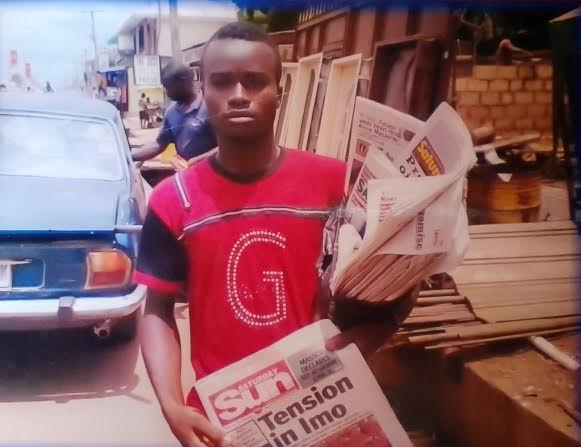
Before he could attend a tertiary institution, Lawrence Nwimo, an Anambra-based journalist, worked as a newspaper vendor for 12 years. In this interview with Chinedum Elekwachi, our correspondent, the Master’s Degree student of the Nnamdi Azikiwe University, Awka, shares his experience and how he found himself in the media industry. Excerpts:
What informed your decision to quit newspaper vending for journalism?
My becoming a journalist was more of passion. I started journalism practice as an undergraduate. I didn’t even know I’ll eventually become a full-fledged journalist. I studied Library and Information Technology at the Federal College of Education (Technical) Umunze, affiliated with Nnamdi Azikiwe University, Awka. While in year one, I had a conversation with a friend who asked me what I intended to do after graduation. “Don’t you think this course would not offer you much after all,” he had asked me. I laughed it off then. But on getting home, I gave that question a deeper thought and reasoned on the need to have a plan B in case I later found it difficult to secure a job on graduation. I asked myself what else I have passion for and I knew that it was writing. While in secondary school, I had a long note dedicated to writing essays and articles. I decided to develop my writing skills.
Meanwhile, I was combining my studies with selling newspapers because I lived with a woman popularly called Madam Kon, who was into newspaper sales/circulation. Actually, she trained me from secondary to tertiary level. During my university days, I was shuttling between Awka and Umunze because she insisted I was in Awka every weekend to hawk newspapers on the streets. Since I’m always in possession of newspapers, I developed interest in reading each of them. One day, while flipping through the pages of one of them, I came across an advert seeking reporters in one of the media outfits in the state. I quickly wrote an application and took it to a friend who is in the line of communication. I told him of my interest and he asked if I’m sure it’s something I could do. He also expressed fears of the difficulty I’ll face in sourcing for materials. After convincing him of my capabilities, he promised to link me up with his boss, one Emeka Odogwu to coach me further. He equally assured me of mastering the art with constant practice. One of the things Odogwu told me was that there’s no money in journalism. I replied that my interest was not the money but in learning the job. That same day he gave me an assignment to write a feature on a market in my locality. Before then, I’ve not written any news story, not to talk of features. I took it up as a challenge. It took me up to one month to knock out the features which I titled, “Umunze market, a disaster waiting to happen”. From then on, Odogwu started sending me on assignments and of course, I kept making mistakes until I stabilized. I also covered inaugural lectures and other campus activities. The more I reported those events the more the interest developed. At one point, I was seen as a celebrity in the institution. That was how I gradually mastered the art.
When exactly did you start newspaper vending and how long did you last in the business?
That was 2006 after my primary school. I started from one of the major junctions called Kwata along the Enugu-Onitsha expressway. That was before the flyover was constructed. I sold the paper up till my final year. I stopped selling papers the exact day I wrote my last paper. That was in 2018.
Selling newspapers, especially as an undergraduate can be challenging if not frustrating. How did you cope with the insults, shame and humiliation such menial jobs could bring?
Actually, that was a very big challenge. When I gained admission in 2014, my madam promised to train me on the condition that I continued selling newspapers, but this time with a weekly stipend of N3,000. Though that contract was not signed, she warned that any default would attract withdrawal. For the four years I spent in school, nobody knew I was a newspaper vendor, except a few individuals. I kept dodging anytime I saw my classmates. I felt they would use it against me if they found out. That made me live dual lives. In school, I faced my studies squarely; but at work, my eyes were as sharp as an eagle’s. My securing admission made me change from street hawking to selling at a spot, at least to reduce the number of persons that will see me each day. Though the few people (including my HOD) that saw me were proud of me, I didn’t understand it that way. My solace was that the whole thing will be over one day as I won’t sell papers for eternity. That was why the job terminated on my graduation day. I went to my madam and told her I was done.
How profitable was the vending business?
The business was lucrative then. That was close to the emergence of the internet. But as years passed by, sales and profits started dropping. I had predicted that there won’t be anything like hard copy in the newspaper business by 2018/2020. When I started, a copy of a newspaper was sold for N80 and if you sell a copy, you’re entitled to N20. A vendor could finish 50 copies of SUN, for example before noon. As the prices increased, so did the profit. Though I was entitled to the profit, I retired all to my madam who is responsible for my feeding and upkeep. Newspaper business was so lucrative that many built houses and bought cars with the proceeds. But the trend started changing around 2014-16. I had also expected my madam to reduce my days of business and probably my stipend in view of drop in sales. But she insisted on the sale. Even while in school. There was no weekend I missed sales. I sold full time during holidays.
How did you combine newspaper vending with your academics?
It was really a miracle because if you check my academic records, you won’t believe it was from someone with such distractions. One would think I was a full-time student resident in the hostel. In fact, I was among the best three graduating students in my department. After Friday lectures, I would always leave for Awka to only return to Umunze Sunday night in preparation for Monday lectures. I’m the kind of student that loves studying ahead. I would collect materials from my predecessors, at least three of which I devoted time to study every holiday. Before the resumption of a new semester, I was already good to go.
What’s growing up like that compelled you to work for someone else at that early stage of your life?
I came from a poor, humble background. My dad (now late) was a motorcycle mechanic. There are seven in the family, four girls and three boys, but I’m the first son. After my primary education, two people came to my house, requesting for someone to assist them in their business – one of whom was my Madam. I chose her against the other man because she promised to train me in school. Though she was not specific on the type of assistance I would render to her, as a lover of education I had no option than to accept the offer. From my early days, I was determined to succeed knowing my background.
I remember the ‘Small Boy’ nickname they gave me then because of my age and size. I was faced with the risk of crossing the highway in pursuit of customers with other older colleagues. There was a day a speeding private vehicle from Onitsha nearly ran over me. Actually, my size attracted more patronage from customers. One miracle I won’t forget in a hurry was how God saved me from a fatal accident in 2008, at Kwata junction, that left about 80 persons dead. I was supposed to be around that spot when the incident happened but I went to Amawbia to sell papers that day. I was there when I got the news of the crash. That was how I relocated and remained in Amawbia for some years.
You said you took advantage of possession of the papers to read them. Do you think that contributed to shaping your writing skills as a journalist?
Yes it did. It did not only contribute in shaping my writing skills but venturing into journalism practice. Right from time, I love reading. I remember reading articles of columnists like Funke Egbemode, Dimgba Igwe, Jude Atupulazi and other authors. I consumed every newspaper at my disposal. Though that attitude pitched me against my madam. At times she would scold me for reading instead of giving 100 percent attention to selling the papers. But I didn’t bother. The number of clients that patronized me against my colleagues could be attributed to this. Because most of my customers knew I had knowledge of the content of most papers, they would come to me and ask, “which paper carries better news?” I would advise them on the ones to buy. Same was applicable to those looking for jobs. That gave me an edge over my colleagues whose interests were only in the number of papers they sold.
How many media houses have you worked for and how do you feel being a journalist?
As a campus reporter I contributed to New Telegraph, The Authority and Daily Sun. After graduation, I reported for a community newspaper called Ogene Newspaper based in Ndikelionwu in Orumba North Local Government Area. I also freelanced for Daily Sun before being employed at Orient Daily Newspaper. I’m currently with Ikenga Online and Odogwu blog.
I feel great especially when I compare myself with my contemporaries who see me today as a big man. Journalism has taken me to places and I have enjoyed the company of the high and mighty in society. When I remember all the derogatory names and remarks they made about me then, I feel good. Some of the special recognition I’ve gotten from the profession as well as personalities I’ve met also make me feel on top.
Which of your stories would you rate as your best?
That would be difficult to pick. Apart from my investigative stories, I rate highly one of the reports I did in Aba, titled: “Obohia, a health disaster waiting to happen.” It was my first time visiting Aba with my sick dad during my NYSC, and I seized the opportunity to do that report. I also cherish my report titled: Five Years After Disability Law, PWDS in Anambra Still Denied Inclusion.” It was published last year and it fetched me the first runner-up of the Prof. Stella Okunna Award for Ethical Journalism. They are countless that still give me joy today.
What’s your advice to youths of today who view these menial but lucrative jobs as befitting for them?
When I talk to the youths, I make them appreciate that life is all about what you decide to make of it. Life is all about determination and building blocks. As you’re building, you’re adding knowledge and that makes you stronger. Tracing my life history, you’ll see determination and eagerness to succeed. One peculiar incident I wouldn’t forget hurriedly is a comment by someone to me while hawking the newspaper. He said, “I like the way you’re suffering now so that when money starts coming, you won’t waste it on women.” That statement registered in my mind. Anytime money comes into my hand and the thought of squandering it comes, I’ll remember that comment. While under my madam, we were about seven boys. But I was the only graduate. That tells me that life requires patience. When I see those hawking along the street, I remember my years of struggle. The youths must know that there’s no amount of struggle and suffering that will kill them. But they will rather be toughened by life challenges.
Any regrets in life?
I had intended to be a military officer. I had wanted to attend the Nigerian Defence Academy, NDA. But I wasn’t taken, not because of poor performance, but on quota basis. I knew my chance was good. I scored over 250 in JAMB, but only six people were selected from my state. That was a very big disappointment because I wanted to study something different in the university. This was what led to my studying at Umunze. Instead of wasting an extra year, I decided to go for the course I eventually studied. That’s the only thing I can see as regret in my life. But that doesn’t mean I don’t like the course because I see lots of prospects.