02 May 2023 © Numero Unoma 013/2023
You know what…I totally get it when people like us, and I totally get it when certain other people despise us. By ‘us’, I mean us Nigerians, naturally.
You see, the ones that despise us don’t expect anything better from a bunch of jungle dwelling Africans, than all the intrigue, chicanery, juju and black magic they consume day in day out, courtesy of The Worst of Nollywood. I mean there’s so much base emotion – lust, greed, hate, jealousy, betrayal and murder – it’s almost like…what do you expect from a pig but a grunt?
The other ones, the ones who like us, on the other hand, those ones like the adventure without the risk – I guarantee you they would never book a flight to West Africa to come and see all that Nollywood action for themselves. For them we are akin to a zoo, a menagerie of exotic animals, creatures who have a propensity to be dangerous, but who are restrained and subdued by life sentences of captivity. Our prison in this case being the film frame out of which, none of our larger-than-life characters can leap into their world, with their dramatic cocktails of base humanity.
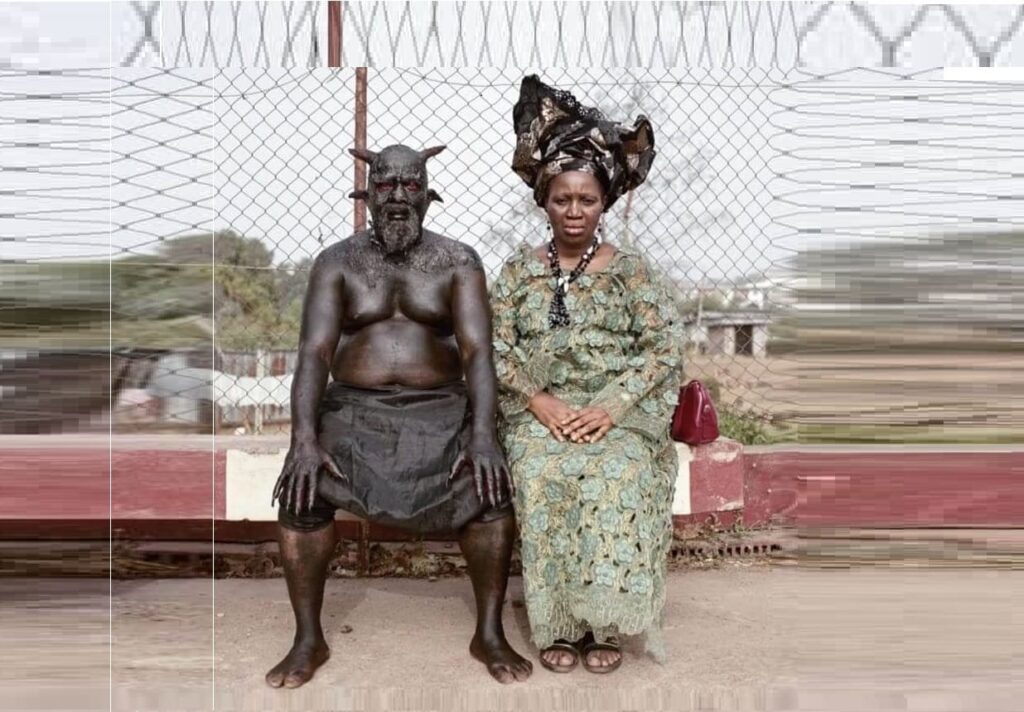
In the late 2000s the South African photographer Pieter Hugo published a coffee table photobook titled “Nollywood”. Many Nigerians were offended by it. Not me, except in one instance. Mostly he managed to capture Nollywood in photo stills by implying the same exaggerated visuals that Nollywood itself so often uses. My only offence with that body of work was his beyond-cliché white gaze, the one that sexualises the black man, whose naked penis he depicted in a full frontal, whereas in a similar photo of himself, the ginger white man, he kept his Y-fronts on. I can hear your comments, stop it already!
I remember finding myself half way up a volcano on a tiny Caribbean island in 2001. We had gone hiking in the forest and had lost our way. We had left at dawn and originally had planned to be back at base for noon, but having lost our bearings, we’d run out of drinking water and it was by now a scorching hot afternoon. We knocked at the door of a little house nestled in the cool shade of mango and breadfruit and banana trees. The home owners invited us in and gave us water to drink. We introduced ourselves and when I said my name you should have heard their exclamation. They recognised it, and they wanted to demonstrate to me how it was that they recognised it, so out came a huge collection of Nollywood DVDs.
There are two ways of looking at the popularity and sheer reach of Nollywood. On the one hand it means revenue and exposure. On the other hand however, what sort of exposure are we talking about? Dem say when breeze blow, fowl nyash go open. What use is exposure if it is actually the see finish breeze that opens the fowl nyash.
Why are so many of the stories ugly and mean and twisted and depraved? Why are so many depictions of our cultures caricaturised? Why are the characters so often loud and disagreeable? Why are the historical stories revisited with so much artistic license that younger generations watching them are misled and misinformed? And WHY….you must be asking yourself…am I being so critical of Nollywood? I’ll tell you one reason why: I once sat at the Tanzanian Consulate on Yedseram Street in Abuja. The Consul and I sat next to each other on a sofa politely insulting each others countries. I had gone to get a visa to attend a friend’s 50th celebration in Zanzibar. My gripe was that Tanzania treated us Nigerians with disrespect, with their ludicrous visa requirements, and I told him I would go spend my money in the equally beautiful Kenya and Zimbabwe before I collect Tanzanian insult. His comeback was that we only had ourselves to blame because the industry for which we are most famous does us no favours whatsoever when it comes to PR. I was almost speechless, but I caught myself, promptly asked him what low quality films he was watching, and made a few recommendations of Nollywood films of which we can be proud. These days Netflix has changed all that. But the proliferation of macabre and sordid storylines still dominates the Nollywood space, causing even our distant relatives in the Caribbean who love Nollywood so much, to require a re-education.
One cannot tell this story without first praising its ascent. Cast your mind back, if you can, to a time when we had returned from the post-Civil-War military governance to our attempts in the early 1980s at democracy again. It was during President Shehu Shagari’s second term that my Bu decided that democracy was not for Nigeria. Yes, I’m talking about the same Buhari who has just managed to dabaru the same Nigeria over the past 8 years with his own brand of democrazy (Can you see the Nollywood factor in there at all?) The economy was debt-ridden and the youth (that was us back in the day, yes) lacked opportunities. But guess what, camcorders were all the rage, and some Igbo boys with their “ife niiine bu afia” mentality (ihe niine bu ahia – everything is market or trade) began to make crudely cobbled-together films and put them out there. And so it was that they created a market that had hitherto not existed. The scripts were rudimentary, the sound and video quality was greatly sub-standard, and the packaging and distribution were baseline.
The thing is, when you think about it, even before Nollywood or Netflix we were manufacturing absurd, weird and wonderful narratives, we were producing real-life narratives of a very similar ilk.
One of my favourites is the one about the young, handsome, brilliant and articulate army general, Sandhurst-trained and at the top of his game. Thrust into the limelight as head of state of Nigeria during the oil-booming 1970s, he once proudly boasted that the only problem Nigeria had was how to spend her money. Well, you can trust well-meaning Caucasians to come to our aid, they love nothing like a negro in need of redemption, especially when there is a killing to be made on his stupendous stupidity. But was it stupidity…or was it, as some scholars claim, corruption? How did Nigeria end up with 20 million tonnes of cement, caking offshore on ships laughing all the way to the bank with their demurrage earnings, and at the same time clogging the Apapa port, which had a 1 million tonne per annum capacity? I remember the shelves of supermarkets being sparse with goods we had otherwise been accustomed to having relatively easy access to. The two I personally missed most of all were books…and butter. Makes you wonder…Can anyone tell me if the term aje-butter existed before then?
Another story that will always stick with me was the time that First Lady the late Stella Obasanjo visited the primary school of my daughters in West Hampstead, London. The school staff had made a point of letting those of us of Nigerian descent know that her presence was expected in our midst, so that children could prepare for the day. Finally that day came, and my daughters went to school adorned in their trad threads. After school , I asked them how it had been and what they had talked about. I cringed with embarrassment and dismay when they spoke of how she had shown them the many sparkling and expensive rings on her fingers and told them that they too could aspire to owning some one day when they grew up. It broke my heart to hear of her demise not too many years later, not only because the loss of a life is a painful thing, and I felt for her widower, our then President, but for the message her pointless passing left etched in history for all the Nigerian women to come. Today we have the highest number of young women dying from cosmetic surgery procedures in the history of the country.
There are so many absurd stories “straight outta Nigeria” that it can only be a reflection of our warped value system.
There was the head of state supposedly eliminated through poison fed to him by Indian prostitutes. So Nollywood! Then there was a president who ruled from the realm of the ancestors for months. Following that we had the science lecturer who by virtue of his name first accidentally became governor, and then even an accidental president too. Notably, together with his wife, he (they) embodied the two things by which Nigerians continue to wing it, even 63 years post Independence – good luck and patience! Next in line …enter my Bu, every bit the cliché himself, a soldier who aborted our embryonic democracy, who then returned 30 years later as a civilian democrat (having achieved ZILCH in the interim three decades) to ruin our by then slightly more mature democracy, with 8 years of astronomical incompetence, hypocrisy and miseducated ignorance. Not even Nollywood could write this stuff!
So as I said…I totally get it when some people like us Nigerians, and I totally get it when certain other people despise us. Shikena!