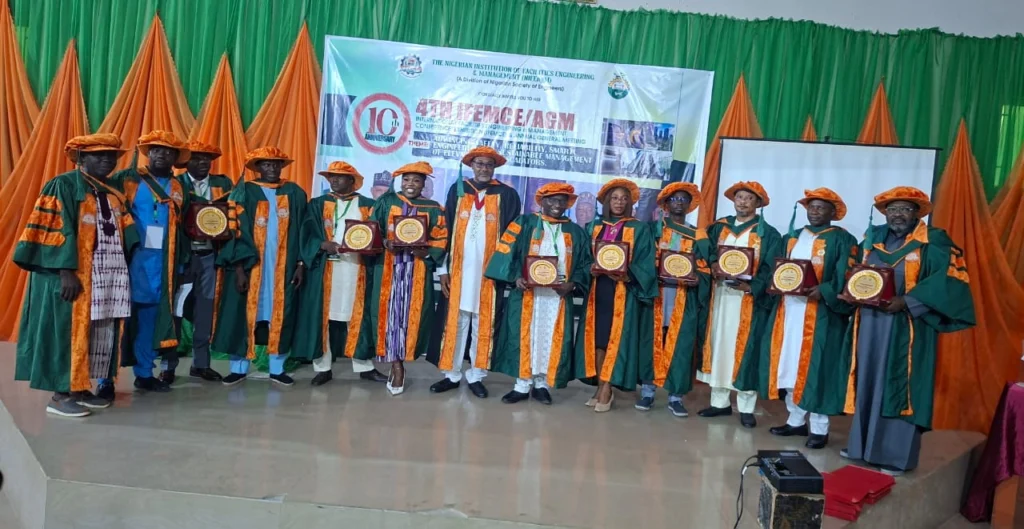
The Nigerian Institute of Facilities Engineering and Management (NIFEngM) has called for stronger preventive maintenance, improved safety standards and adoption of smart technologies to enhance the reliability and sustainability of elevators and escalators in Nigeria.
The National Chairman of NIFEngM, Mr Christopher Egwuatu, made the call at the 4th International Facilities Engineering and Management Conference and Exhibition (IFEMCE), Annual General Meeting and 8th Fellowship Conferment Ceremony in Abuja.
The event also marked the 10th anniversary of the institute and featured discussions on emerging technologies, infrastructure management and strategies for improving safety in vertical transportation systems.
The conference had the theme: “Advancing Safety, Reliability, Smart Engineering and Sustainable Management of Elevators and Escalators”.
Egwuatu said the institute’s decade-long journey had been characterised by professional development, policy advocacy, capacity building and efforts to improve maintenance culture across Nigeria’s built environment.
He said NIFEngM, inaugurated as a specialised division of the Nigerian Society of Engineers (NSE) in 2016, had continued to promote best practices, sound policies and operational efficiency in infrastructure management.
According to him, infrastructure development goes beyond the construction of buildings, stressing that effective facilities engineering and maintenance are essential to sustaining national development.
He noted that Nigeria’s growing urban population and increasing construction of high-rise buildings had made elevators and escalators critical components of modern infrastructure.
“As Nigeria’s urban centres grow vertically with high-rise edifices, commercial towers and shopping complexes, healthcare and educational facilities, and public institutions are becoming central to daily life,” he said.
Egwuatu stressed that vertical transportation systems had become indispensable to urban productivity and the efficient operation of modern buildings.
“Therefore, vertical transportation systems are no longer luxuries. They are lifelines of urban productivity,” he said.
He, however, identified ageing equipment, inconsistent preventive maintenance, power fluctuations and substandard installations as major challenges threatening the safety and reliability of elevators and escalators.
“Rapid urbanisation, industrialisation, and civilisation bring critical challenges: ageing equipment, inconsistent preventive maintenance, power fluctuations, substandard installations, and safety incidents put lives, properties, and investments at risk,” he said.
The NIFEngM chairman said the conference was designed to strengthen regulatory compliance and promote predictive and reliability-driven maintenance across the country’s built environment.
He added that the institute would encourage the adoption of Internet of Things (IoT), Artificial Intelligence (AI) and remote monitoring technologies to improve equipment performance and prevent avoidable breakdowns.
Egwuatu also reaffirmed the institute’s commitment to promoting energy efficiency, local manufacturing, knowledge transfer and sustainable procurement practices.
He said strengthening local technical capacity remained essential to ensuring that Nigeria developed the expertise required to manage and maintain its growing infrastructure.
The Minister of Housing and Urban Development, Mr Muttaqha Darma, represented by his Assistant, Mrs Ruqqayat Aliyu, also called for a fundamental change in the country’s approach to facilities maintenance.
Darma said Nigeria needed to move away from the culture of repairing facilities only after they had broken down to a proactive maintenance system capable of preventing failures.
He explained that emerging technologies, including AI, smart sensors and predictive maintenance systems, could help identify equipment faults before they developed into major failures.
The minister said the Federal Ministry of Housing and Urban Development remained committed to the maintenance, rehabilitation and restoration of federal public buildings through its Department of Federal Public Assets Maintenance.
He identified Executive Order 11 of 2022 on the maintenance of public buildings as an important policy framework for strengthening maintenance practices across Ministries, Departments and Agencies (MDAs).
Darma urged stakeholders in the built environment to embrace safety as an institutional culture, stressing the importance of compliance with relevant standards and maintenance regulations.
Similarly, the President of the Nigerian Society of Engineers (NSE), Mr Ali Rabiu, urged the ministry to leverage the expertise of facilities engineers in policy formulation, technical advice and infrastructure management.
Rabiu, represented by Mr Oladipo Mabogaje, Assistant Director, Engineering, Planning, Research and Statistics, Council for the Regulation of Engineering in Nigeria (COREN), described NIFEngM as a multidisciplinary professional division covering 24 engineering disciplines.
He said the institute had professionals working across Nigeria’s six geopolitical zones, particularly in the South-South, North-Central and South-West regions.
Rabiu called for stronger collaboration between the Ministry of Housing and Urban Development and NIFEngM to improve infrastructure management and ensure the effective utilisation of professional expertise.
The keynote speaker, Mrs Alice George, Lead, Incident Investigation and Learning Management, Renaissance Africa Energy Company Ltd., identified elevator doors and sensors as frequent sources of equipment downtime.
George emphasised the need for regular inspections, timely repairs and preventive maintenance to minimise disruptions and improve the safety of elevator users.
She also recommended emergency response drills to prepare facility managers, security personnel and front-desk officers for incidents involving trapped passengers, power failures and peak-hour disruptions.
According to her, facilities managers should adopt elevator zoning systems, staggered working hours and technology-assisted monitoring to reduce waiting times and improve service delivery.
George further recommended a structured maintenance improvement plan beginning with a baseline assessment of waiting times and previous equipment outages.
She said the plan should also incorporate scheduled maintenance, emergency response drills and periodic performance reviews to ensure continuous improvement in service delivery.
The second keynote speaker, Dr Augustine Ukpong, an energy industry leader, said maintenance decisions should be guided by operational data rather than assumptions.
Ukpong stressed that proper documentation of equipment performance and maintenance activities would promote institutional learning and improve future maintenance decisions.
He proposed a 90-day pilot programme to establish baseline equipment performance, install monitoring technologies, assess operational improvements and develop evidence-based maintenance plans.
The energy expert urged NIFEngM to introduce data-driven maintenance practices into professional training and develop smart-facility certification programmes to strengthen professional competence.
He also recommended the establishment of a national lift and escalator register and the adoption of electronic maintenance records for public buildings.
Ukpong further called for mandatory remote monitoring requirements in new public buildings and hospitals, standardised backup power and rescue systems, improved professional certification and public investigations into serious elevator and escalator incidents.
He said the adoption of these measures would strengthen accountability, improve emergency preparedness and promote safer and more reliable vertical transportation systems across the country.