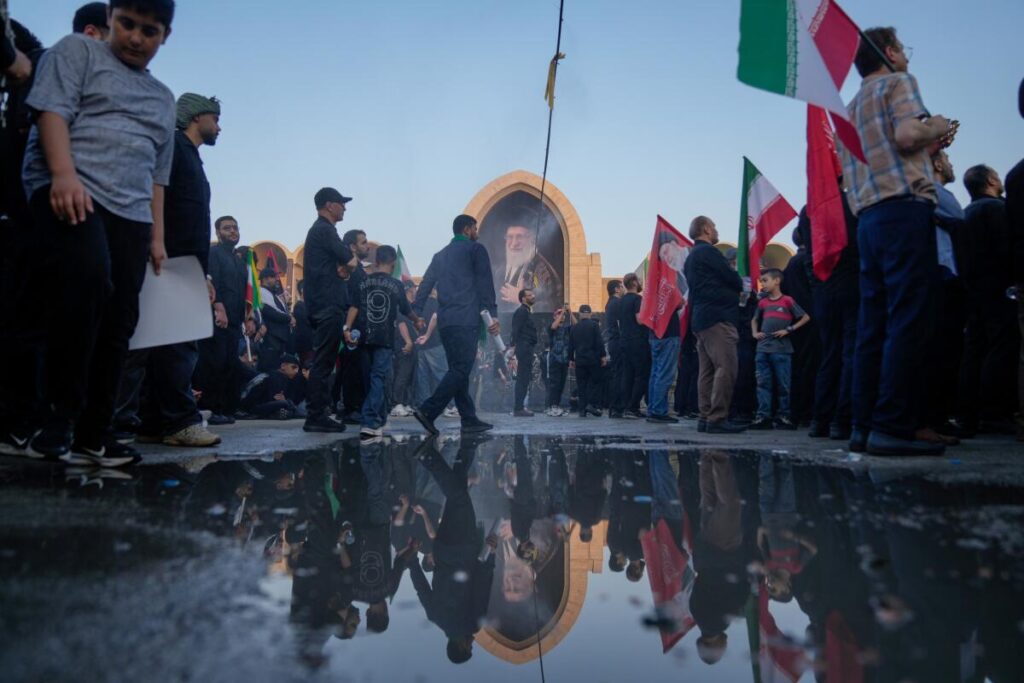
Hundreds of thousands of mourners began a day long funeral on Saturday for Iran’s
Supreme Leader Ayatollah Ali Khamenei, beating their chests in sorrow before the glass case containing his flag-draped coffin in Tehran and calling for revenge against Israel and the United States.
The funeral for Khamenei, who ruled Iran for decades before he was killed at age 86 in a Feb. 28 airstrike in the opening moments of the Iran war, could provide a boost for the country’s theocracy and its new supreme leader, his son Ayatollah Mojtaba Khamenei.
That is important as Iran tries to leverage its hold on the Strait of Hormuz in negotiations with the US over a permanent end to the war and as concern lingers that Israel could attack again. The funeral was delayed as the war raged, and talks appear to be on hold until it is over.
During the ceremony, Iran’s top negotiator warned France and the UK over their comments about potentially launching joint patrols in the waterway, the narrow mouth of the Persian Gulf through which a fifth of all oil and natural gas once passed in peacetime.
Mourners wept at the sight of Khamenei’s coffin alongside those of his family members also killed in the airstrike, with some chanting: “Our word is one! Revenge! Revenge!” Some carried banners and flags. Billboards across the city bore Khamenei’s image. Crowds of men rhythmically beat their chests in mourning, a common practice at Shiite funerals.
“Imam Khamenei was our heart, our father, our everything,” mourner Masoumeh Mohammadi said. “I still can’t believe they martyred him. We will not rest until we avenge his death.”
An outdoor stage at the Grand Mosalla resembled the stage where Khamenei once gave his speeches at a husseiniyah, or congregation hall, at his compound in downtown Tehran. There was a chair like the one he once sat in while giving his sermons, complete with a microphone on a stand and a table next to it. Above it hung an image of the late Supreme Leader Ayatollah Ruhollah Khomeini, who died in 1989.
Khomeini’s funeral saw chaotic scenes as millions thronged his mourning ceremony and trip to the cemetery. Khamenei’s death was only the second time Iran has lost a supreme leader since the 1979 Islamic Revolution.
The caskets of his dead family members sat beneath Khamenei’s, which had his black turban atop it, identifying him as a direct descendant of the Prophet Muhammad. The dead included the wife of Mojtaba Khamenei, whose possible appearance at the funeral remained unclear. He reportedly was wounded in the attack that killed his father and has not been seen publicly since the war began.
“We attended the funeral to show that we are all committed to defend our country and religion,” said one mourner, Ali Kazemi.
As sunset approached, the streams of people continued. “Authorities advised not to rush to the sites,” said a later visitor, Mohammad Barati. Mourners had also been advised not to stay too long, to allow others to come.