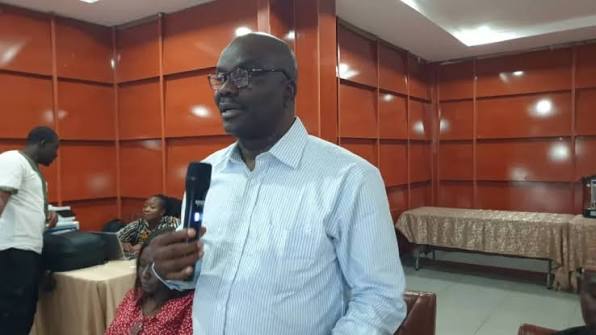
Dr. Gani Enahoro, until few weeks ago represented Africa on the Executive Council of the World Veterinary Association. A veterinary doctor whose career has spanned over three decades, he is an animal conservationist who believes in the preservation of wild animals. He spoke to DEBORAH OLUSEGUN and SANDRA OBOCHI on safe animal practices in Nigeria, such as the consumption of dog meat and the general consumption of bush meat. Excerpts:
Are there any breeds to avoid when eating dogs?
Dog eating is not fashionable. That is number one. But, we know that by custom and tradition, some people from time immemorial have always eaten dog meat. Now, who are these people? We have them in Africa, we have them in Nigeria, and we have them in China and Japan and some other countries.
These are traditional fetishes. You won’t find such smart shops in urban areas even in those countries. Now, dogs are supposed to be companion animals by which it means animals who live with man because they are the oldest friends that man has. So, those who chose to eat dog meat, in the areas they live in Nigeria, don’t have access to the kind of dogs that we see in urban settings like the exotic imported dogs. We are talking of dogs like German Shepherds and so on.
They are not after those kinds of dogs; they also go after the mongrels, the dogs native to them. I’m sure if you give them any of these foreign dogs, they won’t even want to eat it. I know that they are just living in the past because like the Western countries and other urban areas in Nigeria, if anybody eats dog meat, they will just be seen as being out of fashion.
So there are no breeds to be avoided?
Dog is dog. Dog meat is dog meat. Like I said, those who eat dogs are definitely traditionalists and would prefer dogs that are native to them. So, it’s not like there is any dog to be avoided.
Is it safe to eat bush meat and what are the dangers?
For bush meat, there are two ways to look at it. One, for health reasons, a part of it would have been very okay. What I mean is that bush meat is lean meat that is free of fat and is natural. They live in the wild; they eat freely, unlike the controlled feeding we give to the animals we rear in the cities. When you look at it from that angle, it is supposed to be very nice, clean meat to eat.
There is no way you can know which bush meat is healthy to eat because the ones that you buy off the shelf in the market place are already prepared. But, nobody is sure if they were healthy before they were brought to the market. In any case, before you can catch a game, it must be a very weak one, some of them are actually very sick and then they get trapped easily. At times, there could be some that are healthy and then they got trapped by accident.
So because there are no postmortem checks or inspection by a veterinarian to see if there are portions that could be eaten by human beings and others that could be condemned before they are sold out to the market. Since this practice does not exist, it makes it unsafe. Let me scare you a little bit, 65 percent of infectious diseases in human beings are traced to animal sources today.
That is a study that has been verified. Imagine, having to worry about the bush meat that has no access to human checks and veterinary checks. It could have been a carrier of disease. You know that Lassa fever for instance, is caused by infected rats. It is a disease that was discovered in 1959 in Nigeria here. It has been traced that the carriers are rats.
There is no way that even rabbits will not also carry it and these are different species of bush meat. So how do you know the bush meat that has not been contaminated or that has not been sick with Lassa fever before the hunter brought it from the forest? So because of all of these worries and lack of critical checks, I will therefore say it is not safe to eat bush meat.
You know the danger is this, those who eat it in the restaurants are not particularly at risk, but the women in the kitchen who are preparing it are most at risk because they are having direct contact with the body fluids of the animals that have been brought in. So because of that, we as veterinarians campaign that bush meat eating is not safe for public health. Then of course, animal conservationists will tell you it is not good for us to depopulate the wild. On this note, we will tell you not to eat bush meat.
Are you an animal conservationist?
Because I am a veterinary doctor, the answer is yes. We are advocates of animal welfare, so by that we are also conservationists so to say.
So you do not support rearing animals for food?
Oh yes. We have safe animal production practices or safe livestock production practices that are identified globally as a standard. I support that, it is okay. Animal conservation is not about domestic animals, it is about preserving the existence of wild animals, to prevent them from going into extinction.
The metric production for yield by man is standardized and known globally. There could be unsafe practices which some animal rights campaigners object to, such as using cages to rare birds. Some animal rights campaigners at some point believed that confining animals and birds in cubicles may not have given the animal the kind of freedom of space. And then of course, we have tried to imbibe all of them as safe production practices and this is in the area veterinarians are to manage. That is what we do, we try to promote safe production practices and by that, it also includes avoiding use of chemicals and drugs. There are some drugs that when you use them, they will remain in the meat or the flesh of the animal, and when eaten by man could be a source of cancer or cause of other troubles in the future. These are all part of the safe production practices a veterinarian also campaign and worry about. Conservation is a different subject matter. Conservation is for wild animals because we don’t want to wipe them out of existence.
What is the government’s contribution to safe animal production practices?
Government has laws, the problem has always been enforcement. There is an Act of parliament in this country that is referred to as the Animal Disease Act. Inside that Act, is a provision that all animals are supposed to be registered by the department of veterinary practices in each state, wherever they are located. Now, how many people have chosen to compel farmers to register their animals? This implementation would allow veterinary authorities to monitor and manage the practices in those places. There was a bill that recently scaled through the first and second reading in the Senate that has to do with livestock data management to include all these things. So it is not as if the laws are not there; the government needs to do more in enforcing these laws that are already in existence.
As a columnist in many national dailies in the last 25 years, you have complained about the lack of attention to animals by the media. What do you advise Nigerian startups to do? What changes will you like to see?
You have just started now, what you are doing is the right way to go. A lot of information is out there, if you don’t get into the public domain, it remains there. I expect traditional newspapers and start- ups to have a column that educates Nigerians on animals. A lot of people only emphasize human angle stories to issues in medicine and health. How about animal health production and environmental health? As someone who has related well with the press, I expect every newspaper to have a column for animal discussion. It could be on any topic at all. We need to give exposure to information that has to do with animals.
Regarding people who keep lions as pets, how safe is it? What are the dangers?
First of all, it is a wrong thing to do. Wild animals are not meant for domestication. It is unfair to such animals. The animal conservationists would object to it. It is not acceptable. Those who are doing that are breaking the law. The law establishes that if you must have a zoo, where wild animals are kept, the ministry of environment must give you the permission. So if someone has a lion, what are his intentions? Is he trying to raise a zoo? Because with time, he or she will add another animal. Secondly, animals would always be animals. They have instincts, so if you keep a wild animal in your house, chances of accidents and attacks will be there. There could be a breakdown in control at some point. The animals could either attack the owners or visitors or even get loose and run into the city, causing public disorder and which in turn becomes a public health hazard.