

By Joy Onu
The National Agency for Science and Engineering Infrastructure (NASENI) and the Government of The Gambia have agreed to develop a comprehensive Memorandum of Understanding (MoU) to strengthen cooperation in technology development, technical and vocational education and training (TVET), research, innovation, skills development and technology commercialisation.
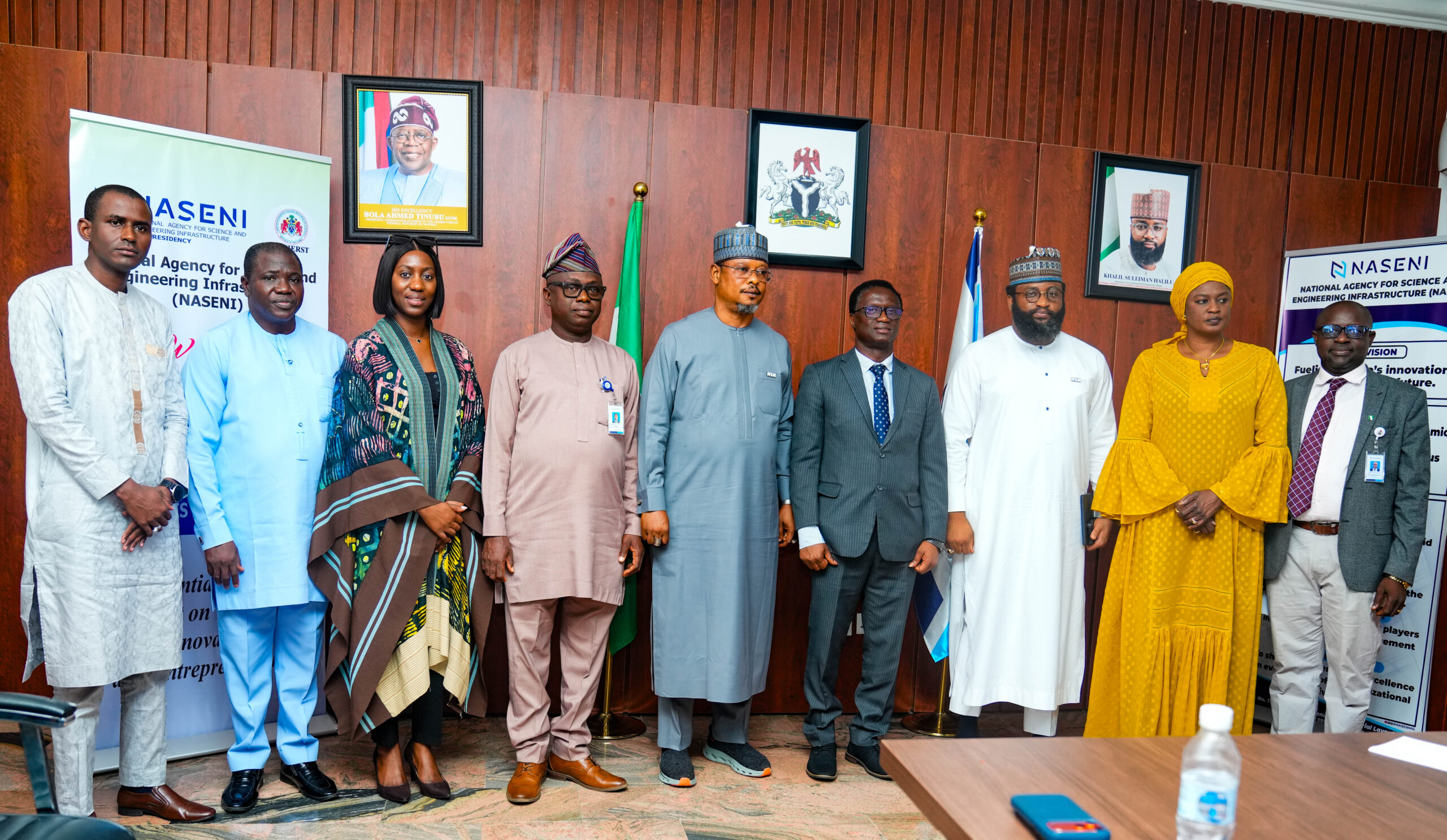
In a statement signed by the Deputy Director, Information, Chima Akwaja, on Wednesday, the agency said the agreement followed a high-level experiential learning visit by The Gambia’s Minister of Higher Education, Research, Science and Technology, Prof. Pierre Gomez, and his delegation to NASENI headquarters in Abuja.
The Gambian delegation had earlier visited selected NASENI facilities, including the Centre of Excellence and NASENI Solar Energy Limited (NSEL), where it was exposed to the agency’s technology ecosystem, research capabilities and network of specialised institutes.
During the visit, the delegation was briefed on NASENI’s interventions in renewable energy, agricultural mechanisation, electronics, power systems, advanced manufacturing, scientific equipment, aeronautics, solid minerals, machine tools, drone technology and other emerging areas.
Representing the Executive Vice Chairman/Chief Executive Officer of NASENI, Mr. Khalil Suleiman Halilu, the Director, Technology Business Development and Special Adviser on General Matters to the EVC/CEO, Engr. Ozigi O. Benard said the agency was positioned to serve as a technology development, transfer and commercialisation platform for Nigeria and other African countries seeking to build indigenous technological capacity.
Benard explained that NASENI operates through a network of specialised Development Institutes that provide an integrated platform for research and development, prototyping, testing, manufacturing, technical training, technology transfer and commercialisation.
He said the agency’s strategic direction was anchored on the principle of the “3Cs”: Creation, Collaboration and Commercialisation with increasing emphasis on taking research outputs beyond laboratories and prototypes into the marketplace.
According to him, NASENI had identified several areas with strong potential for cooperation with The Gambia, including renewable energy and solar photovoltaic systems, power electronics, embedded systems, industrial automation, agricultural engineering, advanced manufacturing, scientific equipment, materials development, aeronautics, drone technology, solid minerals processing and technical skills development.
He further said that NASENI had strengthened partnerships with universities, polytechnics, research institutions and indigenous private-sector companies to support curriculum development, technical training, certification, joint research, technology development and the commercialisation of locally developed technologies.
Benard added that the agency’s commercialisation drive had recorded significant progress since the assumption of office of Halilu as Executive Vice Chairman/CEO in 2023.
Earlier, Gomez said The Gambia was seeking to transform its higher education and TVET ecosystem through practical learning, institutional partnerships and stronger African cooperation.
He said the delegation came to Nigeria to learn from NASENI’s practical approach to research, development, manufacturing and technology transfer, with the intention of adapting relevant models to The Gambia.
Other members of the NASENI team at the meeting included the Acting Managing Director, Solid Minerals Machinery and Equipment Development Institute (SOMMEDI), Prof. Ikyo Barnabas Achakpa; the Overseeing Officer, Scientific Equipment Development Institute (SEDI), Minna, Dr. Mahmoud Jafar; and the Coordinator, Implementation Management Office (IMO) and Special Adviser on Institutional Reforms, Mr. Yusuf Kasheem, among others.
The proposed MoU is expected to provide a framework for sustained collaboration between Nigeria and The Gambia in technology development, skills acquisition, research, innovation and the commercialisation of locally developed technologies.



