

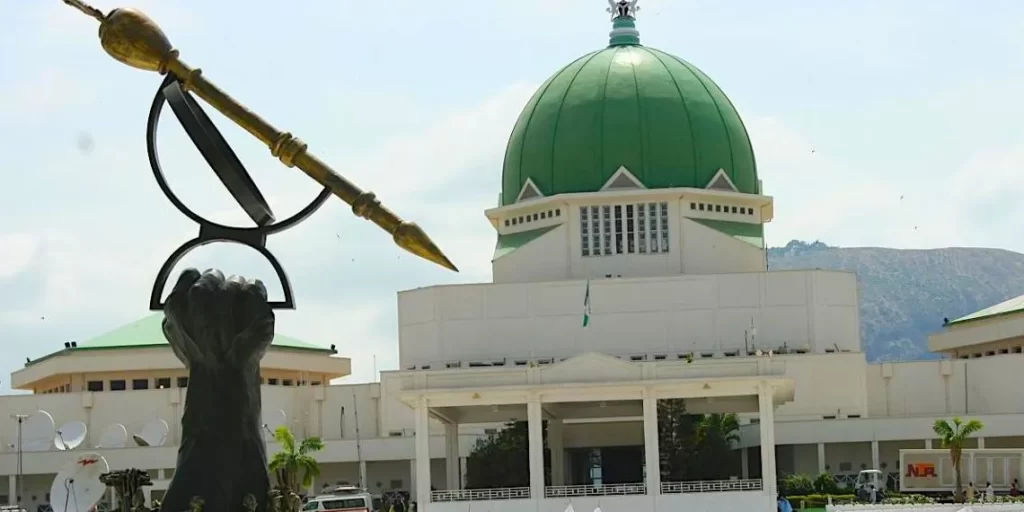
The National Assembly is about to begin a new constitutional amendment process, which has historically cost the nation N1 billion year on average.
The 1999 Constitution has undergone at least thirty amendments over the previous 24 years, at a total cost of N24.85 billion, according to the Guardian’s research.
According to custom, the Senate and the House of Representatives will continue working on more constitutional amendments the next week, focusing on changes to the State police, Value Added Tax (VAT), and election processes.
The need for additional amendments is related to the VAT collection issue that has led to a court dispute between the Federal Inland Revenue Service (FIRS) and certain state governments.
When the two chambers return to legislative work after their three-week Christmas and end-of-year break, they will form distinct committees under the leadership of the deputy speaker, Benjamin Kalu, and the deputy president of the Senate, Jibrin Barau.
The 4th National Assembly (1999–2003) initiated attempts to change the 1999 Constitution, but the real exercise started in the 5th National Assembly (2003–2007), under the leadership of the late Ibrahim Mantu, who was the Senate’s deputy president at the time. Reports about President Olusegun Obasanjo’s then-administration’s plans for a third term tarnished it.
Every National Assembly term to date has started a new project to modify the constitution, approved for around N4 billion to be appropriated and disbursed based on N1 billion annually. This is on top of the additional cash that was given to the committee to cover unanticipated expenses.
Since the National Assembly was unable to complete a thorough examination, concerned attorneys, Civil Society Organizations (CSOs), and politicians have contended that the ongoing effort to amend the constitution has amounted to little more than resource waste.
The 24-year-old constitutional amendment process has failed to address a number of issues, including resource control agitations, reorganizing the Nigerian State, and changing the country’s security architecture through the establishment of state police.
At the height of his committee’s frustration, immediate past deputy president of the Senate Victor Ovie Omo-Agege—who chaired the Senate’s committee on constitutional review during the previous Assembly—blamed the failure on the governors, alleging that they had refused to permit the state Houses of Assembly to approve the 44 bills that had been sent to them.
Then Senate President Ahmad Lawan and former House of Representatives Speaker Femi Gbajabiamila later confirmed the failure when they begged Kaduna State Governor Nasir el-Rufai to convince his colleagues to allow Houses of Assembly to endorse the proposed changes.
However, as the National Assembly leadership refused to cooperate with them on crucial subjects for modifications, the state Houses of Assembly disputed accusations that they were impeding the Constitution review and said that they were using blackmail.
The Houses noted that the National Assembly rejected the state police alternative that they had advocated through the Conference of State Assembly Speakers.
Any portion of the Constitution may only be successfully changed with the approval of a measure backed by a two-thirds majority in at least 24 of the 36 Houses of Assembly.
The findings indicate that the new constitution review committees will address past shortcomings of the National Assembly by reexamining issues like the right of an independent candidate to run for elective office, the establishment of state police, the federal structure and devolution of power, fiscal federalism and revenue allocation, electoral and judicial reforms, immunity for presiding officers of the National and State Assemblies, complete fiscal autonomy for local governments, and state creation agitations, among other things.
The new constitution review committees will also have to deal with the long-standing efforts to split the role of the state’s attorney general from that of minister or commissioner of justice; alter the process for enacting a completely new constitution, including a referendum; and include primary healthcare and basic education in the categories of essential and legally actionable human rights.
The inclusion of electoral offenses as a basis for disqualifying candidates from subsequent elections, the president’s obligatory annual state of the nation address to a joint session of the National Assembly, and the elimination of the president’s consent to bills amending the constitution are additional issues that need to be addressed.
The Human and Environmental Development Agenda (HEDA), lamenting the lack of significant constitutional revisions, claims that obstacles to the fight against corruption in the Constitution are being left in place and are making matters worse when it comes to corruption and associated issues.
According to Sulaimon Arigbabu, the Executive Secretary of HEDA, “Corruption is Nigeria’s issue and the root of the country’s problem.”
A revision of the constitution is desperately needed. Many of the events that are taking place are the result of constitutional gaps.
Every agency is impeded by that constitution in one way or another. The constitution doesn’t have enough clauses to, at the very least, lessen corruption. It’s quite regrettable that people who have the authority to contribute to this situation are not working to lessen corruption but rather enabling it.
Arigbabu bemoaned even more, saying that some of the individuals whose corrupt cases were previously publicized had managed to rise to positions of authority in the nation. Because Nigerians have a tendency to forget, some have been nominated to important positions and others have become governors.
Human Rights Writers Association of Nigeria (HURIWA), in response, asserts that the National Assembly’s lack of responsive leadership was the root cause of the dispute between State Assemblies and the National Assembly over some aspects of the revisions.
Nigerians were entrusted with demanding that the National Assembly fulfill its mandate and provide Nigeria an amended constitution, for which billions of tax dollars had been spent.
Emmanuel Onwubiko, the national coordinator for HURIWA, clarified that the conflict demonstrated the absence of smooth communication and collaboration between the National Assembly and the State Assemblies.
It would have been quite simple for both sets of lawmakers to have a place to convene and work together if the National Assembly’s leadership had been really competent and efficient over the previous four years.
Previous attempts to change the constitution, however, were successful in a few areas. One such area was the National Assembly’s financial autonomy, which allowed it to take money straight from the federation account—also referred to as the first-line charge.
The amendment of Sections 145 and 190 was effective in forcing the president or governor to send a letter to the National Assembly or State Assembly so that their deputies can take over in the event that they are on vacation or are unable to perform their duties.
Another amendment allowed a person sworn in as president or governor to serve out the remainder of the term of an elected official, but it also barred that person from running for election to the same position more than once.
In order to incorporate the time previously served in office, Sections 135 and 180 of the Constitution were altered to align the remaining term of office for a president or governor who wins a rerun election.
Sections 81, 84, and 160 of the Constitution were also amended to establish the financial and administrative independence of the Independent National Electoral Commission (INEC).
In order to shield members from partisan politics, Section 156 of the constitution was altered to remove party affiliation as a requirement for nomination to INEC.
In order to expedite justice, further effective adjustments were made to sections 285 (5) to (8), which established deadlines for the filing, hearing, and disposition of election petitions, and to sections 76, 116, 132, and 178, which offered a more expansive timeline for the conduct of elections.
Section 285 and the Sixth Schedule of the 1999 Constitution were also effectively amended to limit the number of members on tribunals to two, as well as the number of quorum to the same number of members and the chairman.
Sections 66(h), 137(i), and 182(i) were amended in addition, eliminating the clause that prohibited anyone charged by an administrative panel from running for office.
In order to expedite the legal process, the Not Too Young to Run Bill was changed to lower the age requirement for political office and to change the deadlines for filing, ruling on, and dismissing pre-election litigation.
Additionally, changes were made to sections 134, 179, and 225 of the constitution to increase the amount of time that INEC has to hold a run-off election between the top two candidates for governor or president from seven to twenty-one days.
The constitution’s Third Schedule, Seventh Schedule, Sections 6, 84, 240, 243, 287, 289, 292, 294, 295, 216, and 318 were modified, and a new section 254 was added to establish the National Industrial Court as a court of higher record and standing comparable to the Federal High Court.
Just before the Muhammadu Buhari government ended, more revisions to the constitution were made, including as ones pertaining to the state legislature and judiciary independence.
The president has also authorized the removal of the railroad, jail, and electricity from the exclusive legislative list and their placement on the concurrent list.
The others include the following: removing all references to the Criminal Code, Penal Code, Criminal Procedure Act, Criminal Procedure Code, or Evidence Act; regulating the first session and inauguration of members-elect of the National and State Houses of Assembly; and for related matters.
The changes to provide for the post-call qualification of the Secretary of the National Judicial Council, to exclude the period of intervening events in the computation of time for determining pre-election petitions, election petitions, and appeals, and for related matters, have also been approved.
It was also possible to change the Exclusive Legislative List to remove the entry “prisons” and replace it with “Correctional Services” in the Concurrent Legislative List, as well as to address related issues. Another modification that was successful was moving the item “railways” from the Exclusive Legislative List to the Concurrent Legislative List.
Along with other relevant changes, the constitution was revised to permit states to produce, transmit, and distribute power in regions serviced by the national grid.
The amendment to mandate that the Senate or State House of Assembly confirm the names of those nominated as Ministers or Commissioners within sixty days of commencing office was also passed. Additionally, relevant topics were approved.
Another change was made to mandate that the government focus its strategy on guaranteeing Nigerians’ right to food and food security, as well as other relevant issues.



