

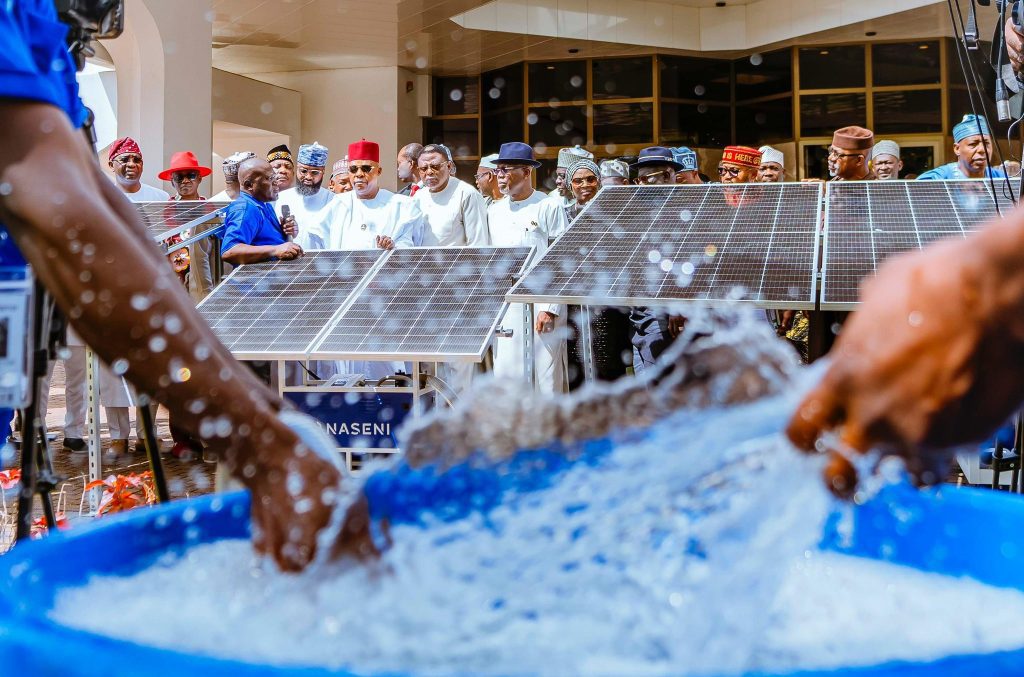
As part of efforts to boost food security, the National Economic Council (NEC) has endorsed solar-powered irrigation pumps developed by the National Agency for Science and Engineering Infrastructure (NASENI) for nationwide deployment ahead of the 2025 dry season farming.
The NASENI solar irrigation pump, designed to replace petrol-powered models, is expected to increase agricultural productivity, reduce operational costs, raise farmers’ incomes, and improve livelihoods.
At its 152nd meeting on Thursday at the Presidential Villa, Abuja, NEC resolved to formally seek President Bola Tinubu’s approval for mass production and distribution of the pumps.
To ensure timely rollout, the council directed the Minister of Budget and Economic Planning, Senator Abubakar Bagudu, to work out funding modalities for NASENI to produce the pumps at scale.
Vice President Kashim Shettima, who chaired the meeting, said the innovation reflected Nigeria’s ability to compete globally with homegrown solutions. According to him, the pumps would not only strengthen food security but also unlock carbon credit opportunities for farmers.
“These pumps replace expensive petrol-powered systems, lower farmers’ costs, expand dry-season cultivation, and even provide backup power for households. Their advanced features, including GPS tracking, mobile app dashboards, usage monitoring, and pay-as-you-go integration, prove that Nigerian ingenuity can compete with the world,” Shettima said.
The Vice President also highlighted other government efforts to enhance food security. He said 250,000 farmers have been insured across eight states, while the ₦250 billion Bank of Agriculture facility is being activated to support smallholders. He added that the Green Imperative Project with Brazil is being repositioned for financing, while the World Bank-backed AGROW programme is mapping priority value chains for rollout.
On updates from the Presidential Food Systems Coordinating Unit, Shettima noted that the “Harvesting Hope Caravan” had already reached half a million citizens in eight states, building trust and mobilising grassroots support.
The council disclosed balances in key national accounts as at September 17: Excess Crude Account, $535,823.39; Stabilisation Account, ₦83,495,784,133.24; and Natural Resources Account, ₦125,818,396,257.41.
NEC also resolved to participate actively in the forthcoming Nigerian Economic Summit Group (NESG) summit to strengthen collaboration and mobilise support for President Tinubu’s Renewed Hope Agenda.
In response to an anticipatory action plan presented by the National Security Adviser, Malam Nuhu Ribadu, the council directed his office to expand the scope of the framework to cover more states and present a final draft for ratification at its next meeting.
Additionally, a report on the rising cost of production and the impact of energy prices on food output was presented by Jigawa State Governor, Umar Namadi.
The council pledged to tackle the challenges of high energy costs and fertiliser prices. It also directed the Minister of State for Petroleum (Gas) to engage stakeholders to address the high cost and availability of gas domestically and report back to the council.



