

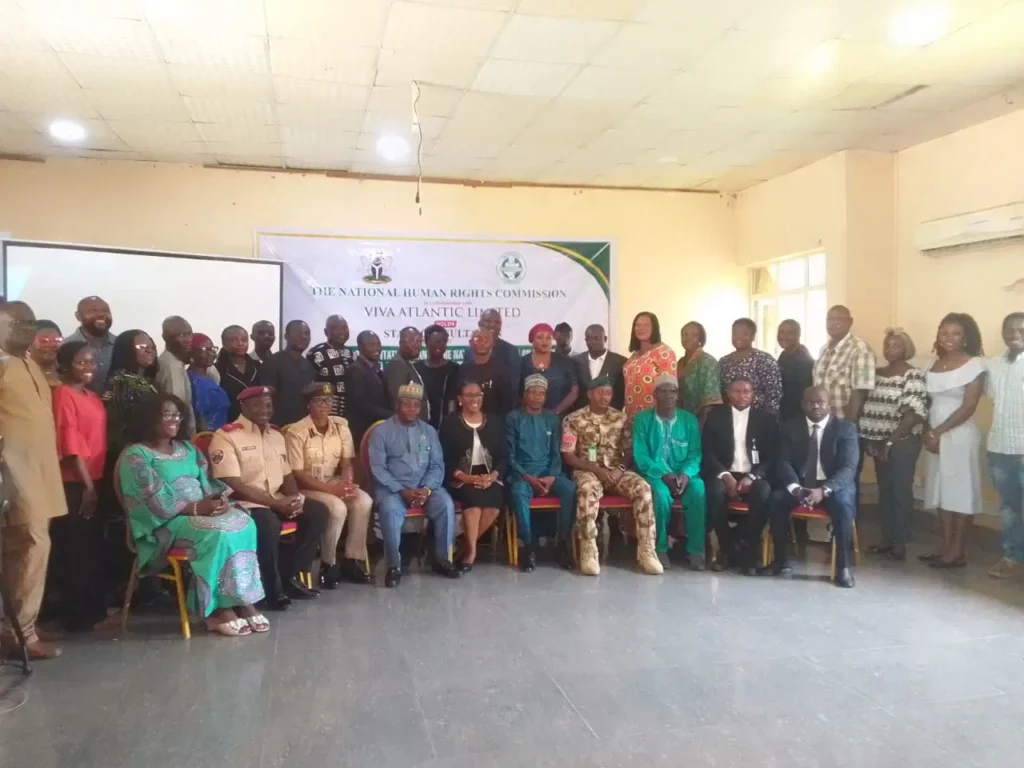
National Human Rights Commission (NHRC) has called for stronger
collaboration among government agencies, civil society groups, and other
stakeholders to ensure effective implementation of Nigeria’s National Action
Plan (NAP) 2024-2026 on human rights.
The appeal came during a state consultative meeting held on Monday in Lokoja
in partnership with Marian Marketing Co. Ltd.
The forum brought together focal persons from ministries, departments, and
agencies (MDAs) alongside civil society organizations (CSOs), who all agreed
on the need for coordinated action to advance human rights promotion and
protection across the state.
In his remarks, the NHRC Executive Secretary, Dr Tony Ojukwu, described the
National Action Plan as a guiding document aligned with the 1993 Vienna
Declaration and Programme of Action.
He said that the NAP 2024-2026 reflects a renewed and broader commitment to
safeguarding human rights in Nigeria.
Ojukwu, who was represented by the Kogi State Coordinator Dr Abdulwahab
Oyedokun, said the NHRC, as the coordinating and oversight body for NAP
implementation, convened the meeting to clarify roles and responsibilities for
stakeholders.
“Human rights is everybody’s business,” he stated, urging CSOs to actively
monitor MDAs on human rights issues.
Participants identified key challenges undermining human rights in the country,
including extrajudicial killings, torture and poor prison conditions, insurgency
and kidnapping, and high unemployment.
Adekola Ranti of the Network of People Living with HIV and AIDS in Nigeria
(NEPWHAN) called on CSOs to intensify efforts to hold MDAs accountable
and encouraged the NHRC to hold more dialogue sessions.
Idris Maliki Abdul, Executive Director of Conscience for Human Rights and
Conflict Resolution, stressed the need for wider awareness through traditional
and modern media.
He advised that the NHRC leverage its radio programmes to sensitise citizens
on their rights.
Also, Mrs Eunice Agbogun of Challenged Parenthood Initiative (CPI)
emphasised grassroots advocacy, noting that most human rights violations occur
at the community level.
Stakeholders also recommended that the NHRC should work with social
welfare officers to train them in documenting violations, and that similar
engagements be extended to senatorial zones.
The meeting was attended by representatives from the International Federation
of Women Lawyers, FIDA; the Nigeria Labour Congress, NLC; the Justice,
Development and Peace Commission; TB Network; and other organisations.



