

By SIMEON OGOEGBULEM
Nigerians across the geopolitical and religious divide have taken the federal government to task over the worsening economic conditions of the masses and urged the government to take more concrete steps to address the high cost of living, energy insecurity and other economic challenges being faced by Nigerians.
The stakeholders who were reacting to President Nola Tinubu’s 2026 Independence Day address to Nigerians lamented that the reforms embarked upon by the government in the last three years are yet to reflect the improved standard of living of the majority of the people.
A public Affairs analyst, Aliyu Illias, said the the President in his speech should have provided Nigerians with concrete evidence of measures already taken to reduce the cost of energy and transportation. Illias said Nigerians had continued to spend a significant portion of their income on energy, adding that the administration needed to take more immediate steps to ease the burden on citizens.
“If you look at it very well, Nigerians actually spend more on energy. So, if he wants to actually do more, he has to find a way. I expect the president to tell us what he has been doing to ease people’s suffering. Especially, there was this conversation that by Oct. 1, Nigeria was going to start having affordable transportation”, Illias said.
He expressed disappointment that the President was silent on his promise to announce measures that would lead to the crashing of transportation costs. “I was thinking today he will tell us that he has reduced so-and-so price, inaugurated so-and-so vehicles or made this possible. I did not hear anything about that,” he said.
Illias said that the President should give account of the measures taken to reduce the hardship being experienced by Nigerians, adding that the President should do more on energy security, especially on petrol, diesel and even electricity going forward.
The Coordinator of the Human Rights Writers Association of Nigeria (HURIWA), Mr Emmanuel Onwubiko, said there was a gap between government pronouncements and tangible results in the electricity sector. Onwubiko accused the government of talking too much with little action to back it up.
“What value addition has this administration added to the electricity sector in terms of generation, distribution and even getting the power plants to be optimally equipped to work 24/7?” he queried said.
Onwubiko said there was insufficient evidence in his assessment of significant improvement in the electricity sector under the administration. He expressed concern over the performance of the power generation and distribution companies, particularly over electricity supply and billing.
“The Gencos and DisCos are incompetent, just as the DisCos are busy fleecing unfortunate Nigerians for so much darkness under some nebulous arrangements of classifying consumers. These power companies do not keep to the terms of the contracts between them and the consumers,” he said.
Also reacting, Mr Jide Ojo, a public affairs analyst, said Tinubu’s speech contained several promises on poverty reduction, employment and improved living standards but provided insufficient details on concrete achievements.
Ojo said there was a need for positive developments in the administration’s macroeconomic policies, including efforts to attract fresh investment and improve the country’s foreign reserves. He, however, said many Nigerians were still living on hope and needed to see the impact of government programmes in their daily lives.
Ojo noted that the credit scheme that he talked about is only for those who are in gainful employment, people who are perhaps public servants who have regular income, not for everybody, stressing that the President should have provided statistics showing how many Nigerians had benefited from credit schemes such as the Nigerian Consumer Credit Corporation (CREDICORP).
Ojo also said the speech should have provided clearer figures on food production and the impact of government interventions in agriculture, stating that he should have mentioned things around what has been achieved in concrete terms in the reduction of food inflation.
“How many people have benefited? He inaugurated about 10,000 tractors in 2024. How have they been deployed? How much food imports have we been able to reduce? Are we self-sufficient in rice production, cassava and maize, or are we still import-dependent?” he further queried.
Ojo said although the president spoke candidly about the country’s economic situation, Nigerians needed to see faster and more measurable improvements in their standard of living.
While conceding that the President spoke with candour, he stated that much is still left to be desired in terms of how fast Nigerians can start to feel the lower cost of living from the current situation that many Nigerians are facing.
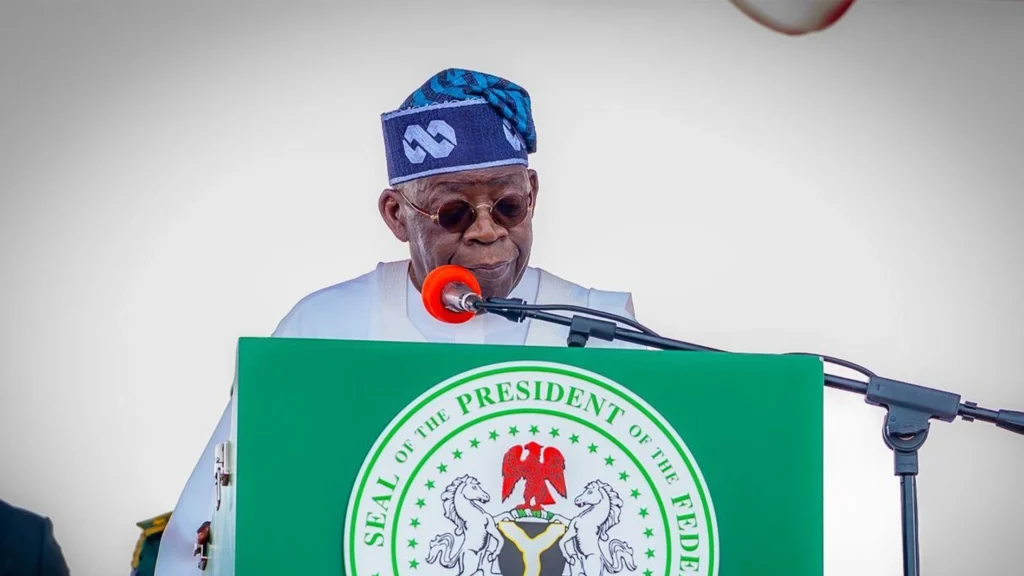
Tinubu had renewed his pledge to build an economy where factories have reliable electricity, businesses can access credit facilities and families can afford essential goods and services.
The President who gave the assurance in his Independence Day address to the nation, said bringing down the cost of living remained at the centre of the government’s economic priorities. Tinubu said the administration would seek to reduce prices by lowering the cost of producing and transporting goods consumed by Nigerians.
He explained that the past policy choices had contributed to economic distortions that made it harder for citizens and businesses to prosper. According to him, his administration’s ambition is to turn the long-standing promise of prosperity into tangible improvements in the everyday lives of Nigerians.
Tinubu assured Nigerians of efforts to achieve cheaper production and transportation, greater access to education and finance, and reliable power supply.
“When I speak of prosperity, I do not speak merely of a larger economy, abstract numbers or better statistics. I mean something much more personal. I mean a Nigeria in which the farmer can cultivate his land safely, produce more at lower cost, and earn a decent return for his labour”, the President stated.
“A Nigeria in which factories have reliable power, businesses can obtain credit, and young people can find productive work. A Nigeria in which food and transportation are affordable, education is within reach, and hard-working families can look towards the future with confidence.”



