

By Joy Onu
Nigeria’s worsening cooking gas crisis is driving a sharp return to charcoal use across households, as rising Liquefied Petroleum Gas (LPG) prices push millions of families into energy poverty and reshape domestic cooking choices, household spending patterns, and the informal stove market.
LPG prices have climbed steadily from about ₦7,322 for a 5kg cylinder in March 2025 to roughly ₦8,707 by April 2026, while a 12.5kg cylinder now sells above ₦23,000. The sustained increase driven by global energy shocks, and local supply constraints has made cooking gas increasingly unaffordable for low-income households, particularly in urban and peri-urban communities.
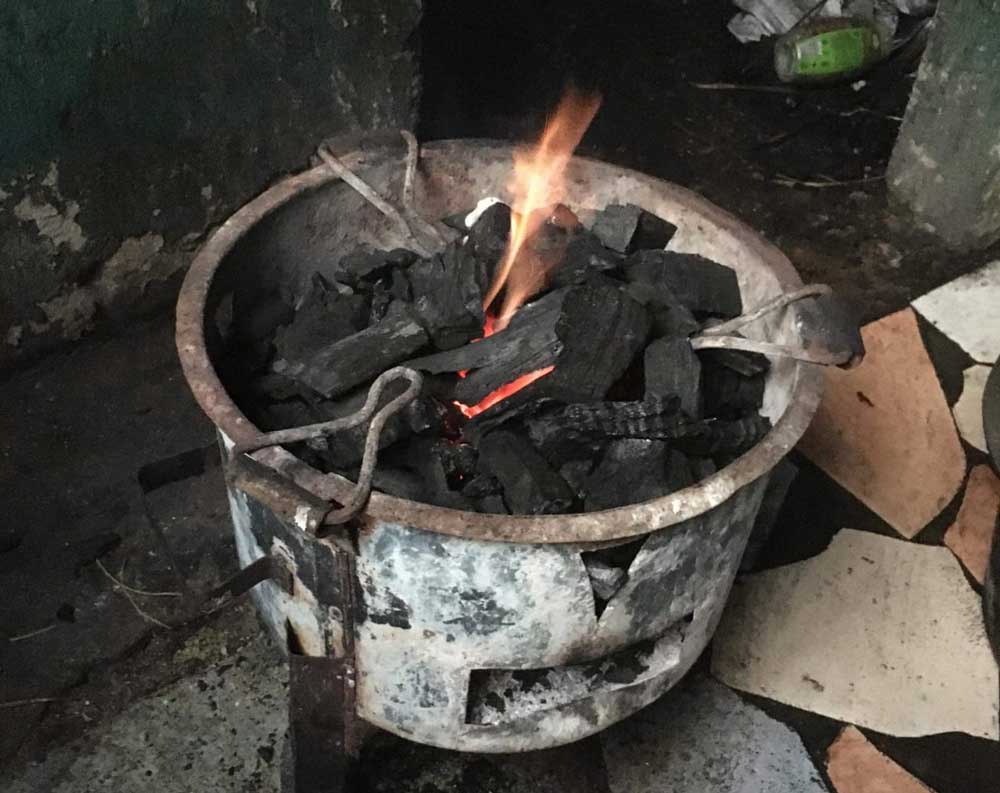
As a result, charcoal priced between ₦300 and ₦500 has become the only viable option for many families for daily cooking.
In Abuja, a teacher, Rashida Sule, told the New National Star that the decision to abandon gas was purely economic. “If I buy gas, it will last me only two days. But if I use charcoal, ₦400 can take care of cooking for a day or two. I don’t really like charcoal, but the price of gas is too high,” she said.
In Makurdi, Lokoja, Bauchi, Abuja, Lafia and other cities where household surveys show rising dependence on biomass fuels, residents echoed similar frustrations over affordability and survival.
A food vendor in Lafia, Hauwa Sani, said rising fuel costs have changed how she runs her business. “When you hustle and struggle, at the end of the day gas will take all the money. That is why I’m back to charcoal. Business is not like before,” she lamented.
For households and food vendors like Rashida and Hauwa, the shift is not driven by preference but by economic pressure.
National data indicates that only about 19.4 per cent of Nigerian homes currently use LPG, while over 70 per cent still rely on charcoal and firewood. Analysts say more than 60 per cent of households cite cost as the main reason for abandoning gas, describing LPG increasingly as a luxury fuel.
A resident of Abuja, also interviewed by this reporter, summed up the reality bluntly: “I use charcoal most because gas is too expensive.”
The growing dependence on charcoal has also reshaped Nigeria’s informal energy economy, especially the production and circulation of cooking stoves.
In local markets across Ibadan, Lagos, and Abuja, small charcoal stoves produced by artisans remain the most accessible option for low-income households. These locally fabricated stoves typically sell between ₦2,000 and ₦3,500, depending on size and design, and remain widely used because they are cheap, easy to repair, and readily available.
A local fabricator in Ibadan, Bola Ajibade, said demand for his work has increased as more households move away from gas. “People don’t even ask for fancy ones anymore. What they want is something strong and affordable. Gas is expensive, so charcoal stove is what keeps us in business,” he said.
In Abuja’s Karu market, another fabricator, Ibrahim Musa, said the economic strain has changed customer preferences. “Before, people used to ask for better finishing, but now everybody is trying to manage. If it can cook food, that is enough,” he said.
At the other end of the market, improved or branded smokeless charcoal stoves are sold between ₦30,000 and ₦52,500 or more, depending on model and distribution channels. While they are marketed as fuel-efficient and cleaner reducing charcoal consumption and indoor smoke, their high upfront cost keeps them out of reach for many low-income households.
A distributor operating across Lagos, Ibadan, Abuja and Osun State, Akpan Ukpe, said demand for stoves has surged as families search for alternatives to expensive gas. He noted that while interest in improved models is growing, supply remains unstable, with customers often facing delays due to distribution bottlenecks and limited availability.
Market operators say this creates a widening divide between affordability and efficiency, where cheaper traditional stoves dominate usage while modern alternatives remain aspirational.
Experts warn that the increasing reliance on charcoal is accelerating environmental and health challenges. Nigeria reportedly loses millions of trees annually to charcoal production, contributing to deforestation, land degradation, and rising climate pressures.
Health researchers also link household biomass use to respiratory illnesses, cardiovascular diseases, and heightened risks for women and children exposed to indoor smoke.
Despite government efforts to expand LPG adoption, affordability continues to undermine the transition to cleaner cooking energy.
Across households and markets, what is emerging is a clear divide: cooking fuel choices are increasingly determined not by policy or preference, but by the reality of shrinking incomes and rising energy costs.



