

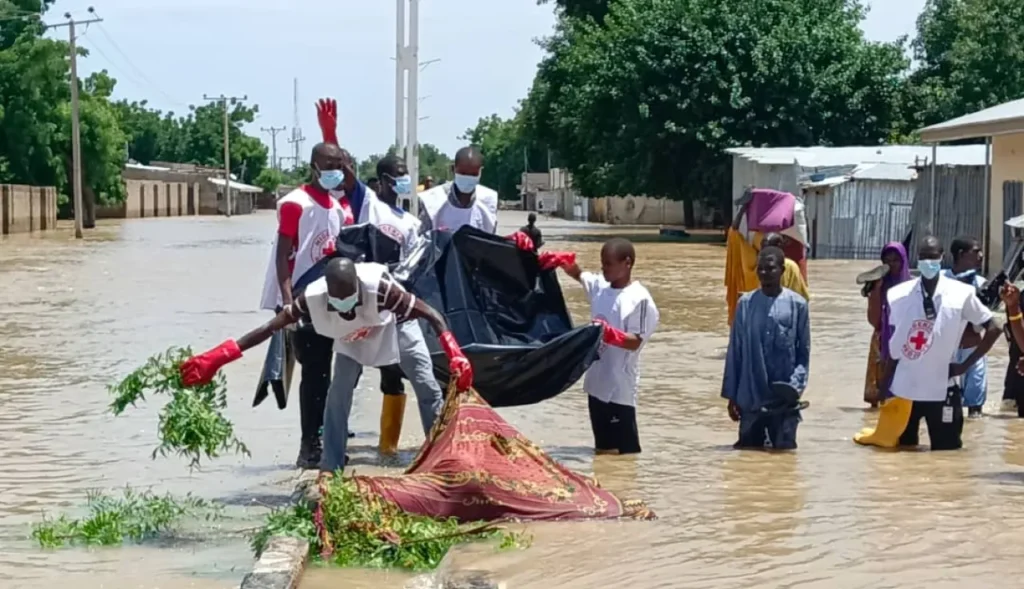
In Nigeria today, mental health challenges are on the increase owing to diverse trauma from insecurity, economic hardship and low self-esteem. Many people are suffering in silence while others are afraid of the sigma that would follow those that opened up on silent life-threatening issues affecting their well-being.
We are all aware that Psychosocial support is the broader assistance that helps people and communities cope with distress, trauma, and social disruption, particularly after emergencies.
As from 2009 till date, millions of Nigerians have been affected by the menace of insecurity and they are trying hard to live through kidnapping for ransom, terrorism attacks, communal violence, displacement, floods, poverty, and economic uncertainty.
The World Health Organisation says almost everyone affected by an emergency experiences psychological distress, while about one in five people affected by war or conflict develops a mental health condition.
Nigeria has a legal framework for responding to the problem. The National Mental Health Act 2021, which received presidential assent in January 2023, replaced the outdated Lunacy Act and established a rights-based framework for mental-health services, including community-oriented care and a Mental Health Fund.
The significance of the Act is that mental healthcare should no longer remain confined to psychiatric institutions. It should reach communities and become part of the wider health system.
However, a law cannot counsel a traumatised survivor, provide psychological first aid, assess a suicidal patient, or follow up a distressed family; concerned agencies, departments and mental health professionals must further encourage those that have suffered emergency trauma to seek solution in their facilities.
This is where psychosocial support becomes critical. Dr Benson Agbro of the Nigerian Red Cross Society has drawn attention to an issue that deserves wider public discussion: some hospitals already have psychosocial units, but many Nigerians do not know that these services exist.
That observation should lead to an uncomfortable question: How many of these units are actually functional?
Recent research puts the number of psychiatrists and other mental health professionals in Nigeria at fewer than 300 for a population exceeding 234 million. That is roughly one psychiatrist for more than 780,000 Nigerians. The shortage extends beyond psychiatrists to psychologists, psychiatric nurses, social workers, and other mental-health professionals, with services also unevenly distributed across the country.
The consequences are serious. Mental health problems that are not identified early can become more difficult to manage. Families may turn to unregulated providers, while people experiencing severe distress may be misunderstood, isolated, or subjected to harmful practices.
Meanwhile, the few professionals available face pressures that can encourage burnout and further migration.
Nigeria is also losing professionals it desperately needs. A nationwide study of early-career Nigerian psychiatrists found that 85.8 per cent had considered migrating, 69.2 per cent were considering leaving, and 52.9 per cent had taken practical steps towards migration. More than half believed they would be working abroad within five years. Financial and professional conditions were major factors.
This is more than the loss of individual doctors. When an experienced psychiatrist leaves, Nigeria also loses a potential trainer, supervisor, and mentor. The remaining professionals inherit greater pressure, creating a cycle in which shortage produces stress, depending on the circle of mental health crisis.
The workforce crisis becomes even more troubling when placed against Nigeria’s humanitarian reality.
United Nations High Commission for Refugees (UNHCR) data recorded 3.71 million internally displaced people in Nigeria as of July 1, 2026, with a total forcibly displaced population of about 3.84 million when refugees and asylum-seekers are included.
These figures represent people who have lost homes, livelihoods, relatives, schools, communities, and, often, their sense of safety.
Nigeria’s emergency response has rightly focused on keeping people alive. Victims need food, shelter, water, medical care, and protection. But survival is not the same as recovery.
A person rescued from kidnapping may return physically free but remain psychologically imprisoned by memories of captivity. A child who witnessed violence may develop fear, nightmares, or difficulty concentrating. A displaced parent may be struggling simultaneously with grief, unemployment, and uncertainty about the future. A flood survivor may lose a home and livelihood and spend months fearing another disaster.
These people need more than rescue and survival assistance. They need opportunities to recover.
The challenge is to move such successful interventions beyond individual projects and make them part of the national health system.
The government should also audit and map existing hospital psychosocial units, determine which are functional, fund those that are not, and make their services visible to the public.
Mental health and psychosocial support must become part of disaster and humanitarian planning. Emergency agencies, hospitals, and humanitarian organisations should have trained personnel and clear protocols for psychological first aid, referral, and long-term recovery.
Finally, Nigeria must retain the professionals it trains through better remuneration, safe working conditions, career progression, professional development, and incentives for service in underserved communities.
The country cannot continue measuring humanitarian success only by how many people were rescued, fed, or housed.
The more difficult question is whether those people were helped to recover.
Nigeria has written the law. It has professionals. It has tested workable models. What it needs now is political will, funding, coordination, and accountability.
A healthy mind is not a luxury for a prosperous economy. It is part of the infrastructure required to build one.
Nigeria’s mental-health emergency will not be solved by rescue alone. Those who survive crisis must also be given the opportunity to recover, rebuild, and become productive again.



