

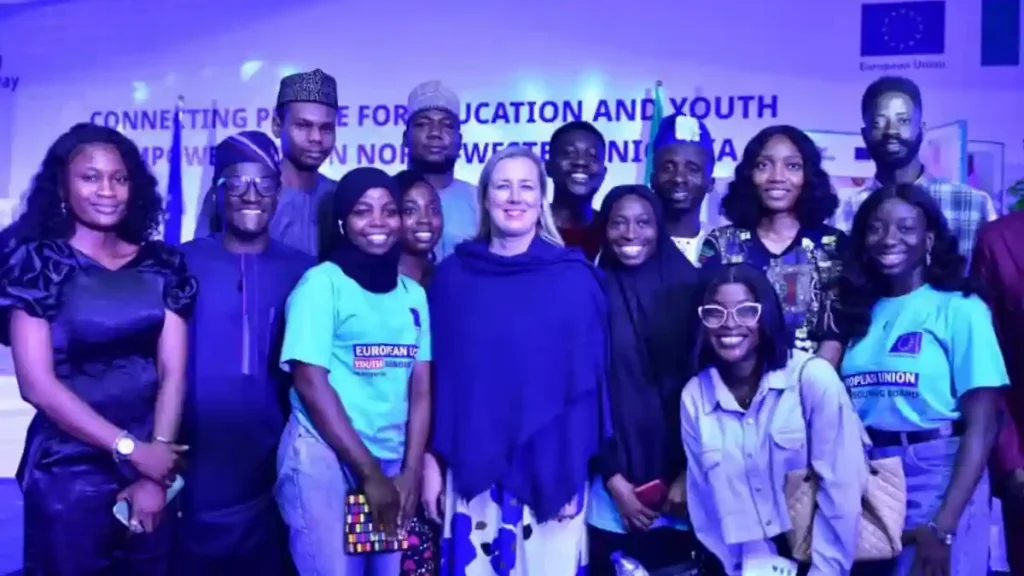
BY JENNIFER EZIMAKOR
The Federal Government and the European Union have inaugurated a National Programme Steering Committee (NPSC) to oversee the €40 million Education and Youth Empowerment in Northwest Nigeria (EYEPINN) project, aimed at tackling the region’s growing education crisis.
The programme, which will be implemented in Jigawa, Kano, and Sokoto states, seeks to reduce the number of out-of-school children, strengthen teacher training, and promote youth skills acquisition.
The steering committee, chaired by the Minister of Education, Dr. Tunji Alausa, and co-chaired by the Minister of Budget and Economic Planning, Atiku Bagudu, will provide strategic direction through annual meetings, while the EU Technical Assistance Team will serve as its secretariat. Quarterly technical meetings will also be held to monitor progress.
Speaking in Abuja on Thursday at the inauguration, Permanent Secretary, Federal Ministry of Education, Abel Enitan, praised the EU’s consistent partnership in improving access, equity, and quality in Nigeria’s education system.
Represented by Dr. Usman Ejeh, Director of Polytechnic Education and Allied Institutions, Enitan said, “The EYEPINN project represents one of the most strategic interventions aimed at addressing the persistent challenges of out-of-school children, teacher capacity development, safe learning environments, and skills acquisition for youths in Nigeria’s North West region.”
He emphasised the importance of collaboration and accountability.
“The committee serves not only as a platform for oversight but also a forum for strategic dialogue to ensure that the collective efforts of all partners are coherent, complementary, and impactful. We must ensure that every Euro invested translates into measurable impact, better learning outcomes, empowered teachers, safer schools, and a more resilient education system that leaves no child behind,” he noted.
The Team Leader for Human Development at the EU Delegation to Nigeria and ECOWAS, Leila Ben Amor Mathieu, described the initiative as the EU’s first standalone education project in the country.
“This is the EU Delegation to Nigeria’s first project solely on education. It is our flagship project. We really wanted it to be designed in tune with the ministry and to serve the needs of the Nigerian people,” she said.
She noted that the EU had earmarked €800 million for national programmes under its 2021–2027 commitment, alongside additional funds from regional windows.
“This is a €40 million project that we fund through UNICEF, Plan International, DIME, and some technical assistance provided to the ministry,” she added, explaining that the project focuses on basic education, particularly targeting out-of-school and nomadic children through partnerships with Quranic schools.
UNICEF’s Chief of Education, Vanessa Lee, said the project’s launch came “at a critical time in Nigeria’s education reform progress,” adding that it supports federal and state agencies in transforming the education system.
She reaffirmed UNICEF’s commitment to reducing the number of out-of-school children and strengthening literacy and numeracy initiatives, as well as providing continuous teacher training through school-based and play-based learning approaches.
The Plan International Country Director, Dr. Charles Usie, hailed the EU’s sustained investment in education and youth empowerment. “What this programme has done is actually to bring hope to a lot of children who would otherwise still be on the streets with no support and no help,” he said.
Similarly, Save the Children International Country Director, Duncan Harvey, described the initiative as a vital step toward inclusive education.
“Every child, no matter their status, no matter where they are living, no matter their gender, ability, or disability, deserves the right to quality basic education,” he said.
The North West region remains one of Nigeria’s most educationally challenged areas, plagued by insecurity, poverty, and inadequate infrastructure. Estimates indicate that around 20 million children are out of school nationwide, with a significant concentration in the North West.



