

……. Obi Says Kwankwaso Will Be an Active Partner, not ‘Spare Tyre’
…… Atiku, Others Still Shop for Running Mates
By Ameh George
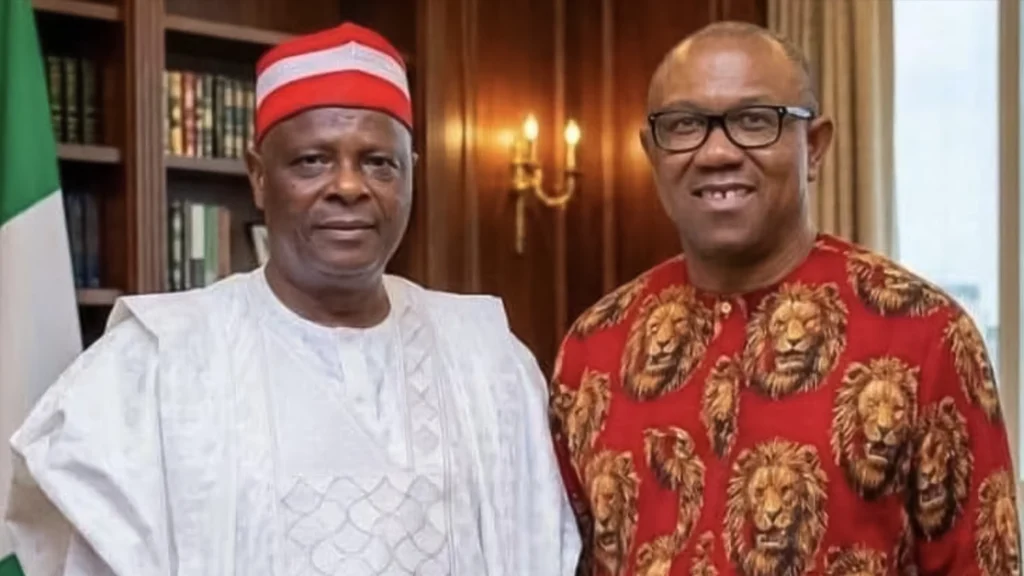
The presidential candidate of the Nigeria Democratic Congress (NDC), Peter Obi, officially announced former Kano State Governor Rabiu Kwankwaso as his running mate for the 2027 presidential election, after emerging as the consensus presidential flagbearer for the Nigeria Democratic Congress (NDC) in Abuja.
Obi formally unveiled the alliance at the NDC national convention. He pledged that Kwankwaso will be an active “partner” in governance and not a ceremonial Vice President. This marks a major realignment of opposition forces.
Peter Obi, says his running mate, Kwankwaso, will work as his partner and not a “spare tyre” if elected in the 2027 election.
Obi, a former governor of Anambra State, spoke at the NDC’s convention on Saturday shortly after he announced Kwankwaso as running mate following his ratification as the party’s presidential candidate in Abuja.
“Spare tyre” is a Nigerian expression used to describe deputy governors or vice presidents who are largely ceremonial and only given real responsibility or power when the substantive leader is incapacitated, unavailable or dead.
Speaking at the event, the NDC presidential candidate said his administration would prioritise partnership with his running mate to move the country forward.
“The government we intend to form will no longer be a government where anybody will say that the vice president is a spare tyre.
“The vice president will be a partner because we want to build a nation where there are two equal people who work for the greatness of the country.
“Decisions will be taken as partners. Everybody will be consulted. That is what we require, and that is how the government functions,” he said.
While Obi has settled for Kwankwaso, the candidate of the African Democratic Congress (ADC), Alhaji Atiku Abubakar, is still hunting for a running mate.
The New National Star reports that Atiku, a veteran of the presidential race, won his party’s presidential ticket on Wednesday, a result disputed by his fellow contestants.
The two contestants, Chibuike Rotimi Amaechi and Alhaji Mohammed Hayatu-Deen, condemned the outcome of the primary, which they alleged was neither free, fair, nor credible.
However, in his acceptance speech, Atiku called on the two men to join him in rescuing the country from the grip of the ruling All Progressives Congress (APC)
The former vice president subsequently visited Amaechi at his Abuja residence to seek his cooperation.
However, during the visit, Atiku was said to have remained silent on the issue of a running mate, neither asking the former governor to be his running mate nor discussing possible nominees.
A day after publicly criticising the process and outcome of the primaries, Amaechi insisted that he stood by his comments on the party’s primary.
He also said that no one had approached him about becoming Atiku’s vice-presidential candidate.
“I stand by what I said about the ‘concocted results,” Amaechi said firmly. “But I am still a member of the ADC. No one has asked me to be VP. They know my worth.”
Investigations indicated that Amaechi is not being considered for the position of running mate by Atiku and his close allies.
Sources close to Atiku and top party members are said to prefer that his running mate come from the South-East, which is considered his natural political ally and strategically important ahead of the 2027 general election.
The position of running mate was reportedly reserved for former Anambra State governor, Obi, before he resigned from the party and joined the NDC.
Investigations gathered that former Imo State governor and former deputy speaker of the House of Representatives, Emeka Ihedioha, is being tipped for the role of Atiku’s running mate.
Unlike many South-East politicians who left the ADC for the NDC alongside Obi, Ihedioha remained in the party and reportedly played a key role in mobilising support for Atiku during the presidential primary.
“He actually played a major role in ensuring that the region was delivered for the former vice president in the just-concluded presidential primary of the party,” said a senior party source on condition of anonymity because he was not authorised to comment publicly.
Ihedioha, who contested the 2019 governorship election on the PDP platform, was sworn in as governor of Imo State on 29 May 2019 but was removed from office by the Supreme Court on 14 January 2020. He was subsequently replaced by Senator Hope Uzodimma.
The former deputy speaker is still widely regarded as an influential political figure in the South-East, the same region from which Obi, the NDC presidential candidate, hails.
Reliable sources close to Atiku and members of his inner circle are said to be concerned that Amaechi, despite coming from the South-South, does not currently command sufficient political control in Rivers State or the wider region.
“Naturally, Atiku is looking towards the South-East for a running mate. Amaechi might have been considered if he had control of his region or even his state. It would amount to political suicide to pick someone who may not even be able to deliver his ward,” the source added.
In the search for a running mate, it was learnt that Atiku and the party are working in line with the electoral timetable released by the Independent National Electoral Commission (INEC).
Atiku’s Special Adviser, Paul Ibe, told our correspondent that consultations were ongoing and that the party would comply with the INEC timetable for the submission of its presidential ticket.
Ibe said the ADC remained committed to meeting all electoral deadlines set by INEC and would submit the name of its presidential candidate within the stipulated period.
According to him, consultations are continuing on the composition of the party’s ticket ahead of the 2027 general election.
Asked about speculation linking Ihedioha and Amaechi to the vice-presidential slot, Ibe ruled out Amaechi as a likely nominee.
However, he was less definitive regarding Ihedioha, declining to either confirm or deny reports that the former governor was under consideration.
He said, “As for the issue of a running mate, consultations are still ongoing. Rotimi Amaechi is not being considered. Atiku Abubakar’s visit to Amaechi has nothing to do with the vice-presidential slot.
“You are also aware that Amaechi himself has denied the speculation. On the other names being mentioned, I do not want to speculate at this point. When the party reaches a decision, Nigerians will be informed.”
A public affairs analyst, Summer Sambo, has suggested that the ADC presidential candidate, Atiku’s move to the South-East to shop for a vice-presidential candidate may be aimed at reducing the influence of the NDC presidential candidate, Obi, in the region.
Speaking on the development, Sambo, during an interview on Arise Television’s ‘Morning Show,’ said there are indications that Atiku will choose his running mate from the South-East.
He said, “The indicators around Atiku’s running mate suggest he’s likely to choose the South-East. The South-East has always been his political base in the South.
“In 2019 he picked Peter Obi, and in 2023 he picked Okowa. His move to the South-East may be aimed at reducing Peter Obi’s influence in the region.”
Meanwhile, a senior INEC source maintained that the date for the submission of candidates in the commission’s timetable remains valid.
The source said political parties have continued to comply with the electoral timetable despite the recent court judgement that has generated debate over the commission’s schedule for the 2027 elections.
“Mind you, another court has ruled that the commission has the right to fix the election timetable. We have also appealed against the initial judgement,” the source said, arguing that the ruling reinforces INEC’s authority to set and implement its electoral schedule.
According to the source, there has been no official alteration to the timetable, and political parties are proceeding with their activities in line with the existing schedule.
The development comes amid growing interest in the composition of the ADC presidential ticket and political parties’ preparations for the 2027 general election.
The commission fixed 29 August 2026 as the deadline for the submission of candidates’ names for the presidential and National Assembly elections.
Meanwhile, with President Bola Tinubu’s emergence as flagbearer of the APC on Saturday, there are concerns whether or not he will replace Vice President Kashim Shettima. The concerns stem from intense political calculations within the party, ahead of the 2027 presidential election. The speculation centres around shifting regional interests and whether President Bola Tinubu will retain his Muslim-Muslim ticket or adjust his political formula.
Recall also that the Minister of Culture, Tourism and Creative Economy, Hannatu Musawa, had warned that the APC may significantly weaken its chances in the 2027 presidential election if it drops Vice President Kashim Shettima from the ticket, or fails to pick a northern Muslim to run with President Bola Tinubu in his re-election bid.
Musawa spoke at an episode of “Mic On Show” with journalist Seun Okinbaloye.
Her comments followed rising speculation that the ruling party might consider altering the Muslim-Muslim presidential ticket with which APC won the 2023 election.
The minister cautioned that replacing Shettima or running without a northern Muslim would pose serious political risks for APC, particularly in the core northern states, where voting patterns were deeply influenced by regional and religious considerations.
Musawa stated, “If there is no Hausa, Fulani or Kanuri Muslim on that ticket, it creates a hurdle. That is the reality of the way people think.”
She explained that politics in northern Nigeria was deeply entrenched in social identity and historical voting behaviour, stating that the region remains one of the most politically sophisticated in the country.
Musawa said, “The core northern states, like Katsina, Kano, Kaduna, Kebbi, Jigawa, Zamfara and Sokoto, understand politics at a very deep level. Politics there, is a way of life. People wait every four years to line up and vote because that is where they feel they have influence.”
The unresolved debate over the 2023 Muslim-Muslim ticket continues to fuel backstage maneuvers. Some factions lobby for a Christian running mate to address regional and religious inclusivity, while others argue that doing so would fracture the APC’s core northern support.
Various high-profile political names have been speculated as potential alternative running mates, driving anxiety among Shettima’s loyalists.
Recent state house gatherings saw party leaders strongly endorse Tinubu for a second term but omit Shettima, breaking traditional party norms.
Both the APC and the presidency have repeatedly dismissed these rumours. APC officials, including National Publicity Secretary Felix Morka, have explicitly labelled talks of a Shettima replacement as purely speculative and utterly baseless. The presidency maintains that Tinubu and Shettima have an excellent working relationship.
Proponents argue that tinkering with the Tinubu-Shettima alliance could alienate the crucial northern Muslim voting bloc. Regional groups, such as the APC Youth Parliament, actively caution that replacing the VP could destroy the party’s unity.



