

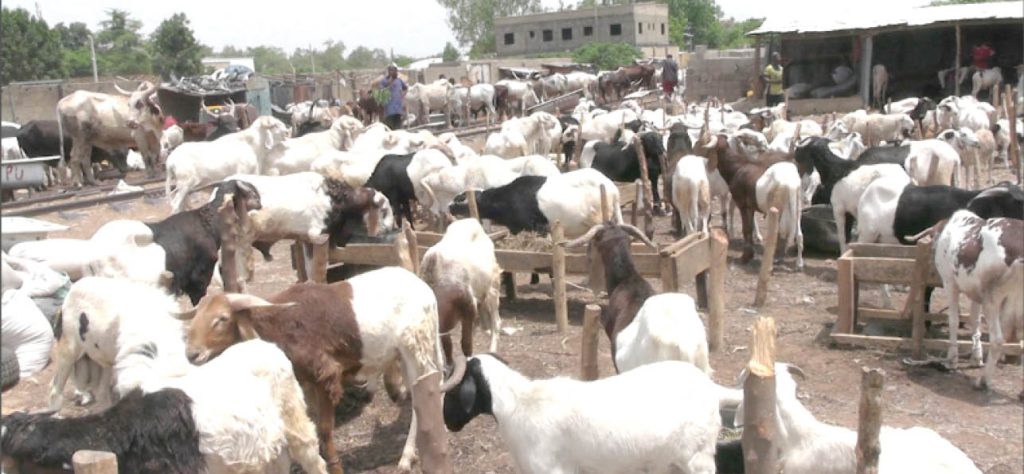
……..Traders lament poor patronage as ram sales N500,000 to N700,000
……..Merchants, buyers blame Mokwa flood for high cost of foodstuff in Niger state
……..Buyers shun rams, settle for cows
BY SAM OTUONYE AND DAVID ADUGE – ANI
The economic hardship in the country seems to have intensified as Nigerian Muslim faithful have decried the high cost of foodstuff in the country as they celebrate the Holy day of Eid-el-Kabir.
Our correspondents who moved round major markets in Abuja, and monitored reports from Kano, Kaduna, Port Harcourt, Minna, and Lagos, noted that prices of rams in the markets soared above the reach of a common man.
The federal government has declared today and Monday next week as public holidays to commemorate the Muslim Eid-el-Kabir.
This development is apparently due to the ban on export of livestock by the Nigerien government, a step it took to stop the surge in price of some animals within its own borders.
Supply shortage of rams in Nigeria therefore, has driven the price beyond the reach of most Nigerians, said traders and farmers.
Also, due to worsening security challenges in the country, Nigeria livestock business has taken a nosedive and investment in that area is no longer profitable, hence, the country depends on supply of livestock from other countries like Niger, Mali and Chad.
“The upcoming Sallah celebration and the export ban enforced by Niger are the main factors driving up ram and cow prices,” said Taofik Adewale, a trader at Agege Ram Market.
He emphasized that most livestock imports into Nigeria come from Niger Republic.
“We started seeing a gradual increase in prices of rams and cows in March when the Niger export ban was enforced,” he said, noting that the surge became rapid as Sallah approached.
According to surveys from Agege and Mile 2 markets in Lagos, rams now go for between N150,000 and N850,000.
A big one which sold for N350,000 before, is now averagely N700,000. The medium sized ram which sold for N300,000 at most before, now costs at least N500,000.
While a small sized ram that used to cost N165,000 before, now costs nothing less than N250,000.
The situation was not different in Abuja as large rams that used to go for between N180,000 and N350,000 now cost N600,000 and N900,000 respectively, while small rams sold for N100,000 to N190,000 now go for N200,000 and N500,000.
The New National Star visited some ram markets at the Apo and Nyanya areas of the Federal Capital Territory (FCT) with lamentations from both sellers and buyers, over low sales and high prices, forcing buyers to take the alternatives like settling for buying of goats and chickens
While a ram trader at Nyanya, Khalifa Usman lamented that the sales have been very dull, a buyer Kabiru, explained that he had to settle for chicken for his Sallah, saying the rams have gone out of reach.
“This thing is gradually going out of hand; last year, with 250,000, I was able to purchase a big ram that served my family for the Sallah. This year, I projected N300,000 considering the reported increase, but here I am, the ram is seriously on the high side. I have no choice than to settle for some chicken, which is also high in price,” lamented a disappointed Kabiru who blamed the Nigerian economy for his woes.
Similarly, a ram trader at Mile 2 ram market, Nofiu Ganiu, said, it is a common thing for prices of ram to shoot up during Sallah celebration because Muslims use them as sacrifice during the period.
He noted that this year’s surge has resulted from a combination of issues bedeviling the domestic livestock industry. Apart from the high demand and Niger ban, Ganiu said worsening insecurity and high logistic costs are also impacting prices.
“Insecurity has made several of our herders migrate to neighbouring countries. This has reduced our local livestock production,” he said.
“The situation has also made us import more to meet demand since local supply is dwindling,” he added.
Some ram traders in Lagos also lamented the preference for cows over rams by Muslims for the 2025 Eid el-Kabir celebration.
The traders disclosed this in separate interviews with the News Agency of Nigeria (NAN) on Thursday in Lagos.
The traders told NAN that most people prefer to buy cows rather than rams because of the size and the fact that five families could buy and share for the celebration.
A ram trader, Ibrahim Hassan, at the Lawanson area of the state, said patronage has been decent, but with an interesting twist.
“The patronage this year is not bad, but I have noticed that people are buying more cows than rams. I believe the reason behind this shift is that cows are more economical and offer better value for money.
“When families or even groups of friends come together, they can share a cow and still fulfil the sacrifice. That way, instead of each person buying a ram for over N500,000, they split the cost.
“The cheapest cow you can get right now is around N800,000, while the cheapest ram starts at about N550,000. Prices also vary depending on the size and weight of the animal.
“I have contacted my sources for more cows, but the market price has gone up since last week. It’s a volatile market, and prices can change quickly,” Mr Hassan said.
A buyer, Folajimi Aderibigbe, who confirmed the trend, said buying a cow seems like a better option.
“We are a family of eight, and instead of buying two small rams, we joined with my brother-in-law and bought a cow. It cost us N950,000, but we split it. Everyone still gets to perform their sacrifice and save money.
“Traditionally, rams are the preferred animal for Eid Kabir (Sallah). However, economic realities have changed things, and we must find a way to adapt,” he said.
In a related development, residents of Abeokuta and its environs have lamented the high cost of ram, while opting for alternatives.
Some of them, who spoke with the News Agency of Nigeria (NAN) on Thursday in separate interviews, noted that the exorbitant prices of sacrificial animals could make them seek alternatives.
Ganiyu Babalola, a civil servant, explained that he used to buy at least two rams to celebrate the festival with his parents and children.
Mr Babalola said the amount spent in 2024 to buy two rams is what he spent buying one this year.
“I remembered I bought the two rams for N250,000 each, but this year I got one for N470,000. Instead of buying two, I called my siblings and we contributed to buy a cow to support the ram I bought,” he said.
Akande Jimoh, a welder, said he has no plan to buy a ram this year, considering the cost implications.
”I can’t afford to buy a ram this year. The price of a big ram ranges from N550,000 to N800,000. Where will I get such money?
“I have decided to take two of the goats I am rearing to celebrate the festival. My God will understand.
“I wish the government had the power to control the prices of these animals,” he said.
On her part, Bidemi Ahmed said, “Ram, whether big or small, is not affordable this year compared to 2024.
“Although my husband has bought one, I must say I’m not so happy with the choice he settled for, at the rate of N250,000.
“Gone are those days when they will be begging you to buy, but right now, when you turn your back, they won’t even call you back,” she said.
Abdulfatah Akanni, an Islamic scholar, described the situation as a challenging moment for Muslims.
“As Muslims, we have to be cautious. Let’s cut our coat according to the size of our clothes,” he said.
In a related development, vegetable oil traders said they have observed increased patronage due to the Sallah celebration.
Linda Nwachukwu, a cooking oil trader at the Lawanson market, said the demand for cooking oil had increased because of preparations ahead of Sallah.
“The celebration usually increases the demand for groundnut oil. Consumers have been stocking up on oil since last week, especially now that there are a few days to Sallah.
“Cooking oil prices have risen, but it is cheaper than last December, a 25-litre container cost N110,000, a price that persisted until April 2025.
“A recent price adjustment, just three weeks ago, sets the current rates for groundnut oil at N78,000 for 25 litres, N35,000 for 10 litres, and N18,500 for five litres.
“This is unusual, groundnut oil prices normally surge in December and then decrease by January or February, but it stayed high for a long time,” she said.
Another trader, Imoleayo Fakunle, said she buys in larger jerrycans and sells in measured portions to customers who cannot afford bigger sizes.
“Not everyone can buy 25 litres or even afford the branded ones. So, as a vendor, what I do is buy in larger containers and sell in small portions.
“Groundnut oil is expensive, but it is essential. A lot of customers have been buying the measured portions, and they are always happy that they can save money.
In a related development, residents of Abeokuta and its environs have lamented the high cost of ram, while opting for alternatives.



