

On June 14, 2023, Otunba Gbenga Daniel, a former governor of Ogun State, ignited a wave of resentment against continued payment of humongous pensions to past elected officials who had served for whatever length of time and find themselves in another public office where they take home huge sums as salaries and allowances.
That year, OGD, as he is popularly called, following his election as senator representing the Ogun East district, had asked his State Government to stop the payment of his monthly pension as an ex-governor, given as he called it, the “ethical code against double emoluments that a serving Senator of the Federal Republic of Nigeria who hitherto was a former State Governor, shall not be entitled to the payment of pension and allowances from such state.”
His letter read in part: “I write to request for the suspension of my monthly pension/allowances of N676,376.95 (gross) (Six Hundred and Seventy-Six Thousand, Three Hundred Seventy-Six Naira, Ninety-Five Kobo) being paid as a former Executive Governor of Ogun State.
“It is pertinent to also have it on record that since I left the office in 2011, I have not benefitted from any welfare packages, be it medical, furniture, transportation etc.”
It is not certain how many of his colleagues in the National Assembly or in the current cabinet, including President Bola Ahmed Tinubu, have reasoned alongside OGD and stopped such allowances being paid to them by their state governments.
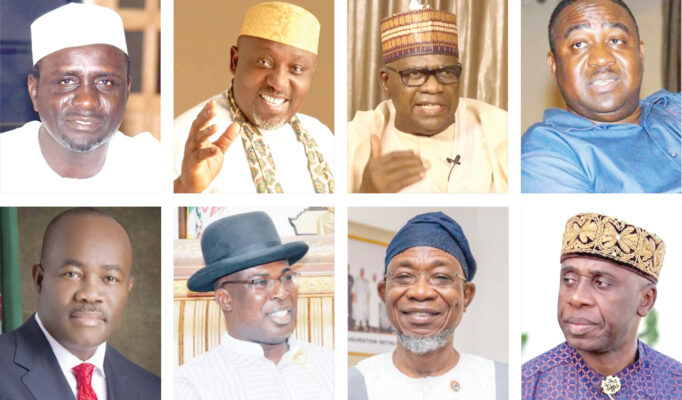
And they are legion: Godswill Akpabio, Orji Uzor Kalu, Nyesom Wike, Adeboyega Oyetola, Atiku Bagudu, David Umuahi, etc.
Lagos State started the obnoxious practice in 2007 when it enacted a law that provided a former governor life pension at the rate of N30 million per annum; a house in Lagos and Abuja for those who served two terms; six brand new cars every three years; free medical care for him and his family members; and a retinue of domestic servants.
Other governors after the class of 2007 have jacked up the perquisites such as the N300 million pension benefits for an ex-governor in Gombe State.
Godswill Akpabio, former governor of Akwa Ibom State and now a senator, signed a pension Act that provided N200 million annual benefit to an ex-governor.
In 2017, reports indicated that 21 state governments had paid N37.4 billion as pension payments to 47 former governors.
But two years after OGD ignited the fire, the revered Justices of the Court of Appeal have reasoned alongside the former Ogun State helmsman.
In what can be described as a landmark ruling, the Court of Appeal has faulted the payment of either severance allowance, pension or gratuity to political office holders and political appointees, saying that the practice was morally wrong.
The three-man panel of the court in a judgment on an appeal marked: CA/A/810/2017 filed by the Governor of Kogi State and three others ruled that it is unjustifiable in the face of the nation’s socio-economic reality for some few politicians, who hold office for not more than eight-years, to allocate huge public funds to themselves under the guise of pension and severance package while civil servants, who committed most of their active years to the service of the nation are denied their retirement benefits.
In his lead judgment, Justice Emmanuel Agim said: “I must state here that the claimants’ claim for payment of severance allowance, because the tenure of their appointment has come to an end, is as unfounded as is morally wrong.
“The fact that elected pubic officeholders and political appointees are paid huge amounts of money as monthly salaries and other forms of allowances while in office, is common knowledge in Nigeria and is not reasonable to open question.
“It is also common knowledge that many of them after an office tenure of between three to eight years become stupendously wealthy, exhibiting mind-blowing opulence and splendor. Yet these office holders insist on being paid severance allowance for holding such offices.
“Meanwhile, career civil servants who have served this country or their states or Local Governments all their life, can hardly collect their pensions and gratuity when retired. They are now being subjected to contributory pension schemes in which they contribute part of their monthly meagre salaries that are always paid in arrears while in service, to be able to earn pension and gratuity upon retirement.
“The political appointees and elected public office holders, who do not work as long and as hard as the career civil servants quickly get paid huge severance allowances upon leaving office in addition to the huge wealth they acquired while holding such offices and without having been subjected to any contributory pension schemes.
“It is not morally right to pay an elected public officer or political appointee pension and gratuity or severance allowance for holding such an office for three to eight years as the case may be.
“It cannot be justified in the context of our present social realities; it amounts to gross social injustice.”
We salute the courage of these eminent jurists and hope that in case the matter goes to the Supreme Court, the final arbiter in the land, the Justices there will uphold the truth.
“It is not morally right to pay an elected public officer or political appointee pension and gratuity or severance allowance for holding such an office for three to eight years as the case may be.”



