

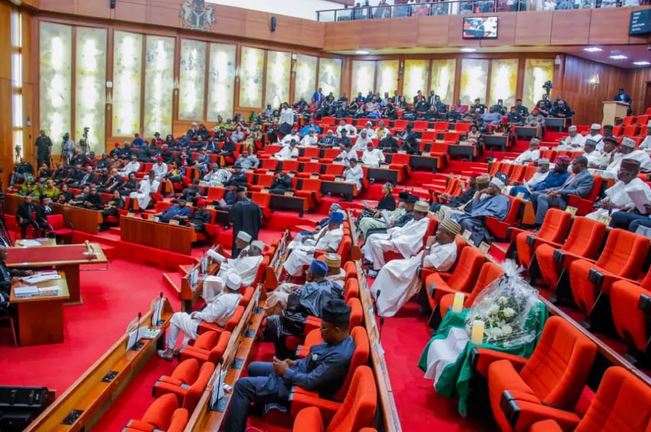
…….Allegation laughable, say Sen. Imasuen, Hon. Salam
……There’s top-flight corruption in NASS – ADC
…..Clerk must be protected – CUPP
BY BEN OGBEMUDIA AND JOHN DANJUMA
It was a moment of startling revelation as a clerk in one of the committees of the House of Representatives could no longer hold back, exposing alleged corruption involving members of the National Assembly in the course of their oversight functions.
In a viral video that has since sparked public debate, the visibly agitated clerk lamented the extent to which lawmakers engage in corrupt practices at the expense of Nigerians.
Speaking at a retreat organised by the National Institute for Legislative and Democratic Studies (NILDS), she alleged that lawmakers receive bribes from Ministries, Departments, and Agencies (MDAs) during oversight visits, manipulate reports, and misappropriate funds meant for staff welfare.
“And why am I mad? I’m mad because we talk, we don’t do. I’m mad because nobody listens. Our legislators are not here; we are talking to ourselves. Now, we don’t have the power to do anything about the things we discuss,” she said.
She further revealed how agencies under oversight often pay for lawmakers’ flight tickets, accommodations, and provide cash inducements, ultimately compromising the integrity of oversight reports.
“We are talking about oversight. How do we explain that the agency being oversighted is the one paying for the flight ticket? What report are you going to write? They give you money, tell you what to write, quarter you, and provide logistics. Then members come and fight over the money they received; they won’t even give the clerk or the committee assistant a dime,” she said.
She continued: “But that’s not even the issue. You are then compelled to write a report about things you didn’t see. Me, as a Catholic, I first go to confession. Last year, we had a public hearing, and the committee told me that a consultant would write the report. I asked the consultant if he was present at the hearing, he said no. So, what report is he writing? I, Ifeoma, will not give you material to fabricate a report. I refused to work with him.”
Recounting her resistance to such pressure, she added:
“I sat down and wrote the proper report of that hearing and presented it to the Chairman. He was shocked. He said, ‘You mean it?’ I said yes. They asked me to change it, but I refused. I told them the original report is on my system. I don’t use secretaries. I type my reports myself. If they want to change it, let them. I’m waiting.”
The National Assembly has however pushed back strongly, dismissing the clerk’s claims as unfounded and laughable.
Senator Neda Imasuen (Edo South) expressed shock that a civil servant could accuse lawmakers of corruption, insisting that oversight functions are critical to ensuring transparency and accountability in governance.
“Oversight functions are constitutionally backed and essential for supervising government programmes. It is not corruption,” Imasuen said.
He emphasized that lawmakers use constituency allowances to fund their work in the field, including monitoring projects initiated by the executive.
“According to the Constitution and the Appropriation Act, it is the executive that carries out development projects, but the legislature has the mandate to track and monitor those initiatives.”
Similarly, Hon. Bamidele Salam, a member of the House of Representatives, described the viral video as “laughable,” urging civil servants to be cautious in their public remarks so as not to incite the public against legislators.
“Legislative oversight is a robust constitutional tool to check executive excesses, reduce corruption, and enforce accountability,” Salam said.
He acknowledged that public perception of misuse of oversight powers has drawn criticism but offered a roadmap to reform:
“To improve oversight, electoral reforms are needed to empower citizens to vote out underperforming representatives. Independent candidate selection, financial autonomy for the legislature, and elimination of inducements during oversight are essential.”
Meanwhile, the African Democratic Congress (ADC) has backed the whistleblowing clerk, describing the practice of agencies funding oversight visits as outright corruption.
Party spokesperson, Hon. Bolaji Abdullahi, said:
“It is against fairness and transparency to allow agencies being scrutinized to foot the bills of their oversight. This undermines accountability and robs Nigerians of the dividends of democracy.”
In its own statement, the Coalition of United Political Parties (CUPP) called the allegations “damning” and demanded urgent investigations.
In a statement issued by CUPP Secretary, Peter Ameh, the group described the National Assembly as a “cesspool of corruption,” adding that the clerk’s testimony was a bold indictment of a deeply broken system.
“Her revelations show that our lawmakers—entrusted with upholding justice—have instead become champions of corruption. This is systemic rot threatening our democracy.”
Ameh warned that the whistleblower could be targeted and called for urgent passage and enforcement of whistleblower protection laws.
“Protecting the Clerk is a litmus test for Nigeria’s democratic commitment. Her safety must be guaranteed, and her testimony must lead to investigations—not silence.”
He also condemned the silence of anti-corruption agencies like the Economic and Financial Crimes Commission (EFCC) and the Independent Corrupt Practices Commission (ICPC):
“In any functioning democracy, her revelations would trigger arrests and legislative audits. But in Nigeria, they’re met with silence. The Assembly was meant to check corruption in MDAs but has instead become a breeding ground for impunity.”
Ameh concluded with a passionate appeal:
“We must rise above the numbness. Citizens must demand a legislature that serves the people—not itself. It’s ti
me to reject apathy and hold our representatives accountable.”



