

… Empowers governors to appoint commissioners
… Says reform will tackle insecurity, strengthen federalism
… CSOs, experts express mixed reactions
By Cyril Ogana Jr
The passage of the State Police Bill by the Senate on Wednesday is seen by many Nigerians as a landmark constitutional amendment. The bill, when passed into law, will decentralise the nation’s security architecture and end 66 years of a single, centralised federal policing system to help address worsening insecurity in the country.
The passage followed a rigorous clause-by-clause consideration of the bill and came after more than two-thirds of senators voted in support of the bill through a manual voting process conducted on the floor of the chamber.
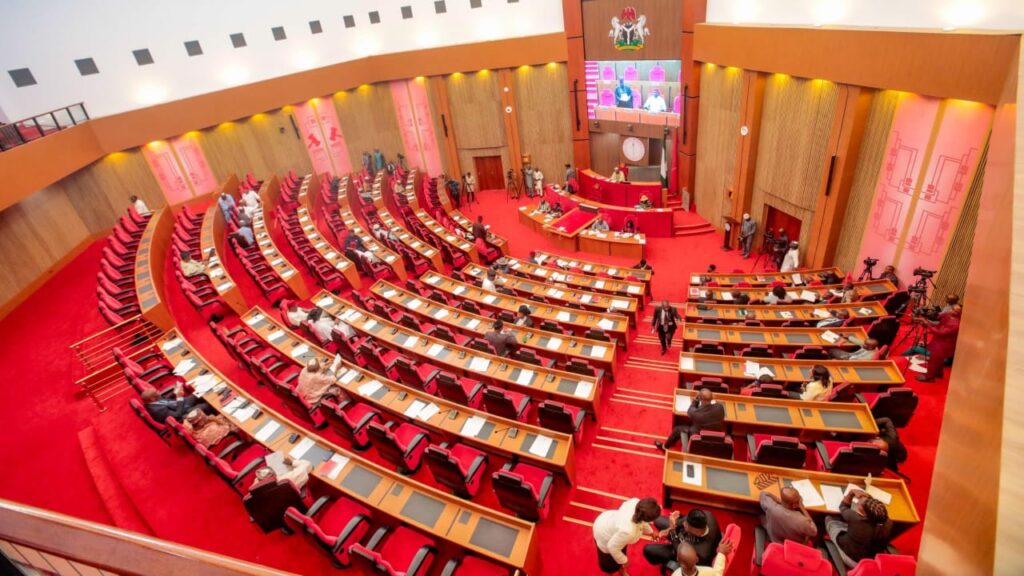
The President of the Senate, Godswill Akpabio, announced the passage of the legislation after lawmakers overwhelmingly backed the proposal during plenary.
The upper chamber approved the bill after considering the report of the Senate Committee on the Review of the Constitution, presented by Deputy President of the Senate and committee chairman, Barau Jibrin.
The bill’s provisions were first considered at the “Committee of the Whole” before lawmakers adopted them and proceeded to a final vote.
Recall that President Bola Tinubu had on Tuesday formally transmitted the proposed State Police Bill to the Senate, setting the stage for a major overhaul of Nigeria’s policing architecture, as the Upper Chamber signalled their readiness to fast-track consideration of the legislation amidst growing calls for decentralised security structures.
The President has described the creation of state police as “unavoidable,” arguing it will significantly improve localised intelligence gathering and rapid threat response. Lawmakers championed the bill as a listening Parliament’s answer to modern security needs.
Owing to its importance, the proceedings attracted unusual interest from top government officials and state executives, leading to a procedural debate over whether non-members should be allowed into the chamber to witness deliberations.
The issue generated heated exchanges among lawmakers after Senate Leader, Senator Michael Opeyemi Bamidele, moved a motion to suspend Senate rules to permit selected officials to observe proceedings from within the chamber.
Several senators opposed the proposal, insisting on adherence to parliamentary procedures.
Following consultations among members of the Senate leadership, a compromise was reached, allowing the visitors to observe proceedings directly, inside the chamber.
Among those who monitored the debate were the Chief of Staff to the President, Hon. Femi Gbajabiamila; Governors Uba Sani of Kaduna State, Lucky Aiyedatiwa of Ondo State and Dapo Abiodun of Ogun State; Attorney-General of the Federation (AGF) and Minister of Justice, Lateef Fagbemi (SAN); and the Attorneys-General of Kaduna, Ogun and Ondo States.
However, the debate on the legislation was led by Bamidele, who urged senators to support what many lawmakers described as a critical reform aimed at tackling insecurity and strengthening federalism.
The legislation seeks to establish a state policing framework that would operate concurrently with the existing federal police system, effectively ending the exclusive control of policing by the Federal Government.
A key provision of the bill “empowers state governors to appoint Commissioners of Police for their respective states, subject to confirmation by the state Houses of Assembly.”
Under Clause 17 of the proposed constitutional amendment, “while the Federal Police Service will continue to be headed by the Inspector-General of Police, each State Police Service shall be headed by a Commissioner of Police appointed by the governor and confirmed by the legislature of the state.”
The bill further outlines the operational relationship between governors and state police commands.
Section 17(6) provides that “a governor may issue lawful written directives of a general policy nature to the Commissioner of Police on matters relating to the maintenance of public safety and public order within the state.”
To address concerns over potential abuse of the new policing structure by state governments, lawmakers included safeguards aimed at protecting political freedoms and civil liberties.
Section 17(7) specifically states that “a state Commissioner of Police shall not arrest, detain, investigate or deploy force against any person, political party or group merely for criticising the government except in accordance with the law.”
The provision is intended to prevent state police formations from being weaponised against political opponents, activists, journalists or dissenting voices and ensures that any action taken must comply with due process and existing legal provisions.
Lawmakers adopted a manual voting process following concerns that technical glitches affecting some voting devices could disenfranchise senators and undermine the integrity of the exercise.
The decision followed a motion made by Bamidele, who argued that every senator should be given an equal opportunity to participate in the historic vote.
Akpabio backed the proposal, insisting that an open voting system would not only guarantee full participation but also promote transparency by allowing Nigerians to know where their representatives stood on critical constitutional issues. Senators contributed and the Bill was finally passed through a manual voting.
Speaking after the passage of the bill, Akpabio commended senators for what he described as painstaking and patriotic consideration of a historic piece of legislation.
Akpabio expressed confidence that the proposed reform would strengthen the fight against criminality, terrorism and banditry while bringing policing closer to local communities.
The House of Representatives had earlier passed the same legislation and it is expected to be ratified by at least two-thirds of state Houses of Assembly.
The legislation would usher in a new era of policing in Nigeria, shifting significant security responsibilities to the states while preserving federal authority over matters of national importance.
The successful passage of the State Police Bill represents one of the most consequential constitutional reforms undertaken by the 10th National Assembly and is expected to reshape Nigeria’s security architecture if it secures the required approval of state Houses of Assembly and other constitutional processes.
The Senate has shifted the battle ground to States as it requires 24 out of 36 states to approve the alteration of the constitution and creation of the State police in line with the provisions of the constitution.
Critics, however, have consistently warned that state police could be abused by governors to intimidate political opponents and suppress dissent.
With the Senate’s approval, the proposal has now crossed a major legislative hurdle, bringing Nigeria closer than ever to the creation of state-controlled police services operating alongside the federal police system.
Meanwhile, Citizens and civic groups have voiced diverse opinions. Many view it as a positive and long-overdue step that enables state and local communities to effectively secure their own environments.
Critics and civil liberties advocates have expressed scepticism, warning that state governors might weaponise a localised police force as a tool for political witch-hunting, suppressing opposition, or intimidating residents.
There are also lingering concerns over the financial viability of state forces and fears that they could struggle without reforming the fundamental challenges currently facing the broader Nigerian security architecture.
An expert in Police reform, Dr. Chima Anthony, said he preferred the establishment of Regional Police to State Police, as such regional formations offer safer path to true federalism.
But, speaking on phone to the New National Star from Port Harcourt yesterday, he stated that while full state-level policing can address some federalism imbalances, it risks profound pitfalls in Nigeria’s current socio-political reality, potentially deepening division rather than delivering security.
He further stated that structuring policing around Nigeria’s six geopolitical zones offers devolution that enhances responsiveness without chaos, adding that such regional formation tailored security to regional crime patterns, cultures, and dynamics while preserving national cohesion.
“This push aligns with broader federalism reform efforts in Nigeria, where debates on true fiscal, political, and security devolution have gained momentum.
“Yet, while full state-level policing addresses some federalism imbalances, it risks profound pitfalls in Nigeria’s current socio-political reality—potentially deepening division rather than delivering security.
“Hyper-fragmentation, capacity shortfalls, abuse potential, standards and trust erosion as well as coordination failures are some of the reasons why pure state police remain fraught with danger.
These risks echo concerns in ongoing debates, including fears of ‘decentralised despotism, and historical abuses.
Certainly, the bill, as expected would trigger intense debate across the country in the coming days as supporters hail it as a long-awaited solution to Nigeria’s security challenges, while critics continue to raise concerns about the possibility of political interference at the sub-national level.



