

BY SAM OTUONYE
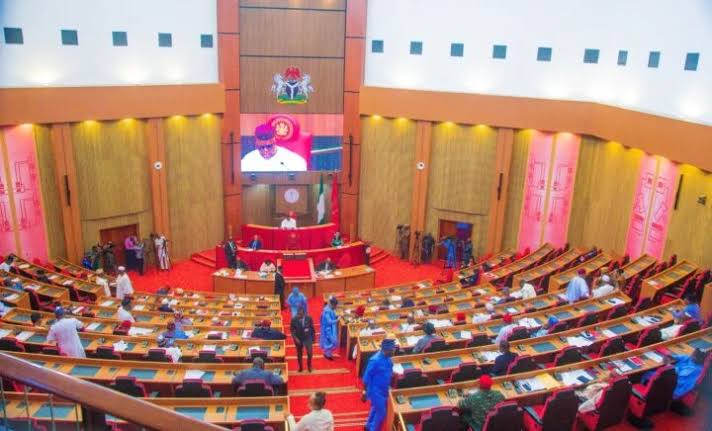
The Senate yesterday, finally passed two out of the four controversial Tax Reforms Bills: Nigeria Revenue Service (NRS) and Nigeria Tax Administration Bill even as it asked the Judiciary to interpret the bills as appropriate.
The four bills which include Nigerian Tax Bill, Tax Administration Bill, Revenue Tax Board Bill, and Nigerian Revenue Service Establishment Bill were forwarded by the President six months ago as part of efforts to reform the country’s fiscal policies and boost revenue generation.
The passage took a long deliberation that lasted more than six hours, both for closed-door meetings and clause by clause consideration of the bills.
The President of the Senate, Senator Godswill Akpabio, said the National Assembly’s role is to enact the law but it is the work of the Judiciary to interpret the laws so enacted.
“So let us not sit down here after we have finished enacting the law, or try to interpret it. If we do so, we are taking over the job of the judiciary,” he said.
The first bill is for an act to repeal the Federal Inland Revenue Services Establishment Act 13 of 2007 and enact the Nigeria Revenue Service Establishment Act to establish the Nigeria Revenue Service charged with powers of assessment, collection of, and accounting for revenue accruing to the government of the Federation and for related matters 2025.
The second bill, Nigeria Tax Administration Bill is to provide for the assessment, collection of, and accounting for revenue accruing to the Federal Republic of Nigeria, the states and local governments, prescribe the powers and functions of tax authorities and for related matters.
Both bills scaled third reading and were passed by the Senate after thorough scrutiny which led to amendment and deletion of some clauses in the bills.
Akpabio thanked the chairman and members of the finance committee, the consultants, and the special committee of the senate, and all senators that worked on these two bills.
He also prayed that these bills will revolutionise tax collection distribution in Nigeria.
“I like your patriotic zeal and determination that from morning to past five in the evening, you have sacrificed so much to ensure that you dot the I’s and cross the T’s and amend where necessary to have a document that can withstand the test of time and work for the whole Nigeria. Today, you have dispelled rumours. You have shown that these tax reform bills were not meant to serve any section of Nigeria or any group of persons. You have shown that these tax reform bills are actually meant for the collective good of all Nigerians to reform our tax administration, tax collection, and add value to governance in Nigeria. So I thank all of you,” Akpabio said.
Some clauses in the bill quickly stirred discontent when the senate dissolved into the committee of the whole to consider the provisions one after the other.
Clause 22 immediately came under scrutiny. It proposed that “three percent of the total revenue collected by the service, which shall be appropriated by the national assembly, subject to the review of the percentage from time to time, depending on the economic situation or as the economic situation requires.”
Sen. Aliyu Wadada raised a concern, suggesting that the figure be reduced to two percent. He argued that the total revenue involved was so substantial it exceeded the combined budgets of 16 states, and therefore required careful management, especially since it includes both oil and non-oil revenue. His amendment was eventually adopted.
Clause 39 also triggered debate when Sen. Adams Oshiomhole, backed by Sen. Ibrahim Dankwambo, cautioned against excessive legislative control over the service’s financial operations. “Anything done should be overseen by the senate, but this should not mean day-to-day interference. That would create bottlenecks and delay urgent financial decisions,” Oshiomhole warned.
But defending the clause, Sen. Sani Musa explained that its purpose was to strengthen the national assembly’s oversight and promote accountability in public finance. He stressed that the intent was not to obstruct timely financial action, but to curb unauthorised expenditures. In the end, the clause was retained.



