

By Cyril Ogana Jr
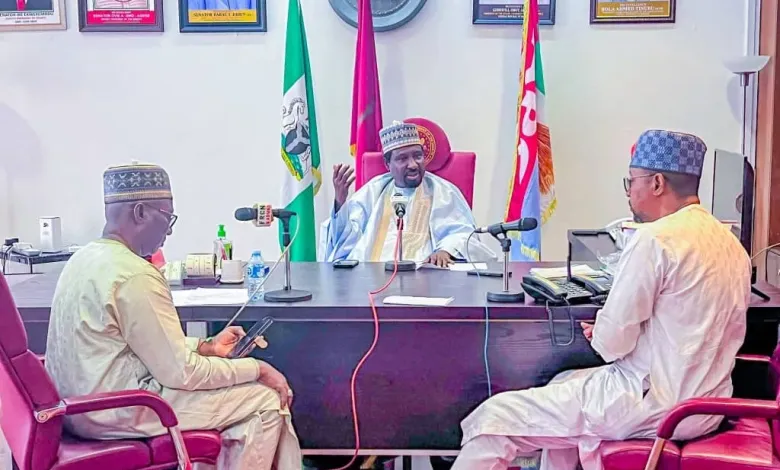
The Deputy President of the Senate, Barau Jibrin, has said that President Tinubu’s push for the establishment of state police as a stroke of genius, that would significantly strengthen Nigeria’s security architecture and help tackle insecurity, particularly in Northern Nigeria.
A statement issued on Sunday by his Special Adviser on Media and Publicity, Ismail Mudashir, said the Deputy Senate President fielded questions from callers across Northern Nigeria during the two-hour programme, where he explained the rationale behind the State Police Bill recently passed by the Senate.
According to him, the executive bill, initiated by President Tinubu, was the product of extensive consultations involving the Presidency, the National Assembly, the Inspector-General of Police, retired police officers, policing experts, governors, civil society organisations and members of the public.
The Chairman of the Senate Committee on Constitution Review said the proposal had also undergone public hearings across the six geopolitical zones and the Federal Capital Territory, with several safeguards incorporated to prevent abuse.
“President Tinubu carefully studied the situation and discovered that while many Nigerians support State Police, there are fears that it could be abused or misused for political or ethnic purposes. That is why safeguards have been built into the system,” Barau said.
He explained that state police would complement, rather than replace, the Nigeria Police Force by enhancing community-based policing through officers recruited from their local communities.
“State Police operatives, who will be recruited from local communities, know the people, the terrain and even the criminals. This will significantly improve our response to banditry, kidnapping and other crimes.
“The North stands to benefit significantly. This initiative is designed to bring lasting peace to the worst-hit areas,” he said while responding to a question from Zubairu Mohammed, a farmer from Kankia Local Government Area of Katsina State.
The Deputy Senate President said the proposed constitutional framework contained adequate legal protections and institutional checks to guard against political interference or abuse.
“If State Police are used for intimidation or actions that threaten lives and property, the President has the constitutional authority to intervene and direct the Federal Police to take over,” he said in response to a question from Abubakar Auwal of Sokoto State.
Barau also reassured Nigerians that responsibilities would be clearly defined between the federal and state police services, with the Nigeria Police Force retaining responsibility for national security matters such as terrorism and cybercrime, while state police would focus on internal law enforcement and public order.
Responding to a question from Nazifi Ibrahim, the lawmaker said state police commandants would be appointed through a rigorous process and protected by law from undue political interference.
He also acknowledged concerns over funding and operational capacity, saying the necessary financial frameworks and operational standards would be developed as the constitutional amendment process and enabling legislation progressed.
Barau expressed confidence that state Houses of Assembly would support the initiative and urged Nigerians to embrace the reform as a necessary step towards addressing the country’s security challenges.
“We must re-engineer our security architecture to better protect lives and property while guarding against abuse. This is a balanced, consultative initiative built on safeguards and aimed at bringing policing closer to the people,” he said.
The Senate recently passed the Constitution Alteration Bill seeking to create state police as part of the ongoing amendments to the 1999 Constitution.
The proposal, which has generated nationwide debate over its benefits and possible misuse by state governments, is expected to undergo further legislative processes, including consideration by state Houses of Assembly, before it can become law.
Katsina Targets African Model For Enterprise Development – Gov Radda
Katsina State Governor, Malam Dikko Umaru Radda, has said that the state is targeting an African model for enterprise development in the policies and programmes of the Katsina State Enterprise Development Agency, KASEDA.
A statement by the Chief Press Secretary to the Governor, Ibrahim Kaula Mohammed, disclosed that Radda made this known on Saturday at the KASEDA 2026 High-Level Board Retreat held at Zuma Rock Resort, Niger State.
The Governor, represented by the Deputy Governor, Faruk Lawal, said KASEDA had reached a defining moment that would determine what the agency becomes over the next decade.
At the end of this retreat my expectation is that we would have laid the foundation for an institution that is not only respected within the confines of our state but recognized nationally and ultimately across Africa as a model for enterprise development, institutional excellence, innovation, and inclusive economic transformation,” he said.
The governor noted that the Micro, Small and Medium Enterprises remain the backbone of every resilient economy. He stressed that they create jobs, stimulate innovation, strengthen local value chains, reduce poverty, provide opportunities for women, young people, artisans, farmers, and emerging entrepreneurs.
He said Katsina had already earned national recognition after being named the Best Sub-National SME Development Agency in Nigeria, while one indigenous enterprise won the Most Outstanding SME at the 2025 National MSME Awards.
“Our ambition should not simply be to remain among the best in Nigeria. Rather, it should be to build an institution that other states deliberately study, learn from, and seek to replicate,” the governor added.
Governor Radda also highlighted the KASEDA Road Corridor Enterprise Infrastructure Programme, which maps roadside enterprises across the state’s 34 Local Government Areas.
“The comprehensive mapping of roadside enterprises across the 34 Local Government Areas has provided the government with an immeasurable understanding of the enterprise landscape within our state,” he explained.
He urged the management of KASEDA to implement the initiative with urgency in line with government approval.
According to him, the success of the programme should not be measured by the number of enterprise structures provided, but by access to finance for entrepreneurs, improved productivity, expanded markets and better livelihoods for families.
“Government creates the enabling environment; entrepreneurs create prosperity. KASEDA exists to ensure that the latter is naturally achieved,” he said.
Earlier, in his welcome address, the Director-General of KASEDA, Dr. Babangida Kabir Ruma, pledged to build an institution that delivers measurable results.
“The responsibility entrusted to us goes beyond programme implementation. It is a responsibility to build an institution that inspires confidence, delivers measurable results and serves as a model for enterprise development across Nigeria,” Ruma said.
He noted that entrepreneurs today require more than training, adding that they need access to finance, markets, technology, business advisory services, digital solutions, strategic partnerships and responsive institutions.
“Let us speak openly, let us challenge ideas constructively, let us learn from one another, and above all, let us remain focused on one shared objective to build a stronger institution capable of delivering greater value to the entrepreneurs and people of Katsina State,” the DG said.
The Lead Presenter and CEO CRC Credit Bureau, Ahmed ‘Tunde Popoola, called for a fundamental shift in how Nigeria approaches economic development, stating that Micro, Small and Medium Enterprises, MSMEs, institutions are “critical infrastructure for national economic transformation” and not just support programs.
Popoola said the real work of inclusive prosperity happens at the sub-national level, through agencies built to support MSMEs. He stressed that when these institutions are built with intention, they identify entrepreneurial talent early, build business capacity to survive and scale, and surface the financing gaps that limit a country’s economic potential.
“The true measure of an MSME institution is not the number of entrepreneurs it trains or the volume of loans it disburses. Its success lies in how effectively it transforms businesses into engines of innovation, jobs, wealth creation, and inclusive economic prosperity,” Popoola stated.
He noted that for states like Katsina, where poverty rate stands at approximately 72.7% according to MPI 2023, bridging the gap through enterprise development is not optional, it is urgent.
Popoola outlined a roadmap for KASEDA to position itself as the architect of Katsina State’s economic transformation by adopting a “Strategic Modern Model” instead of the traditional approach of training, grants and one-off interventions.
The modern model, according to Popoola focuses on ecosystem building and coordination, policy leadership and advocacy, investment facilitation, cluster and sector development, innovation, digital transformation, and export readiness.
“KASEDA must embrace the modern model to drive real economic transformation in Katsina,” he said. “This means statutory autonomy, the right people with entrepreneurial passion, and revenue independence to ensure sustainability.”
Popoola also called for the adoption of technology to drive impact, including a Digital MSME
Registry, Data-Driven Targeting, AI for Credit Access, and Digital Market Linkages to connect Katsina businesses to e-commerce and export opportunities.



