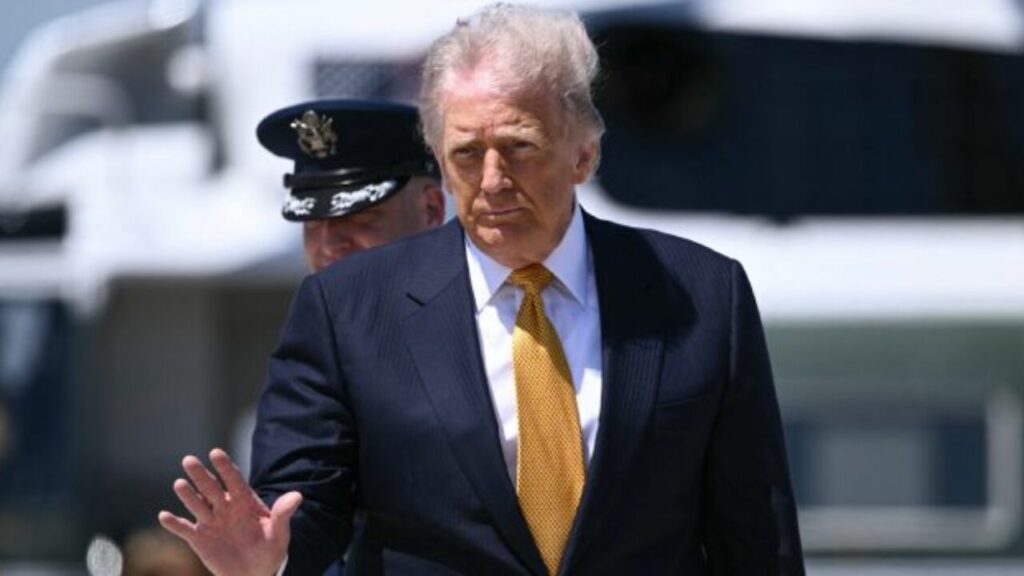
US President Donald Trump said on Tuesday that Americans’ financial
struggles are not a factor in his decision-making as he seeks to negotiate an end
to the Iran war, saying that preventing Tehran from acquiring a nuclear weapon
is his top priority.
Asked by a reporter to what extent Americans’ financial situations were
motivating him to strike a deal, Trump said: “Not even a little bit.”
“The only thing that matters, when I’m talking about Iran, they can’t have a
nuclear weapon,” Trump said before departing the White House for a trip to
China. “I don’t think about Americans’ financial situation. I don’t think about
anybody. I think about one thing: We cannot let Iran have a nuclear weapon.
That’s all. That’s the only thing that motivates me.”
Trump’s remarks are likely to draw scrutiny from critics who argue the
administration should balance geopolitical objectives with the economic impact
on Americans, particularly as cost-of-living concerns remain a top issue for
voters ahead of the November midterm elections.
Asked to elaborate on the president’s comments, White House Communications
Director Steven Cheung said that Trump’s “ultimate responsibility is the safety
and security of Americans. Iran cannot have a nuclear weapon, and if action
wasn’t taken, they’d have one, which threatens all Americans.”
Trump is under growing pressure from fellow Republicans who fear economic
pain caused by the war could spark a backlash against the party and cost it
control of the House of Representatives and possibly the Senate in November.
Rising energy costs linked to the Iran conflict have pushed up gasoline prices
and contributed to inflation.
US consumer inflation in April posted its largest gain in three years, according
to data released on Tuesday.
Trump framed his approach as a matter of national and global security,
suggesting economic concerns were secondary to preventing nuclear
proliferation.
US intelligence assessments, however, indicate that the time Iran would need to
build a nuclear weapon has not changed since last summer, when analysts
estimated that a US-Israeli attack had increased the timeline to nine months to a
year, according to three sources familiar with the matter. The assessments of
Tehran’s nuclear program remain broadly unchanged even after two months of a
war.
Trump’s allies have echoed his argument that the risks posed by a nuclear-
armed Iran outweigh short-term economic hardships.
Iran denies seeking nuclear weapons and says its program is for peaceful
purposes, though Western powers suspect it aims to develop the capability to
build a bomb.