

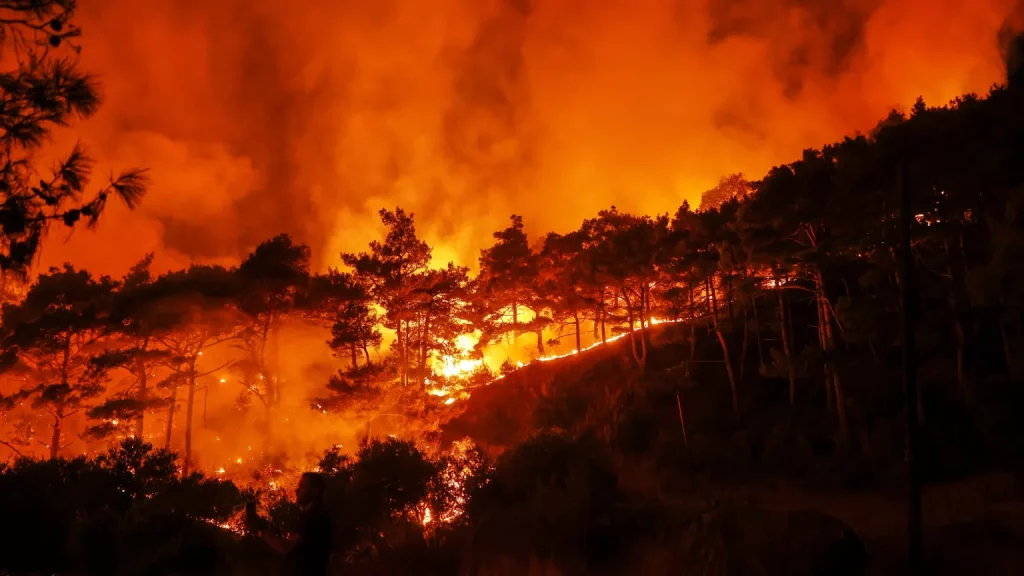
Firefighters in Syria have brought some of the country’s worst wildfires in years under control after 10 days of relentless battles in the forested mountains of Latakia province, officials said Sunday. Meanwhile, fires continued to spread unchecked across southwestern Libya, threatening homes and farmland.
In Syria, strong winds, scorching summer heat, and unexploded ordnance from more than a decade of civil war complicated efforts to contain the flames, which scorched more than 15,000 hectares of woodland.
Civil Defense officials said the fires were finally halted Sunday morning thanks to coordinated efforts by ground crews and aerial teams using helicopters and glider aircraft.
“Extensive efforts by firefighting teams and both helicopter and glider aircraft have stopped the spread,” the Civil Defense said in a statement, adding that crews remain on site for cooling and monitoring. No civilian injuries were reported, though several firefighters were hurt battling the flames.
Among those flying water drops were former air force pilots who defected during the uprising against President Bashar Assad but have since rejoined to help.
“We are extinguishing fires and doing our duty toward our country and people, who need us after this long period,” said Col. Ameen al-Ameen.
Minister of Emergency and Disaster Management Raed al-Saleh said the scene was “promising” by Saturday night, while U.N. humanitarian coordinator Adam Abdelmoula announced $625,000 in emergency funding and appealed for more international aid. Initial U.N. assessments indicate thousands displaced and significant damage to infrastructure and livelihoods in the coastal region.
Turkey, Jordan, Lebanon, Iraq, and Qatar also sent support teams, which Syrian officials praised for their contribution to what al-Saleh called a “collective promise” to extinguish every last spark.
Meanwhile, wildfires continued to rage on Sunday in Libya’s Alawenat Oasis, where dry vegetation and high temperatures drove flames into residential neighborhoods.
“The flames are advancing at an accelerated pace amid a complete absence of government efforts to put out the fires,” said Hamed Mohammed Ahmed of the Alawenat Municipal Council.
The fires, which erupted Saturday in agricultural fields, are the latest in a series of blazes to hit Libya’s south and west in recent years, fueled by extreme summer heat and drought conditions. So far, no injuries have been reported.


