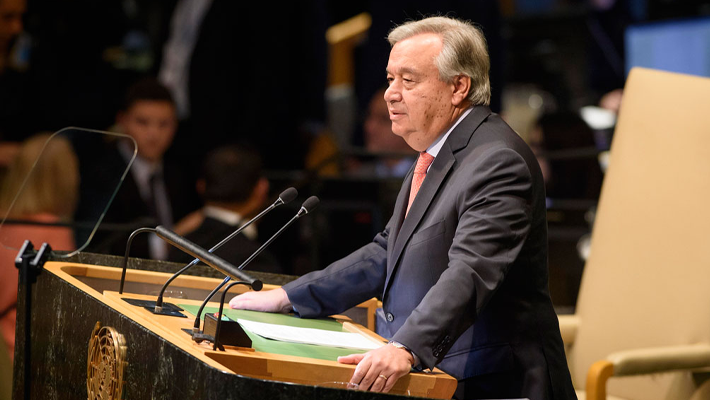
UN Secretary General, Antonio Guterres, has called for commitment to intergenerational solidarity, saying, “together, we can design policies that ensure longer lives are also good ones – lived with choice, security, dignity.”
Guterres said this in his message to mark the International Day of Older Persons celebrated on Oct. 1 to draw attention to the aging population and their challenges.
The theme of 2026 is “The Age of Longevity: Rethinking Systems for Longer Lives,”
It calls on governments, civil societies, the private sector, researchers and older persons to examine how societies can ensure that the additional years gained translate into healthy, productive, dignified and equitable lives for all.
Guterres, however, said elders, being leaders and caregivers, played a vital role in families, communities and economies.
According to him, humanity is living longer than ever before and by 2050, the number of people aged 60 and over is projected to rise from 1.2 billion to 2.1 billion.
The UN chief said the population would be a full 20 per cent of the global population.
“This is one of the great achievements of our time, a sign of improved health and stronger social protections in many parts of the world.
It is also creating both risks and opportunities, transforming economies and societies.
“That is why the theme of the Day is an urgent call to address the needs of an ageing world.
“For too many people, growing older means facing insecurity and the risk of being left behind.
“It also means encountering discrimination which undermines rights and wellbeing. But the correct policies, from employment and pensions to housing, health care and lifelong learning, can help people continue to participate meaningfully no matter their age.”
Meanwhile, the secretary-general has transmitted to the 81st session of the UN General Assembly the mid-term progress report on the UN Decade of Healthy Ageing (2021–2030), marking the midpoint of the ten-year global effort to improve the lives of older people.
The report was prepared by the World Health Organisation (WHO) in coordination with the UN Inter-Agency Group on Ageing and with input from thirteen UN entities, the World Bank Group and civil society partners.
It finds real progress in countries, and persistent gaps that must close before 2030.
The number of people aged 60 and over passed 1 billion in 2020 and is projected to reach 2.1 billion by 2050, with the fastest growth in low- and middle-income countries.
Longer lives are not automatically healthy ones: globally, the gap between life expectancy and healthy life expectancy at age 60 widened between 2000 and 2023, and an estimated 71 percent of excess deaths from COVID-19 between 2020 and 2023 were among people aged 60 and over.
“Longer lives are one of humanity’s great achievements, but we cannot congratulate ourselves while leaving millions without health and support,” Dr. Pascale Allotey, Director, Department of Sexual, Reproductive, Maternal, Child and Adolescent Health and Ageing, WHO, said.
“The first half of the decade has shown what is possible.
“The second half must be about scaling and financing the progress to meet the needs and rights of older persons.”
The report finds that more countries than ever now have legislation against age-based discrimination, up from 44.5 percent in 2018 to 57.7 percent today.
It also noted that over half now have national long-term care policies, up from 49 per cent in 2023 to 56.7 percent, dedicated programmes to build age-friendly environments (54.6 percent), and comprehensive health and social assessments of older people (54.6 percent).
New WHO guidance on services for long-term care and for Integrated Care for Older People (ICOPE) delivered in communities is enabling systemic change as an increasing number of countries incorporate these services within national universal health care benefit packages.
A host of UN agencies and other partners support training, increasing health workforce competencies and use of digital health tools.
“This report shows the Decade of Healthy Ageing is working,” Dr Ritu Sadana, Head of the WHO Secretariat for the UN Decade of Healthy Ageing, said.
“More countries are legislating against ageism, providing integrated care, strengthening long-term care systems, and creating age-friendly environments than ever before, in all regions and income levels.
“But progress is uneven and in one area, regressive: fewer countries report active multi-stakeholder forums on ageing, down from 53.1 percent in 2020 to 43.3 percent today.
“The second half of this Decade must turn commitments into results, in every country.” Sadana added.