

BY JENNIFER EZIMAKOR
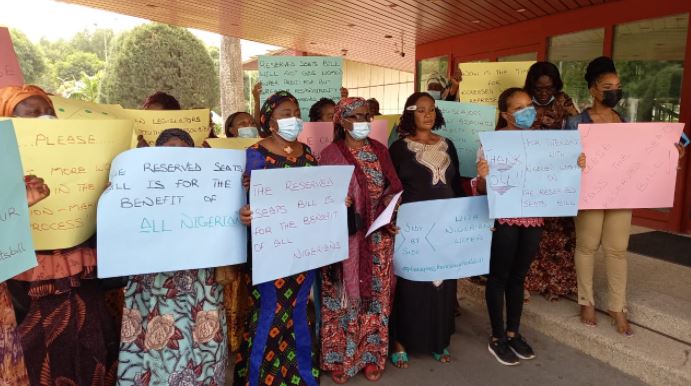
Hundreds of women took to the streets of Abuja on Monday to demand the passage of a bill that would create women-only seats in Nigeria’s National Assembly.
The proposed legislation, known as the Special Seats Bill, seeks to add one reserved seat for women in both the House of Representatives and the Senate for each of Nigeria’s 36 states, as well as the Federal Capital Territory. Implementing the measure would require a constitutional amendment.
Currently, women hold just four out of 109 Senate seats and 16 out of 360 in the House, according to figures from the Policy and Legal Advocacy Centre (PLAC). Nigeria has no quota system for women in politics, unlike several African countries such as Senegal and Rwanda, where such measures have boosted female representation.
“We want the legislature to work for women,” said Dorothy Njemanze, one of the organisers, who estimated that more than 1,000 protesters joined the demonstration.
The protesters, made up of women’s groups from across the country, arrived in a convoy of buses, vans and a truck blaring Afrobeats music as they wound through Abuja’s main streets before delivering signed petitions to a House committee holding a hearing on constitutional reform.
Advocates argue that reserved seats are necessary to counter financial barriers, entrenched gender norms and the dominance of male political power brokers that have kept women out of leadership in Africa’s most populous nation.
President Bola Tinubu’s Minister of Women’s Affairs, Hajiya Imaan Sulaiman-Ibrahim, has already expressed support for the proposal. But PLAC, in its analysis, warned that amending the constitution requires two-thirds support in both chambers of the National Assembly and approval from at least 24 state legislatures — a high hurdle that has defeated similar efforts in the past.
“I want that seat, because tomorrow, I may be the one contesting for it,” said Onu Ihunania, a 50-year-old civil servant who joined the march.
Another protester, Nyiyam Ikyereve, 40, travelled from Benue State, saying a parliament with more women would better focus on issues such as health and economic inclusion.
The debate over women’s representation has gained urgency after Senator Natasha Akpoti-Uduaghan was suspended earlier this year, following her complaint about sexual harassment in the chamber — an episode that activists say highlights the challenges facing women in Nigerian politics.



