Dr Nestor Chukwuorie Nzeribe
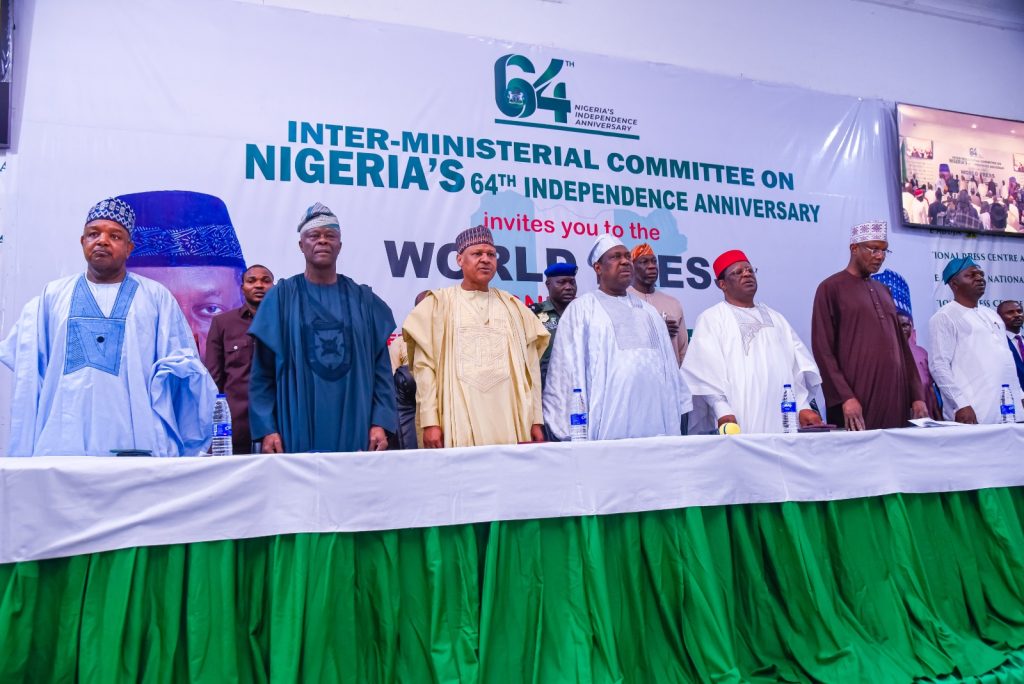
On Tuesday October 1, 2024, the Federal Republic of Nigeria, our dear country, marked 64 years of sovereign nationhood. For Nigeria, a richly endowed former British colony, attaining 64 years of independence is a milestone that came up with another opportunity for both a political and an economic national stocktaking. A sincere self assessment conducted along the guideposts of credibility, objectivity and accountability, will enable us Nigerians ascertain our true state of national health.
For the sake of credibility, we should remind ourselves that existence is not an end in itself but a means to an end. The end for which a thing exists can only be the justification for its existence. That Nigeria has successfully existed for 64 unbroken years as an independent nation, alone, is remarkable indeed. But we also need to be rational enough to acknowledge that existence imposes a responsibility that is subject to scrutiny. If it is not fulfilling a praiseworthy purpose sustainably and progressively, the existence of something would likely not survive a querying.
If we reason soberly about our national objectives, we would rightly focus the celebration of our country’s 64 years of independence on the issues of development. T,he progress it has either made or failed to make would form a much more reasonable basis; and not just that it has successfully “existed” even for donkey years. On individual bases, what difference could we say that our country’s independence had brought, different from what could have been the case under colonization? Have our economy and the quality of our education improved sufficiently enough? Have we had easier access to better education, health care, public transportation and other social services enough to justify 64 years of sovereignty? What about ownership and the deployment of our collective resources? Have the welfare of the ordinary citizen in an independent Nigeria been a priority area for the past 64 years?
Since 1 October, 1960, the fates of tens of millions of Nigerians have been tied to actions taken by its leaders as a sovereign nation. I don’t think that today in 2024,, it could still be considered as being too early to begin to evaluate it’s progress in real terms. Critically querying Nigeria’s progress since 1960, will enable us .ascertain if or not, it is adding any appreciable quantum of value to the human lives tied to it? Such value addition, if there is, must be both tangible and measurable by the quality of life it’s citizens now live in charge of their own destiny. And it must be comparable to what was or could have been the case under colonization.
For greater clarity and for objectivity sake, we should be able to think out of the silly box of sentiments.
At a time when not a few Nigerians have had valid reasons to question our capacity for self governance, we should be frank in assessing the progress of our national journey after 64 years. We should be able to intelligently interrogate the measure of progress our country’s status as a sovereign nation for the past 64 years, has enabled for us. In the context of human populations,64 years counts more than two generations. In so far as my destiny is tied so much to the existence of my country in a competitive world, It will not be thought irrational if in assessing it’s progress, I adopt the same pedestal of reckoning occupied by it’s peers in the global community of nations. That is the only means to obtain an accurate assessment. Comprehensively, I should be able in comparison, to know if my country have been a kind of a filip to me, providing opportunities and the enabling environment that foster my personal dreams; or rather, a filibuster, an obstruction that makes the attainment of my aspirations impossible or very difficult.
Successive Nigerian leaders themselves, have often admitted quite sincerely, that the country has not made good progress in the right directions. Additionally, they have also always acknowledged the fact that wrong leadership actions, inactions and decisions, much more than anything else, have been responsible for the squandering of it’s resources and the national failure to utilize numerous exceptional opportunities for real progress. No statement can be more an acceptance of incompetency and hence, self indicting than their’s. I think it is very doubtful if a country that is missing it’s national development objectives could at the same time, be able to provide the environment needed by its citizens for self-actualization.
The revelations thrown up by a dispassionate assessment of the political and economic programmes of the Nigerian nation can be quite embarrassingly staggering, It therefore, queries the honesty, the patriotism and the level of intelligence exhibited by some highly privileged commentators who while ignoring the absence of genuine progress markers, still choose to celebrate a country’s failures. Those are the elements whose understanding of the true essence of national progress is skewed. But we may ask, Will it not appear obviously curious, if passengers in a cab should choose to celebrate the progress of their journey at such a time when the cab driver conveying them admits that he has by a personal error, lost his way to their destination?
At 64, and presently going through unimaginable challenges, Nigeria’s citizens are in a total agreement that the best years of their nation are behind, and that the future is uncertain. Unfortunately, we get to fully appreciate the extent of the national losses incurred through poor leadership only after that leader who should take the responsibility for failure have left office. Ironically, under such leaders, well-meaning and constructive advises given at critical moments, were not only ignored, but viewed as vicious opposition and treated with contempt. But quite curiously, the very persons who should answer questions for the decisions that clearly sabotaged our national aspirations, go into a happy retirement. We not only continue to pay their bills for life, but the same state they served so dishonesty, keeps them safe from the painful consequences of the poor leadership decisions they took, while citizens suffer.
For their nation’s lack of good progress, Nigerian citizens are themselves complicit. Before any Nigerian leader can assume office, we would have first deified and cast them, avowed tribal or religious irredentists that they are, in a mould of mystique as super human saviours of Nigeria and it’s people. Ironically, the most deified of such leaders have been the most appallingly disappointing. They fail and fall so woefully that the popular biblical mourning statement, How are the mighty fallen!, readily comes to one’s mind.
Indeed, the kind of leadership offered by Nigerian tin-gods have always failed Nigeria because leadership that is bred in bigotry and robed in mystique can never be accountable. The mere suggestion that a leader who is used to being seen as a “god” submits to the people he leads, will be seen by the leader in question as an affront. No “god” tolerates an affront from a worshipper. The regular result of such a practice is that instead of a compassionate, and accountable leadership that is driven by consultation and respect for the led, an arrogant and self opinionated ruler with an over bloated ego emerges. Nigerian tin-gods in leadership of course, live secure in the mystique cocoon unwittingly erected around their person, not even office, by the same Nigerian people who think themselves to be worth nothing more than serfs. Unfortunately, this is a culture that we have derived from a history of subjugation under feudalism.
Nigerians continue to merely wish for a competent leader who would be honest, benevolent, and compassionate enough to use their resources well. But the choices they make whenever the opportunity to hand over the national reins of power to someone presents itself, is often questionable and terribly ridiculous. For instance, if a candidate for the highest office in the land defies the citizens wishes in line with the rules of competition, and refuses to participate in a debate with his opponents during electioneering, shouldn’t that be seen as a red flag? And if a section of the mass media commits itself with disingenuous excuses to defending such a decision, should such practitioners still be regarded as true watchdogs of society?
A system that provides the environment for only a dishonest and incompetent politician to get to power is not just anti progress but also criminal. Without fully subjecting to the necessary checks for the job he aspires to be hired for, a leader who emerges from such a faulty system will only but be a maximum ruler with dire consequences for all. And we often excuse abject failures of leaders who after promising a sea could not even deliver a pond on the pretext of their “good intentions” Intentions are subjective. If that alone is what is required, Nigeria has never lacked leaders with the “magical” good intentions. But it is unfortunate that unlike elsewhere in the rapidly advancing world, none have been able so far, to close the long gap that exists between intentions and actual performance. Incidentally, developing a country requires much more than a good intentioned leadership alone. It requires tough work driven by character, competency and capacity.
At 64, Nigeria needs honest but prepared mortals who understands and acknowledges human inadequacy, not clay-footed tin-gods, to give it good, measurable and accountable leadership. It yearns for a return to the early years of independence when it’s leaders were men you could criticize their policies and they listen, not jail you for doing so. Nigerians seek a return to the era of a healthy competitive striving for development amongst the component units of the federation. They want a return to the governance style that is concentrated on building up the local economy for the good of the citizens to earn both regional and global respect. They desire a stop to the unconscionable system whereby the national wealth is recklessly frittered away to purchase vain regional prestige and global recognition that does not uplift the citizens.
Any sincere Nigerian leader who wants to serve, not rule her at 64, can not overlook the factors that encourage pigheadedness at the highest levels of leadership in the country. Such a leader must distance himself from the regular stories about “correcting past mistakes” while they ironically are profusely making their own incorrigible errors of judgement. At 64, a prepared and ready Nigerian leader should be able to know and avoid the fatal and long term consequences of a morally reprehensible political or economic decision taken, not on the basis of a sound political or economic judgement, but nepotism.
In conclusion, Nigeria at 64 years of age as an independent nation, needs its leaders to find an alternative to the governance approach that negatively alters the nature of every national challenge we focus on resolving. Yes, the governance approach that ends up worsening every political or economic problem we set out to resolve is a huge challenge in itself. It is hoped that after 64 years of wobbling and fumbling, Nigeria’s strategic policy planners and executors will be able to find an answer to the rapidly worsening anomaly of national problems getting not better, but worse when resources and efforts are channeled concertedly towards resolving them.
God bless Nigeria.