

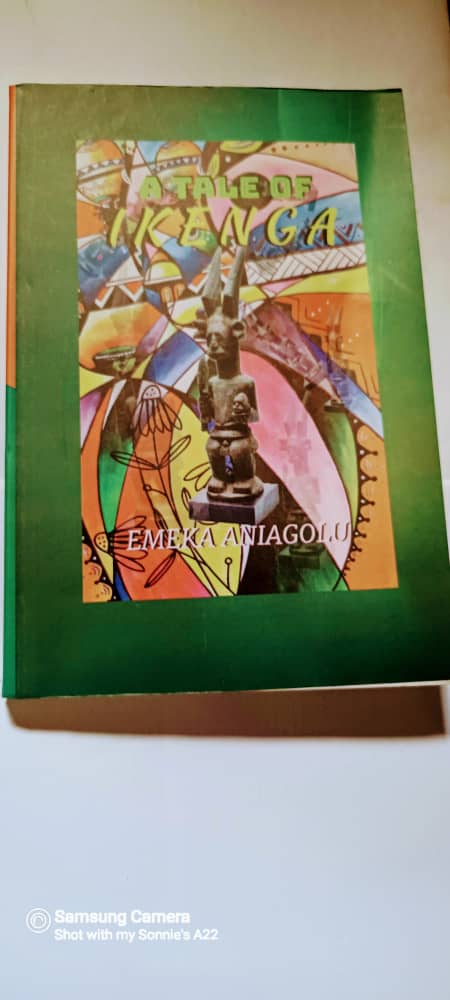
Author: Prof. Emeka Aniagolu
Publisher: Veritas University Press
Pages: 268
Reviewer: Sonnie Nwosu
A tale of Ikenga, an imaginary story of the main character, Ikenna is the Anchor of the whole gamut of this book.
Put succinctly, the subject is out to challenge the mind and induce the reader to put on his or her thinking cap on issues raised in this loaded and insightful work of literature.
In ethos of the revolutionary development of Nigeria, materials presented for reading by authors and writers are actualized as having emanated from the authority of the experiences of the different authors and writers.
In essence, apart from the pungency of the message of the book as presented to its readers, the reader is being treated to a diet of the remarkable and pains taking research by the author on the sojourn of Ikenna in his quest to retrieve his family’s priceless totem, the Ikenga.
The pith of the whole exercise lies in the need for the public to acknowledge the fact that the personality of an individual, his awareness and perspective of values contribute significantly to his achievement in life.
Apart from the equally relevant topics covered in this book, it is a well written account by a renowned story teller of immense quality.
He brought his wealth of knowledge and experience into the writing and thus giving the reader a comprehensive understanding and appreciation of the need for history in deepening the mental horizon of an individual.
The book, which can favourably pass as a scholastic text book is written in a very brilliant way that enables the reader understand the issues therein without getting lost in a maze of technicalities.
The book is well weaved in eleven topics and a postscript that leaves the reader with few salient points to reflect on the wisdom from this tale of Ikenga.
The first topic: The Ancestral Symbol refers Ikenga as the pivotal Ancestral totem of the Igbo, tracing from the delta to its heartland; from the hilly-scape of Enugu, to its south-western estuaries abutting the river Niger; from the riverine complex of islands, sweltering mangroves, inlets and creeks to the coastal swamps, that drain into the oceanic saltwater; that Ancestral totem has stood, ramrod straight, vying with time itself from generation to generation; sumbolizing the unbroken linkage between Igbo families and their glorious ancestors.
The second topic: The Handover deals with the genesis of the handing over of the family’s Ikenga from Ikenna’s grandfather to his father, Ozo Okoli on a cool dry harmattan day.
The third topic, Ekumeku narrated the story Ikenna’s father, Ozo Okoli told him of how the anti-colonial guerrilla movement, known as; Ekumeku, got started in their part of Anigbo.
The fourth topic, The Loss reflects on how everything was going on normally for long before the the Great War came, referring to the wars the white man waged in Africa to colonially subjugate Africans.
The fifth topic, The Quest takes a look at the measure put in place to make sure a given family’s Ikenga is not mistakenly or maliciously appropriated by another family; and, that a family can positively identify its Ikenga, if lost and found.
The sixth topic, The Empire Day posits that the British haven been so victorious in their colonial wars of conquest against Africans, they not only maliciously co-opted a good number of their colonial subjects into participating in their defeat and subjugation, they instituted a number of festivals and holidays celebrating their victory and dominion over their colonial subjects. The most important of those holidays and festivals was known as the Empire Day.
The seventh topic, The Reconnection reflects that no matter how hard Ikenna thought about it or how often he dreamt about the incidents of that day at the killing field of the Ekumeku; and no matter how much he longed to avenge his father’s death and the desecration of his corpse, his path and that of the British officer that commanded the detachment of British soldiers that momentous day, never crossed again.
The eight topic, The Reclamation is an indepth and impressive assessment of how Professor Thompson could hardly contain his excitement if his request for Ikenna to physically examine the Ikenga on display at the London Metropolitan Museum after his encounter with his tribal totem at the Museum of Arts and Culture.
The ninth topic, Closure reveals that nothing could have made Ikenna imagine that he would ever find his family’s Ikenga again, let alone have it in the palm of his hand. Yet, here was in possession of his family’s sacred heirloom! To crown it being that the place he found the Ikenga was in Britain, thousands of miles away from home.
The tenth topic, The Nupital presents the confusion confronting Ikenna on the issue of monogamy versus polygamy, his father up t
to the third generation all married four wives but as a lawyer, he thought of how to cope with four wives as demanded by Igbo tradition of Ozo-titled men.
The eleventh topic, The National Struggle represents the climax but with a twist: Barely three years after Ikenna returned from the UK to Nigeria as a qualified lawyer and in proud possession of his family’s Ikenga, made possible by an improbable set of circumstances as well as cast of characters; war came back to Europe again after about twenty years following the first World War, in which white men ravaged their temperate clime with the most brutal war known to man up to that point in human history, they were at it again.
The book is complemented with the picture of Ikenga on the cover to drive the concept home and help the reader grasp the points being raised.
Since the taste of the pudding is in the eating, it will be wise to grab a copy and find out that the book makes for a very fascinating and interesting reading.


